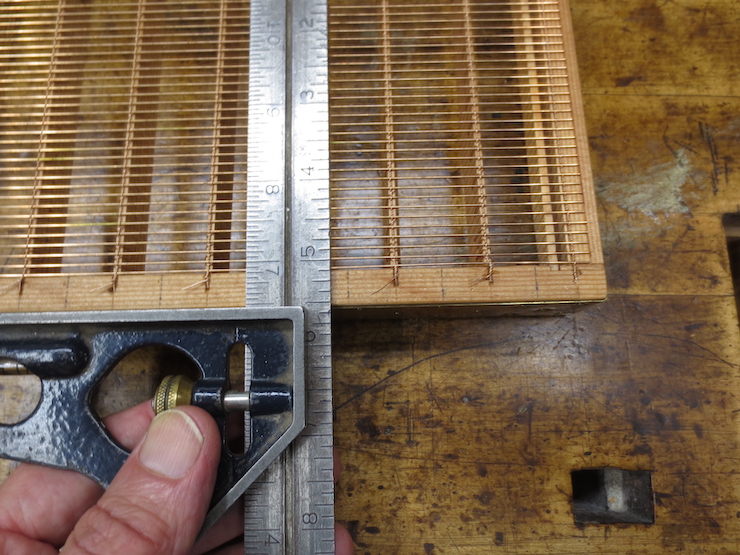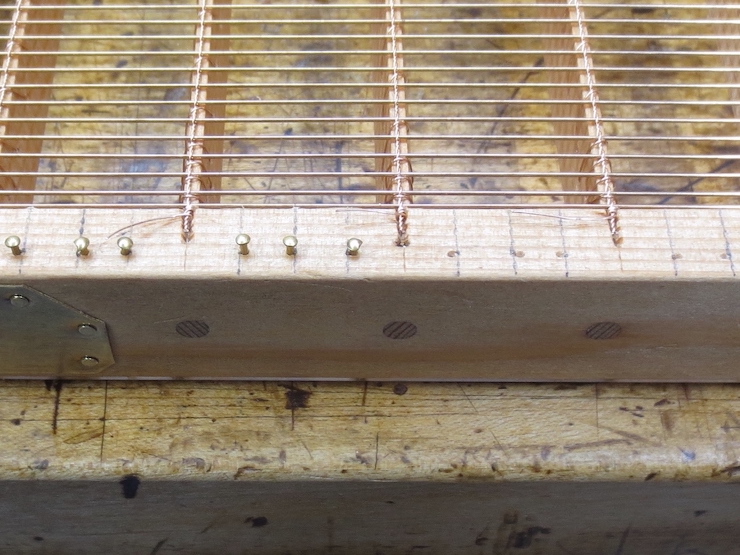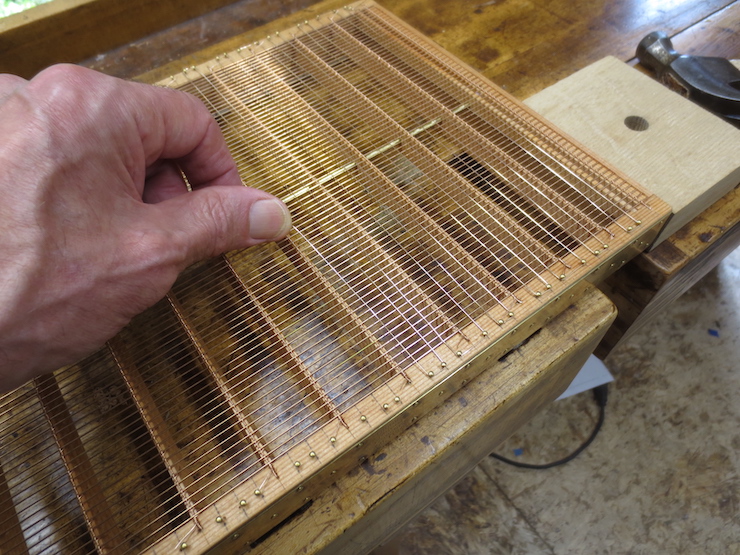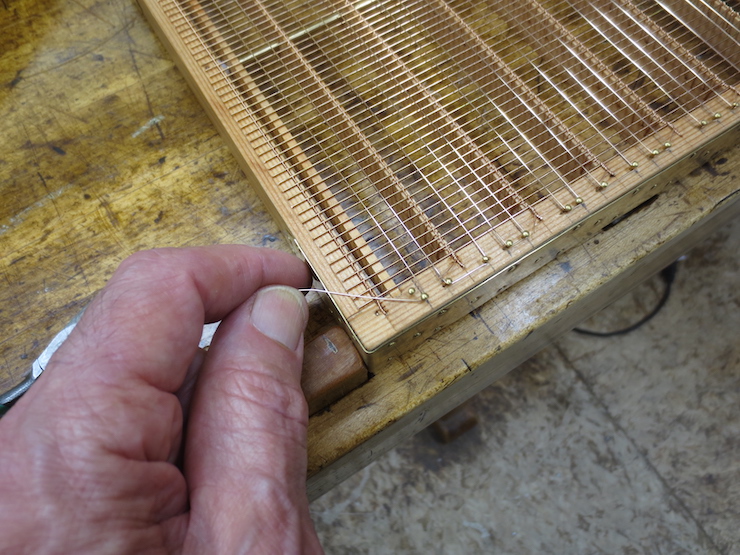
#32 Deckle Joinery: the Mortise Side

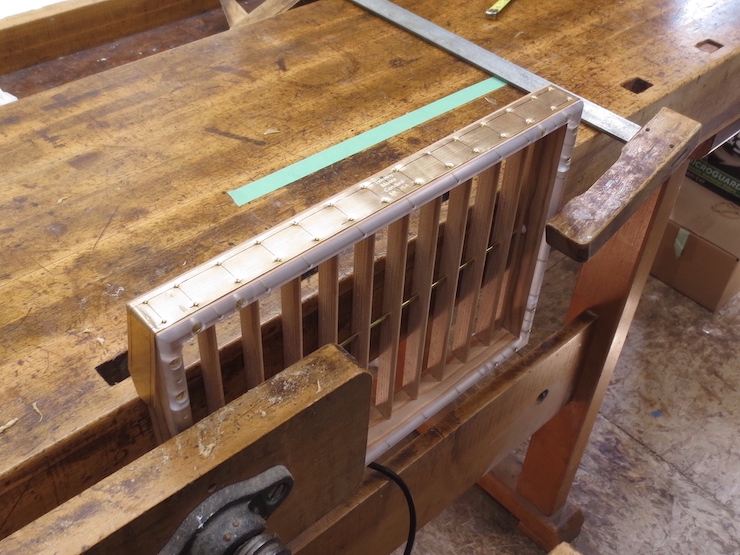
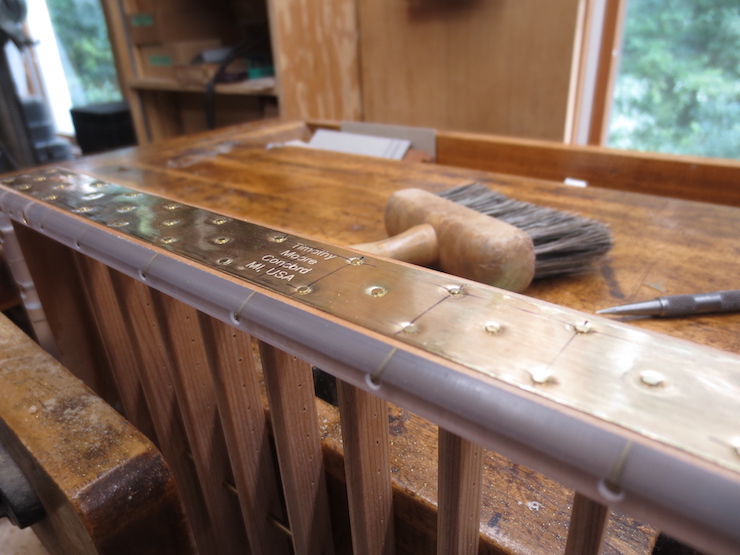
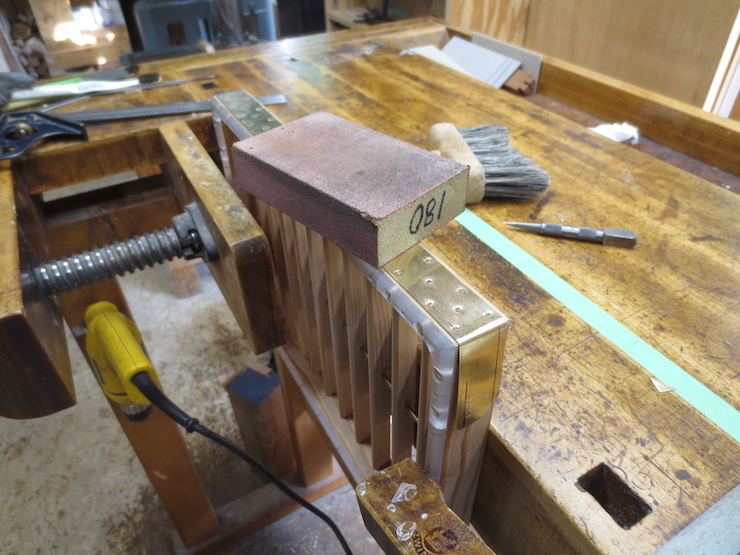
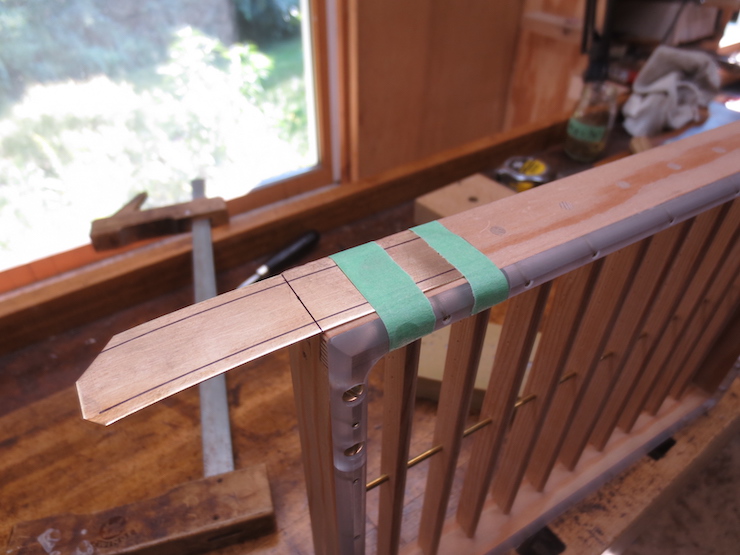
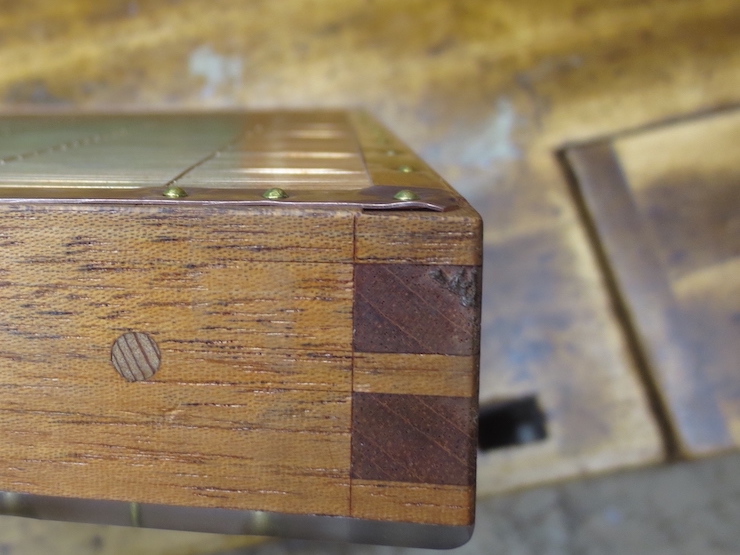
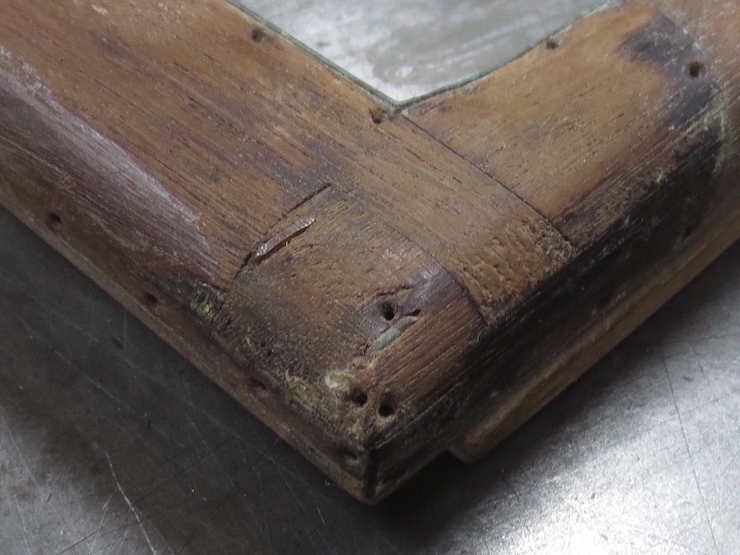
I will now try to explain the making of a traditional British deckle joint; mimicking the form but using non-traditional methods. Its elaborate form must have evolved from the necessity of creating deckles that could stand the abuse of being ‘slapped’ onto moulds hundreds of times a day while being constantly in an out of water. This joint can function without glue; water swells the parts, locking them together. Brass sheathing and a copper wire staple at each corner add additional strength.

When I took this deckle apart a few years ago I discovered that I had been making the joint wrong (or at least not the traditional way) for over 30 years without realizing it. I have since adopted this traditional form but use power tools and waterproof glue. The joint shown above was presumably cut by hand and shows a very high level of workmanship.
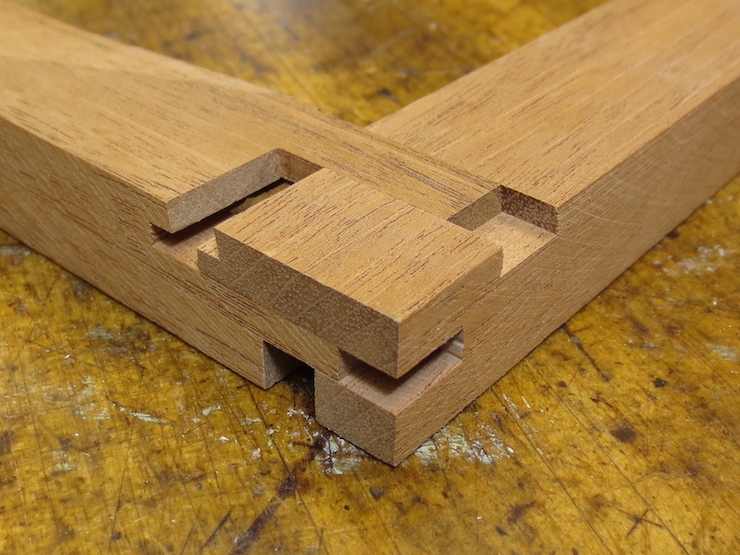
I create what I’ve been calling ‘the mortise side’ of the joint first. This is the part on the right in the photo above. It includes the groove of a sliding dovetail joint. My strategy has been to carefully make this half of the joint first, going through a series of steps using the table saw and router to shape identical features on one end of multiple deckle pieces. Then, using the same tools, the other ends are carefully shaped to make this second side fit neatly into the first side. I’ll explain the process here in four posts without getting hung up on dimensions. Later I’ll publish some standard dimensions and some musings on how the parts of the joint function.
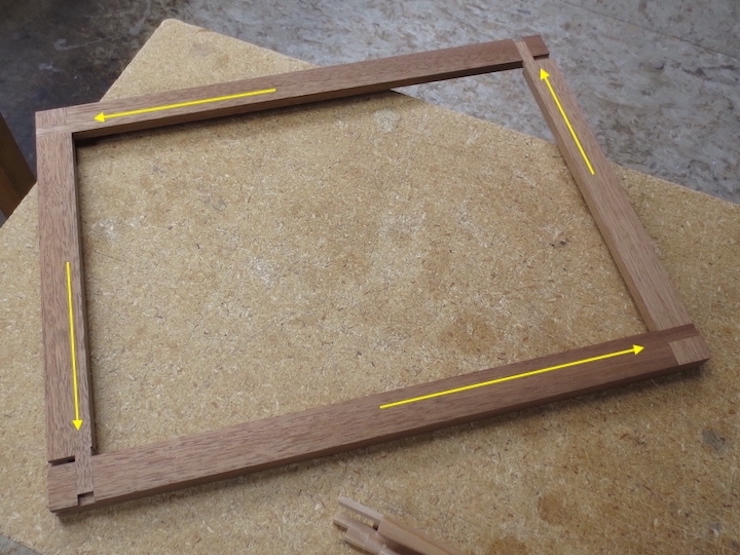
These joints are made to connect in ‘pinwheel’ fashion. All four of the wooden pieces that make a deckle include both sides of the joint, one at each end. This eliminates the need to create opposite (mirror image) forms of the joints. The old deckle that I took apart to examine did not use this strategy but I have read that the pinwheel approach has been used historically.
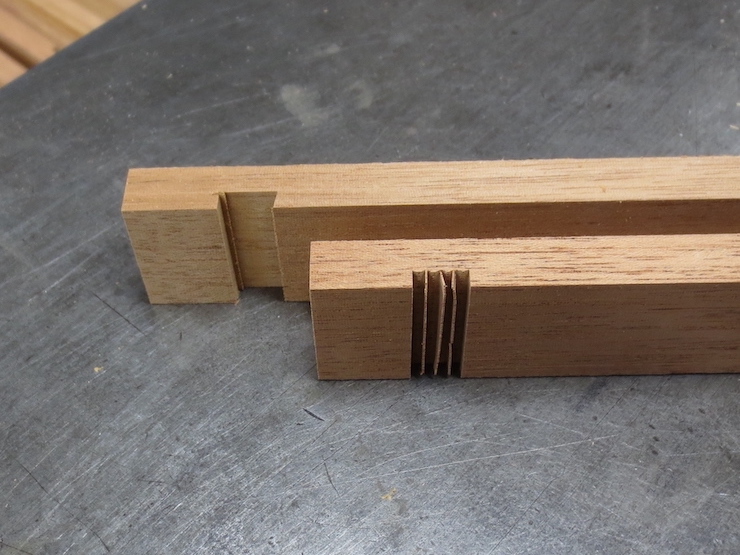
Most of the waste is roughed out on the table saw to start the dovetail groove. I don’t like ‘hogging out’ with router bits, preferring a slow and gentle approach. The cut at the left side of both pieces is a finish cut. It will form one side of the dovetail groove, the non-slanted side.
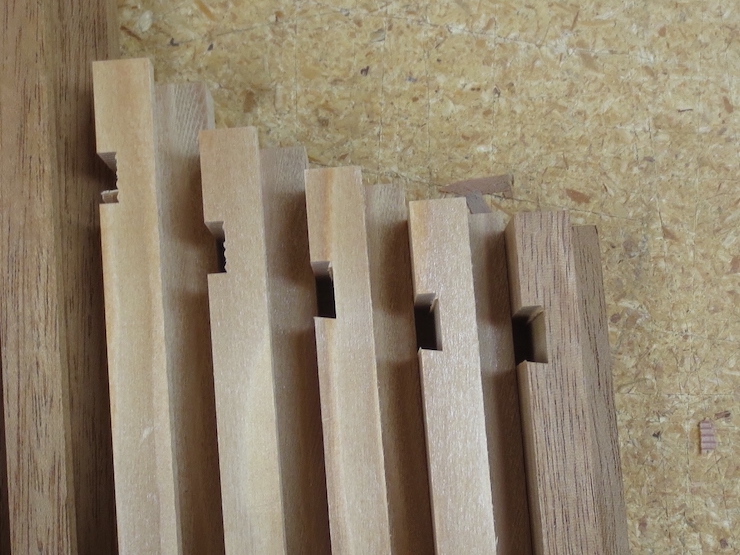
The two parts on the left have been roughed out. On the right three parts have been further refined by one pass over the dovetail bit, creating one slanted face and leveling the bottom of the groove. (There’s nothing sacred about the 9 degree angle used; it looked good to me and dovetail bits are available with this angle).
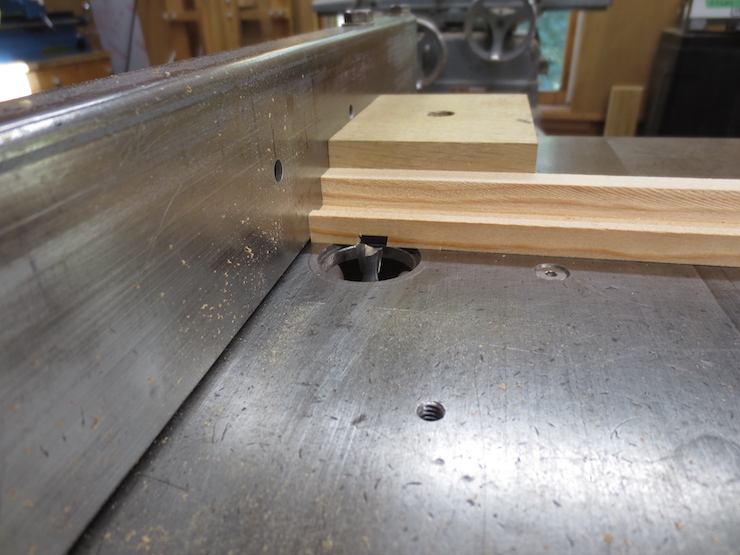
Here’s the set up for routing the angled face and flat bottom of the groove. The block behind the deckle part has true right angles to support the part while it is pushed through.
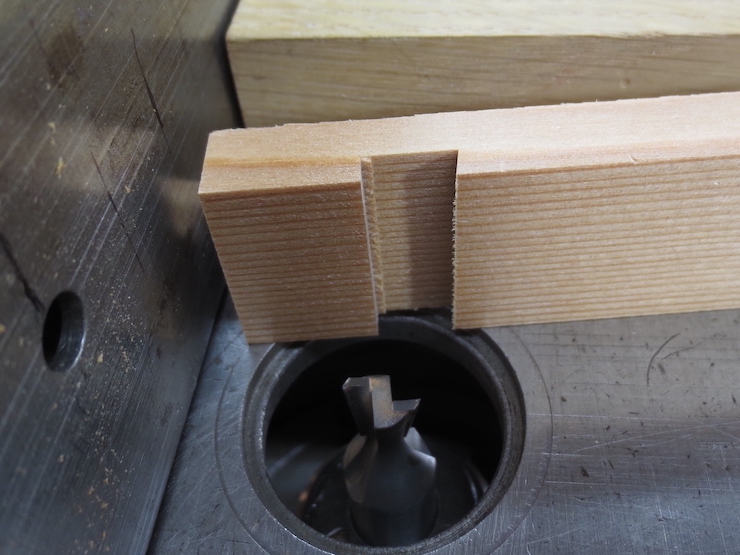
After all of the pieces have been trimmed the fence will be moved a little closer to finish the bottoms of the grooves.
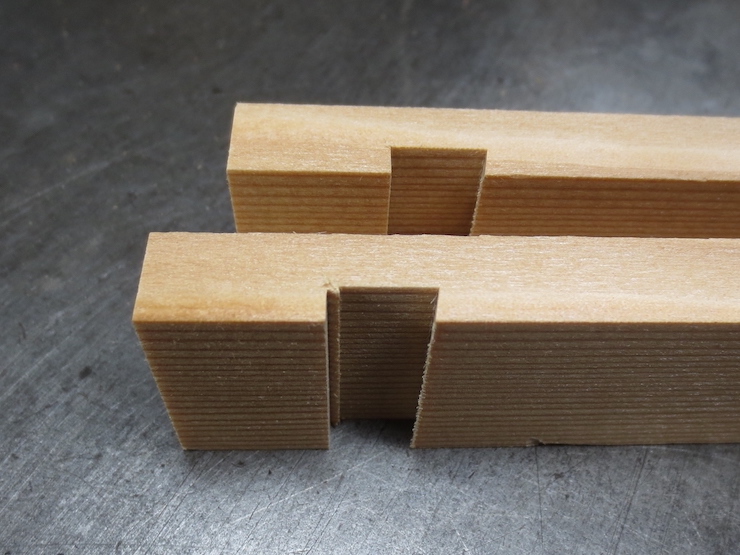
On the back piece a second pass of the router has cleaned the groove up right to the edge, finishing the groove. It might be more accurate to call this a ‘half dovetail’ groove since only one side is slanted. If you imagine the sliding dovetail ‘finger’ or tenon that will be shaped to fit the space (vacant here) you can see that the angled edge of the sliding dovetail would tend to force the parts of the deckle tightly together when the tenon swells from being wet. One end of this ‘dovetail’ edge lies directly above the inner corner of the deckle where two parts of the narrow rim will come together. (The four parts of the deckle form a rectangular ‘wall’ that encloses the pulp to define the edges of paper formed there. The rim is the part of the deckle that rests on the wires of the mould). It can’t be an accident that this part of the sliding dovetail is positioned just here. Its purpose must be to keep the rim parts aligned, helping to insure that they press evenly against the wires of the mould to make clean deckle edges.

The dovetail bit is left at the same height for the next cut; making another 9 degree face parallel to the inner edge of the deckle part. This second angled face also lines up with the deckle rim but at 90 degrees to the first one. When both sides of the joints are completed and put together the wedging action of both slanted faces will work to keep the parts aligned, especially at the inner corner.

A scrap of wood makes a temporary fence so the dovetail bit can be partly hidden beneath to route a narrow margin along the edge of the deckle part.
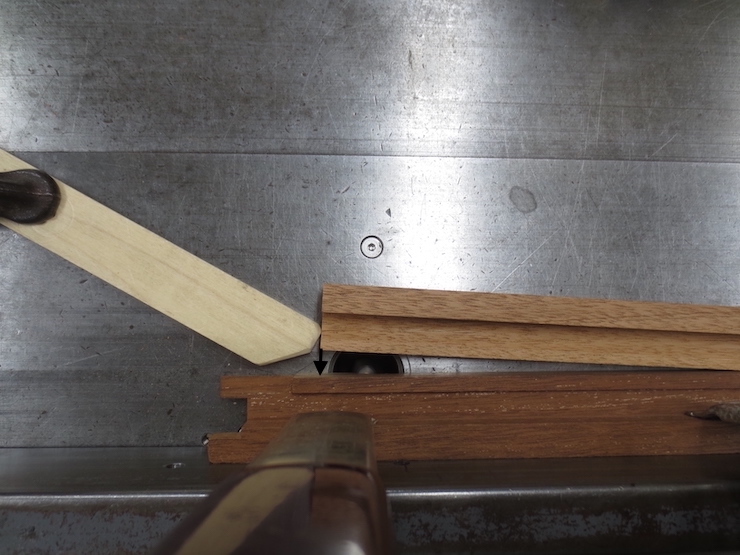
Each part is pushed against the stop, then pivoted against the temporary fence (in the direction of the short arrow).
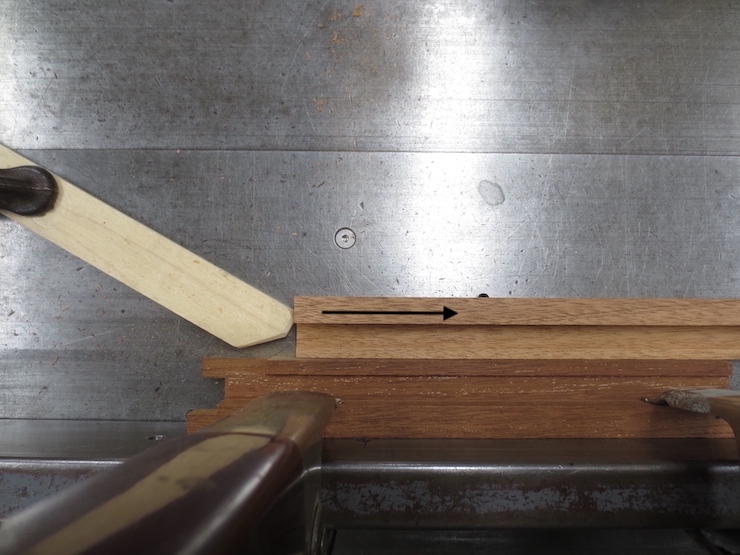
Then it is fed into the cutter (in the direction of the longer arrow) to finish the cut.
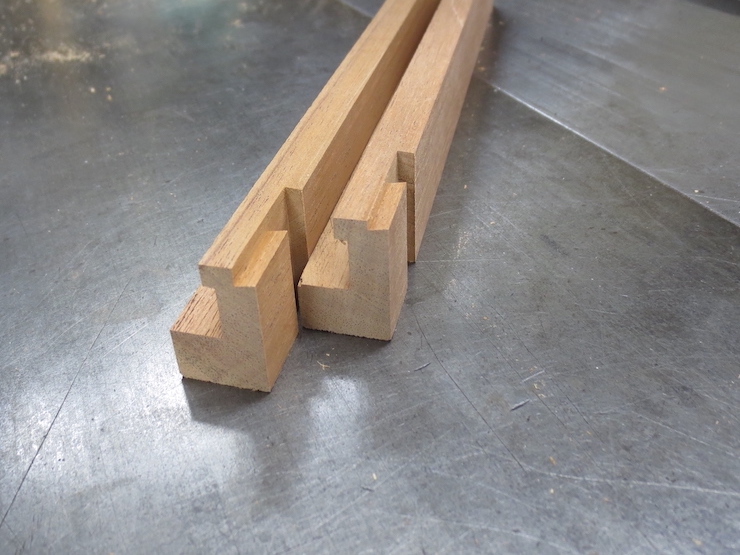
This cut has been made in two stages; the fence being reset before the final cut. If you imagine the nearer ‘dovetailed’ surface extending across the gap to meet the other you see that they intersect above the place where the inner corner of the deckle rim will be.

Making the Slot

Next a slot is made which will receive a ‘tongue’ from the adjoining piece of the deckle. The slot is cut to the same depth as the thickness of the mould frame.
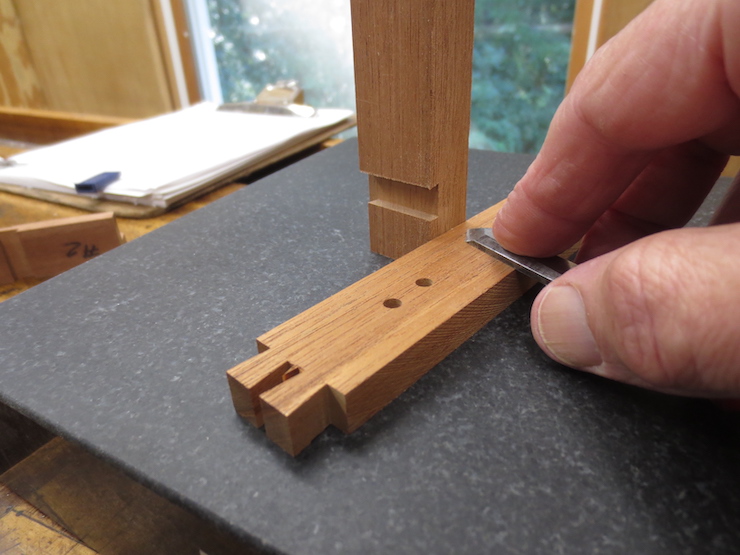
I use a leftover test scrap from a mould to scribe the top of the cut to prevent chip out.
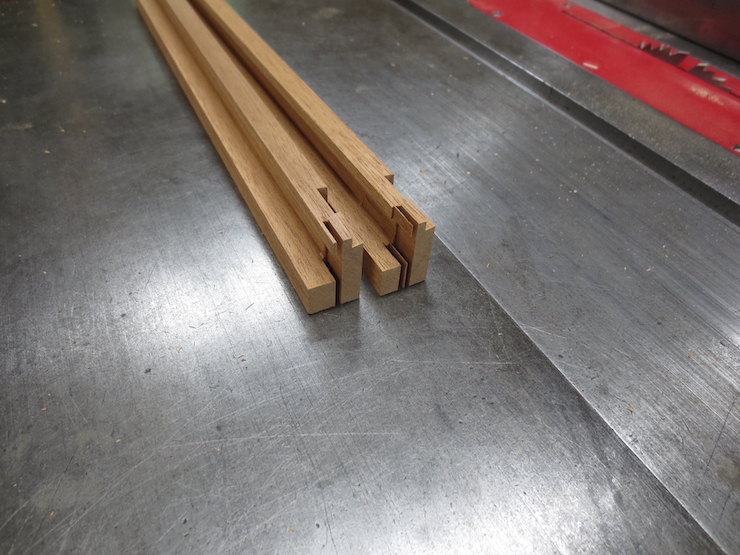
To make these cuts the deckle parts were stood up in the wooden right angle block. (Described in the previous post; this tool appears again two photos down). Two saw cuts create the sides of the slot; both are finish cuts. The waste between them is cut out in another pass. When making deckle joints I make sure to have a few practice parts; short scraps of the same deckle stock that have been processed exactly as all of the other parts. These are used to make test cuts and necessary adjustments to get everything right before running the other parts through each step.
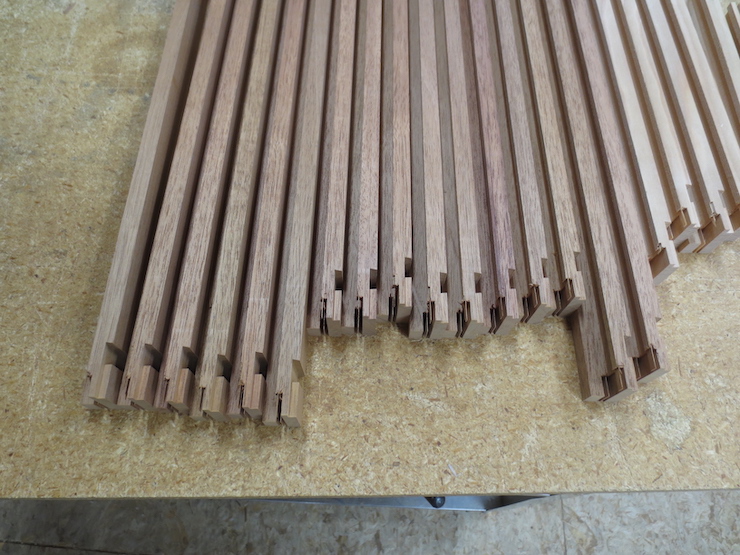
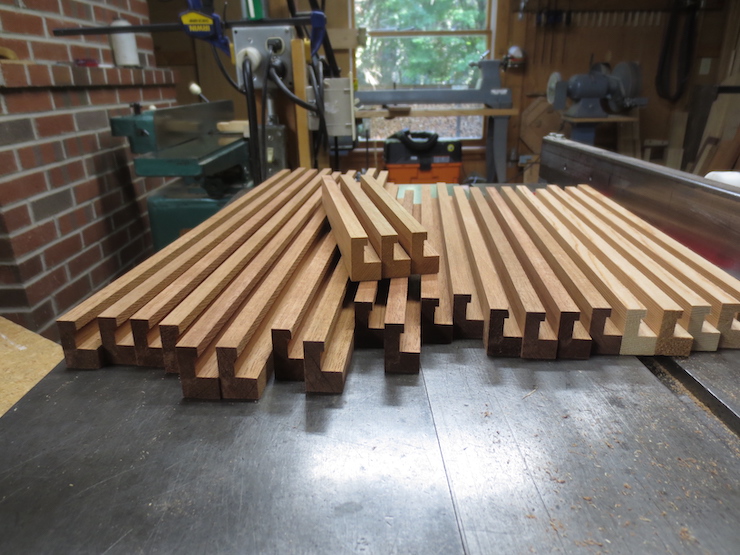
Twenty parts are needed for five deckles; there are extra test pieces at the far right. Making the parts identical (except for length) makes this painstaking method of cutting joints worthwhile and ‘cost effective’.
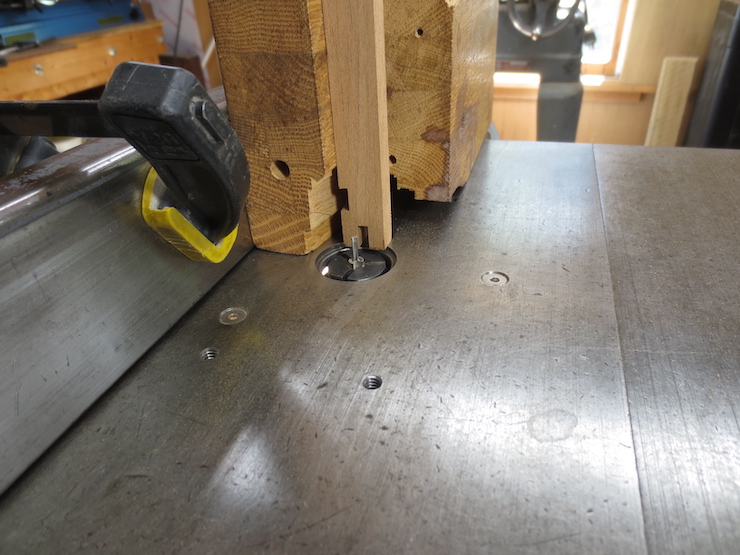
This 1/8″ diameter bit is being used to machine a flat surface at the bottom of the slot. This is the first illustration of the ‘right angle block’ being used to stand deckle parts upright. Many operations are done with the parts lying flat on the table; others depend on the block so the ends can be machined.
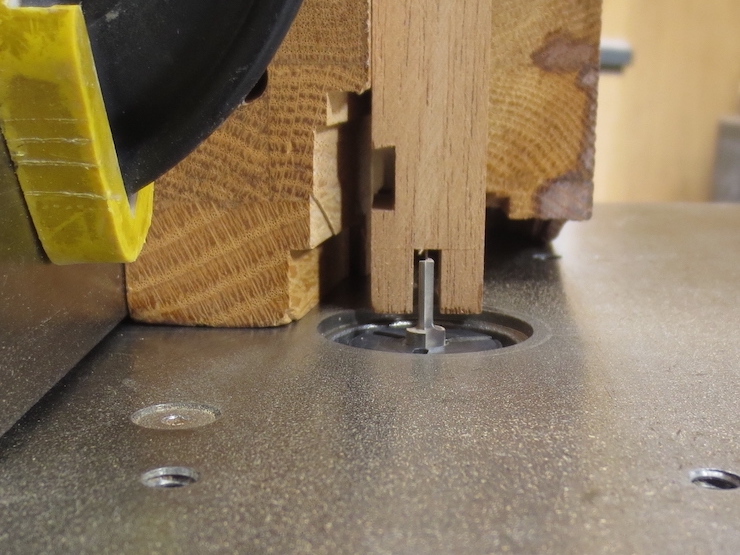
You can see the bit, the slot and the scribed line. It looks like the deckle part would fall into the opening in the table but the ‘stop’ (the yellow clamp pad) will stop the motion before that can happen.
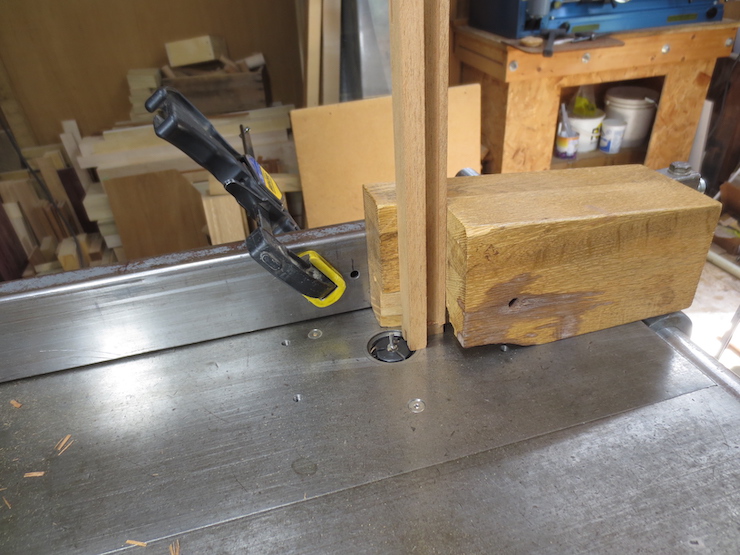
Another view of the right angle block and the same operation.
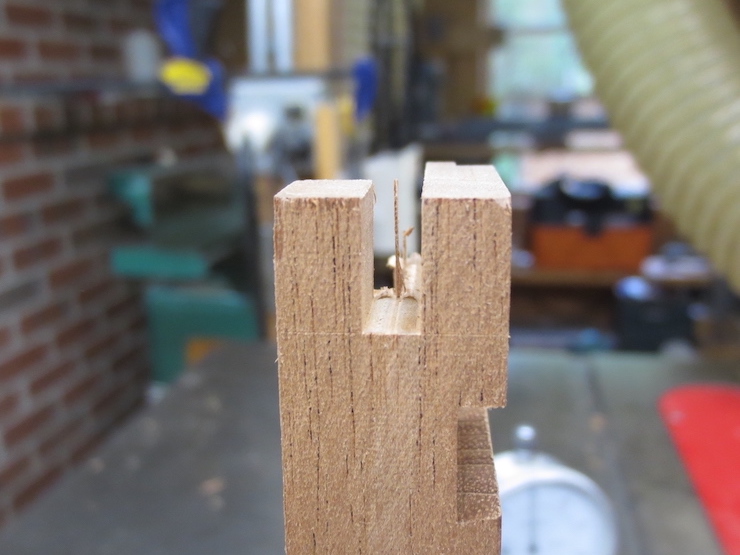
The bottom of the slot has been routed from one side. When multiple deckles are being made all at once it can be worthwhile to make small adjustments. There is always a little bit of hand work at the end, but reducing this saves time. If I was making one deckle only (with four identical parts) this particular operation might not be worthwhile. The bottom of the groove might be more easily cleaned up with a sharp chisel.
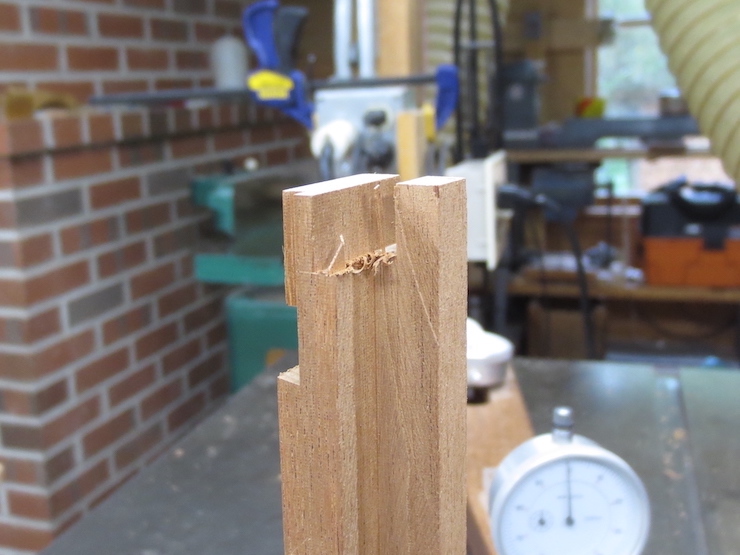
This end of the slot still needs trimming.
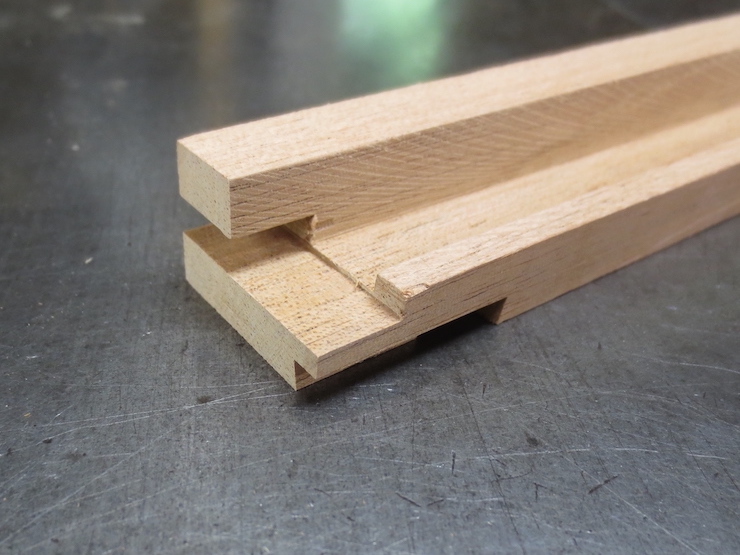
The slot is now finished after trimming from the other side. The part was turned 180 degrees in the right angle block and the fence re-adjusted to guide the part over the router bit.

Trimming the Lap to Width
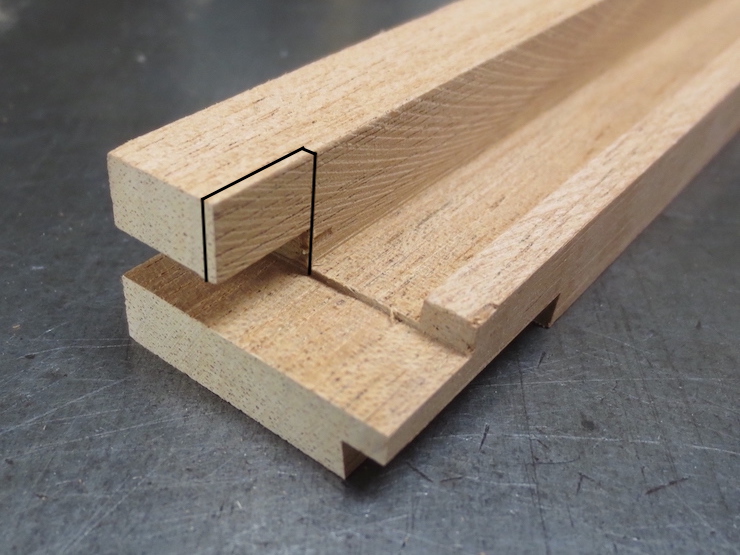
Cutting the groove has left a protruding tenon that will lap over a recessed area to create yet another mechanical connection between the two parts of the joint; a ‘lap joint’. Trimming away the waste (indicated) will complete this half of the joint. The waste can either be routed away, or trimmed on the saw as shown below.
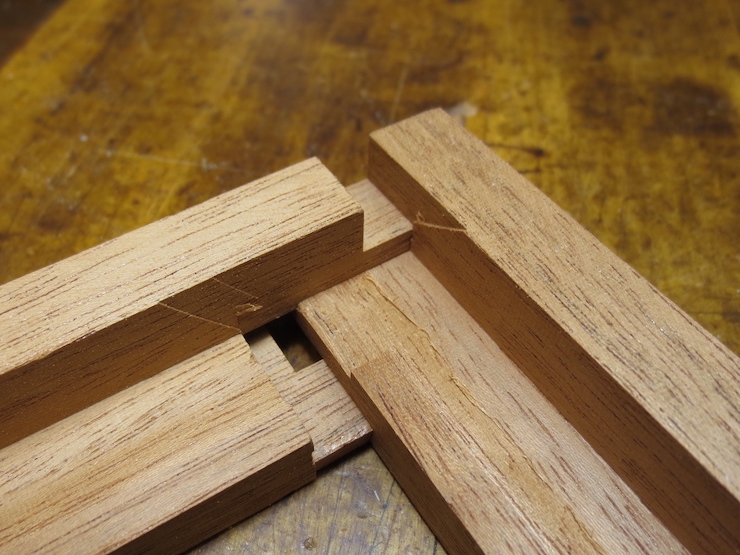
This deckle joint is from an earlier batch. I used the hollow ground saw to trim this part of the lap to its final width. The height of the saw blade must be adjusted to trim the face of the joint without damaging the upper part of the joint (face down and hidden here). The radius of the saw cut extends out onto the inner edge of the deckle. If the deckle and mould have been sized correctly these visible cuts will be trimmed away (or nearly so).
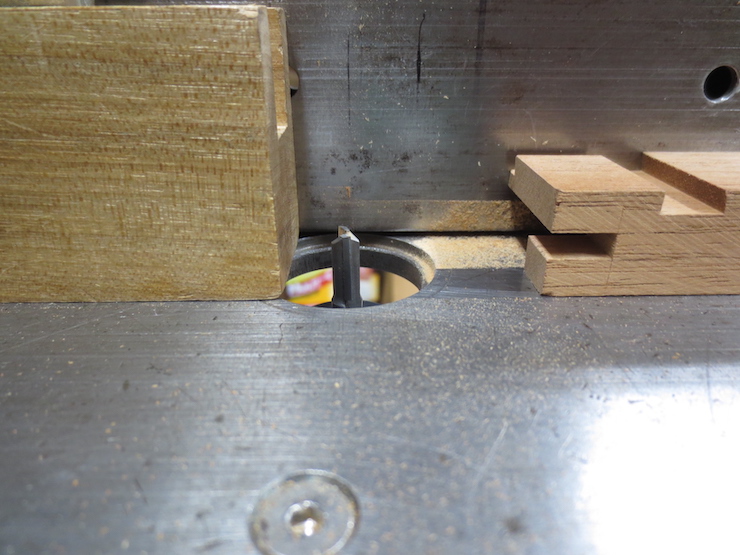
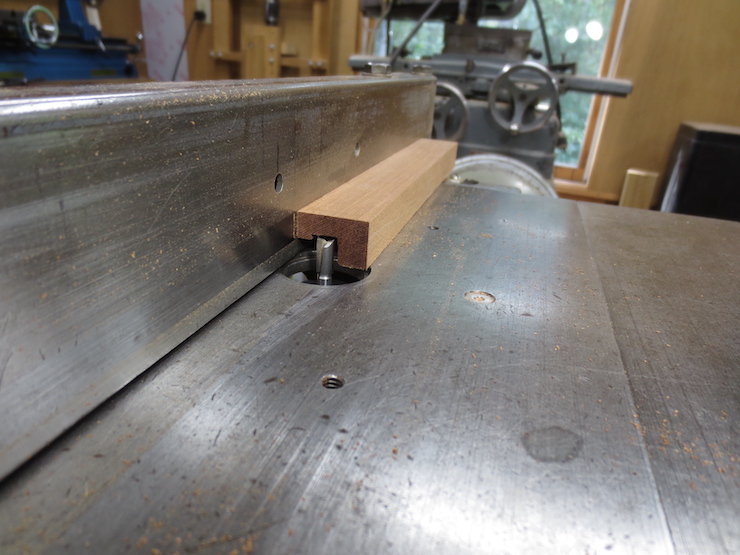
Here is another way to do this with the router and 1/4″ diameter bit. The wooden block at the left is a stop. The deckle part is pressed down on the table and against the fence while pushing it into the spinning bit.
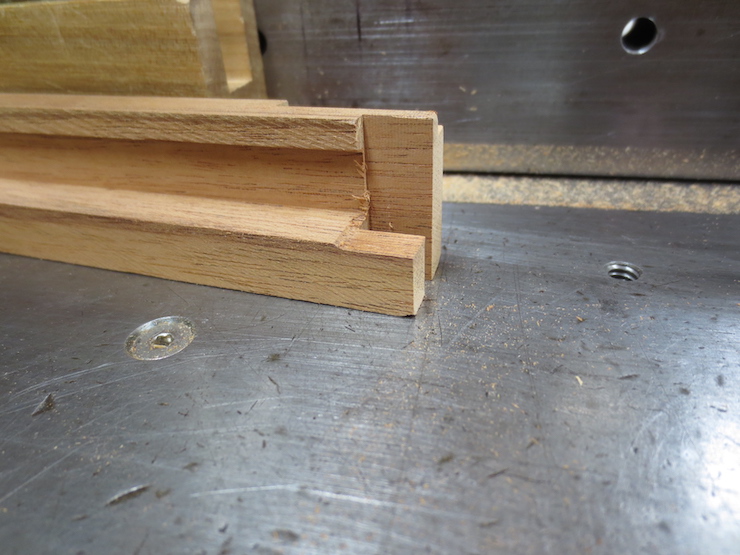
This leaves a ragged edge but this will be trimmed off later when the deckle is fitted to the mould.
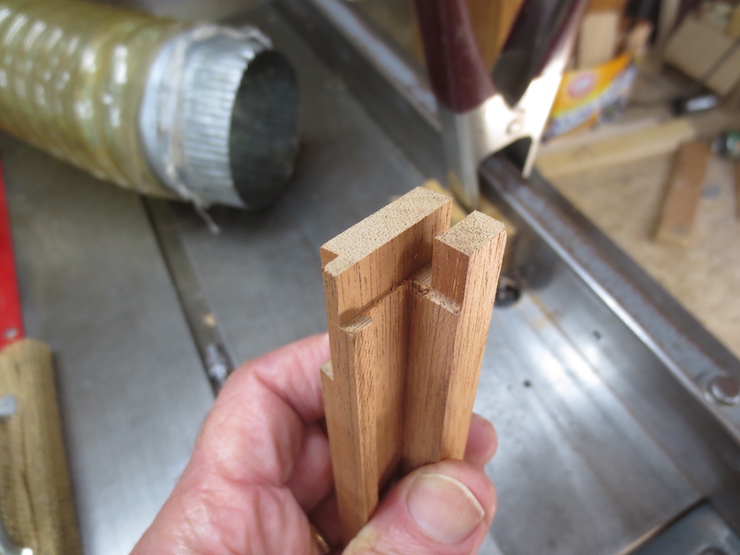
This half of the joint is now complete. The narrow deckle rim on the left and the inner edge where the deckle laps over the sides of the mould are still rough but will be trimmed later as the deckle is being fitted to its mould.

The right side of the joint has been completely formed on all twenty parts of this batch. The next few posts will cover the process of making the mating form of the joint (shown on the left here).
#31 Tool Kit for Deckle Joinery

A brief review of the tools I use to create this unique and elaborate joint. Most of these tools have been used before when making the mould frame and ribs.

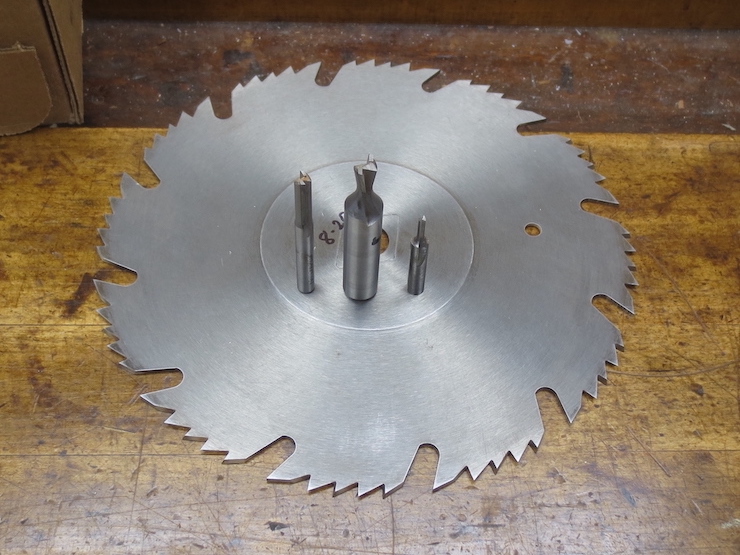
Left to right: a 1/4″ straight bit, a 3/8″ by 9 degree dovetail bit, and a 1/8″ straight bit, all to be used with the router mounted under a wing of my table saw. The hollow ground planer blade has been used all along for making the moulds; freshly sharpened, it will be the only saw blade needed for cutting the deckle joints.

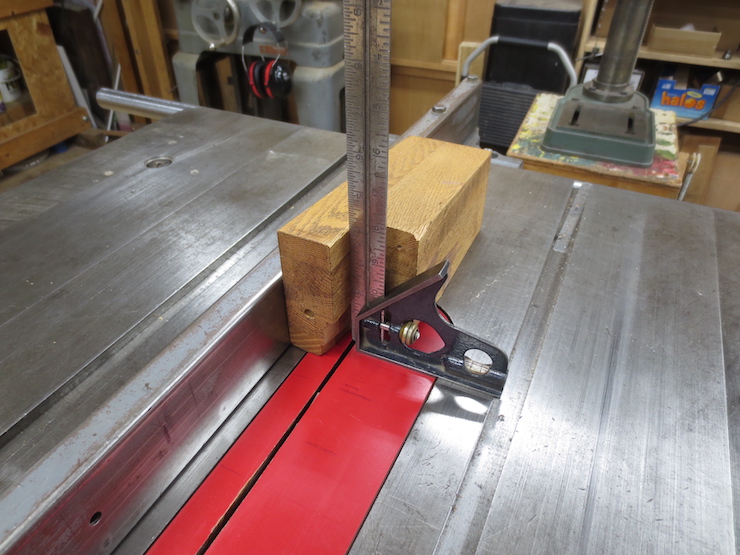
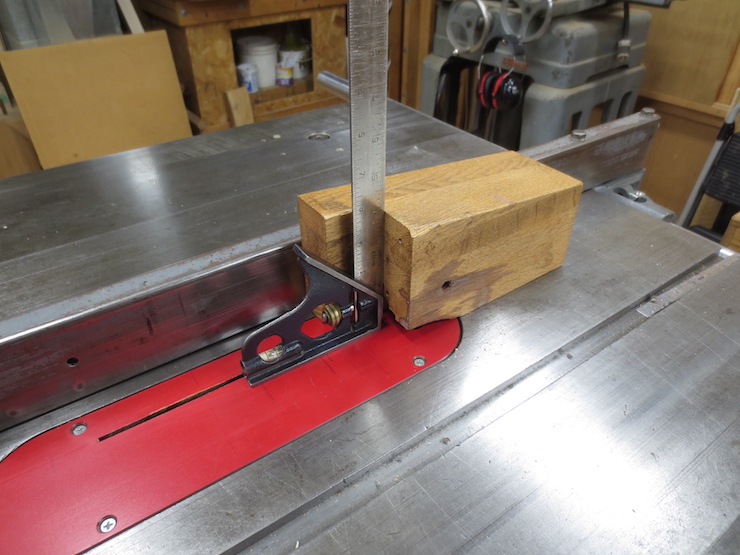
This wooden block has served me well for over 40 years. It has true 90 degree angles here…

…and here so that pieces held upright in the block can be accurately cut with either the saw or router.

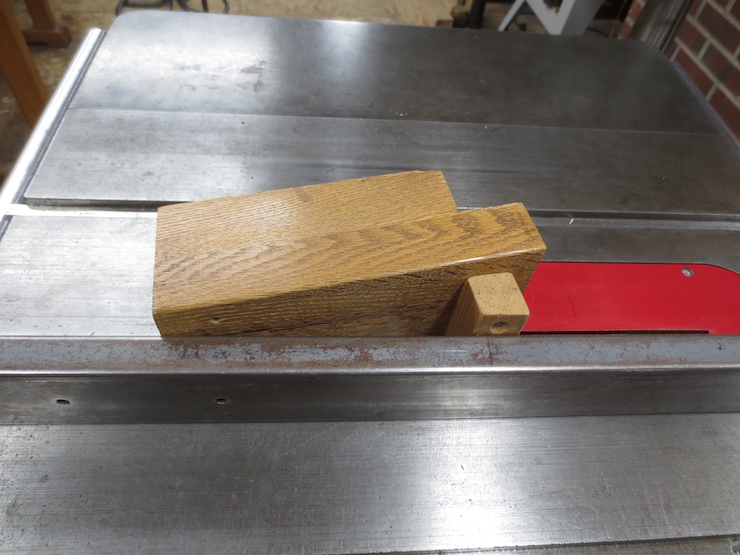
Adding the small block on the right changes the angle from parallel (to the fence) to 9 degrees. This matches the angle of the dovetail router bit so the sliding dovetail part of the joint can be sawn to fit the routed groove.

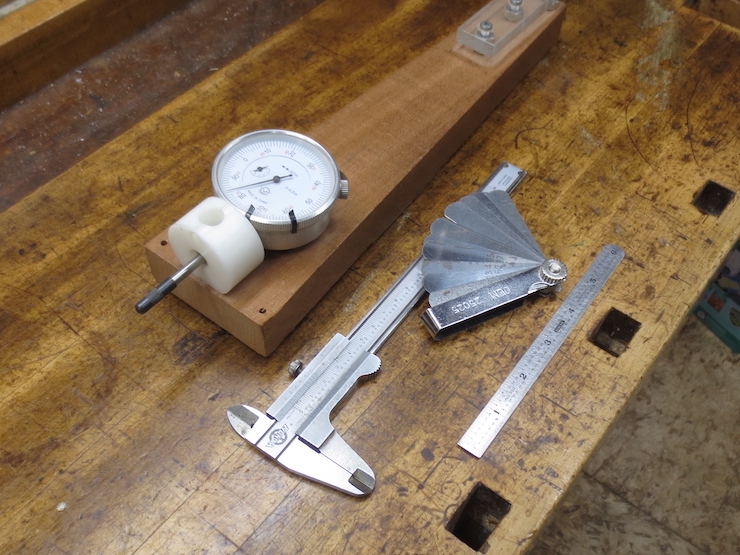
This shows the end of the dial indicator fixture that is used for making lateral adjustments. Also shown are a set of shims, a 6″ vernier caliper and a 6″ rule.

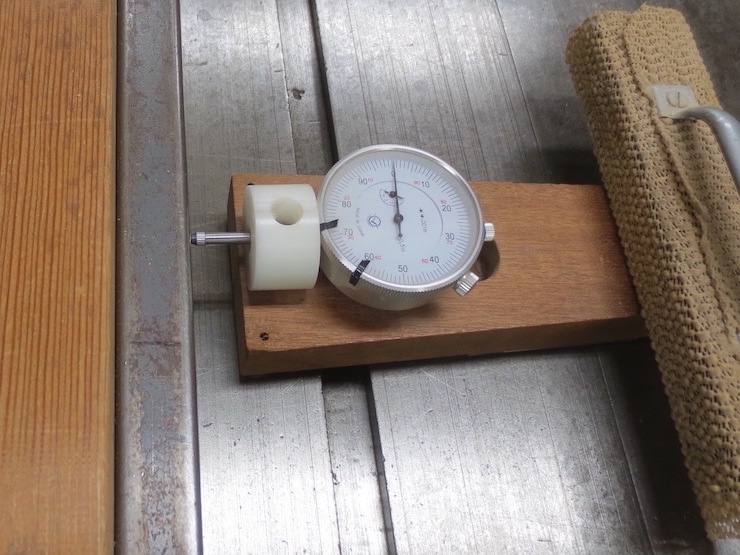
Using the dial indicator for making very fine lateral adjustments; in this case adjusting the table saw fence. It has been ‘zeroed out’ prior to making the desired adjustment. A few tries will be needed to get the fence just right (‘nudging’ and re-tightening the fence each time) but since the fixture remains stationary all the while it will show when the fence has been successfully re-set.

The other end of the dial indicator fixture is used for making vertical adjustments like this. The flat lower end of the plunger has been ‘zeroed out’ while resting on the table. Then it was lifted to rest on the router bit to allow the cutting height to be adjusted.

#30 Getting ready to make Deckles

The moulds have been made and now need deckles.

These pieces have already been put through some preliminary steps. For a review of these see the early post about seasoning and preparing wood. You may also wish to review the techniques used earlier to prepare the frame stock for the moulds, some of which will used below to prepare the deckle stock.

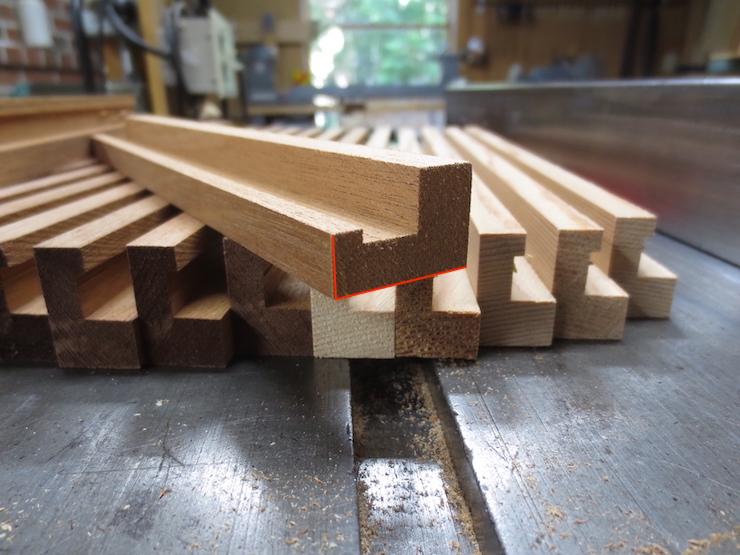
Using the jointer two adjacent sides of all the pieces are made perfectly straight and square to each other. These two finished surfaces are indicated here by red. In the finished deckles the narrower of these will form the vertical sides of the opening that defines the paper’s edges as sheets are formed.

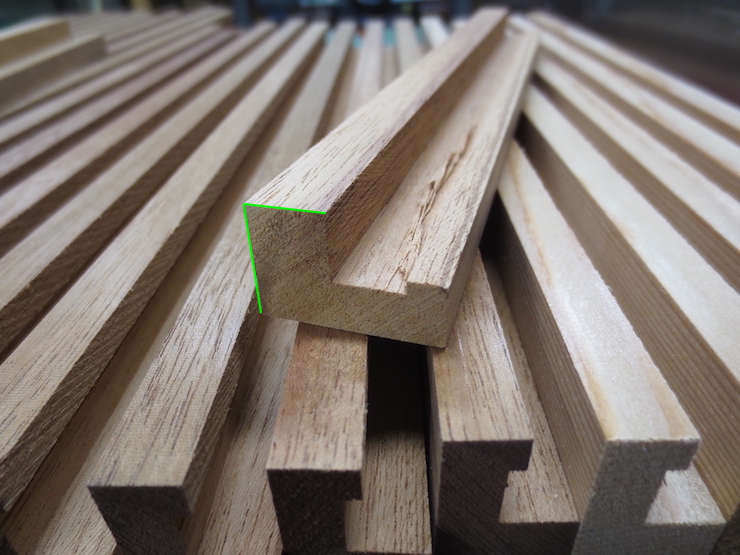
Next the two sides opposite are machined straight and square. Using the dial indicator with the table saw fence allows these deckle pieces to be cut to precise overall dimensions (width and height). These two surfaces (indicated in green) are left rough, straight from the rip saw. They may look ‘rough’ but are functionally very precise; accurate enough to be used as reference surfaces when cutting the joints. These rough surfaces will disappear later, being machined away as the deckle is shaped to its final form.
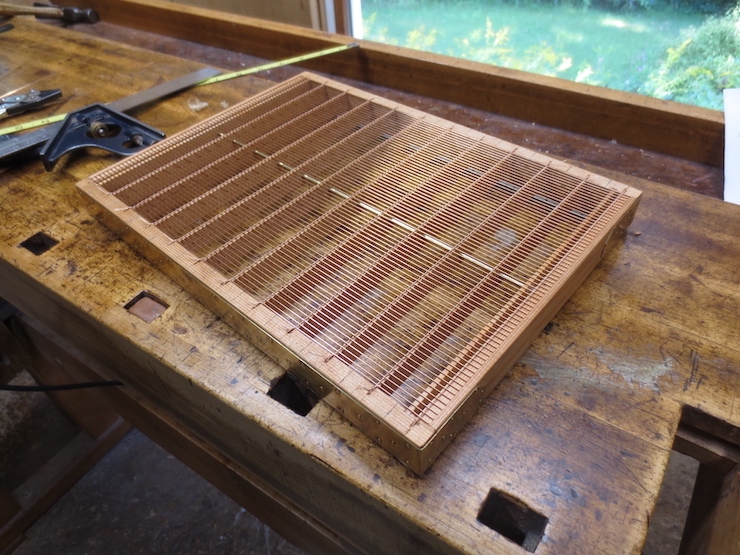
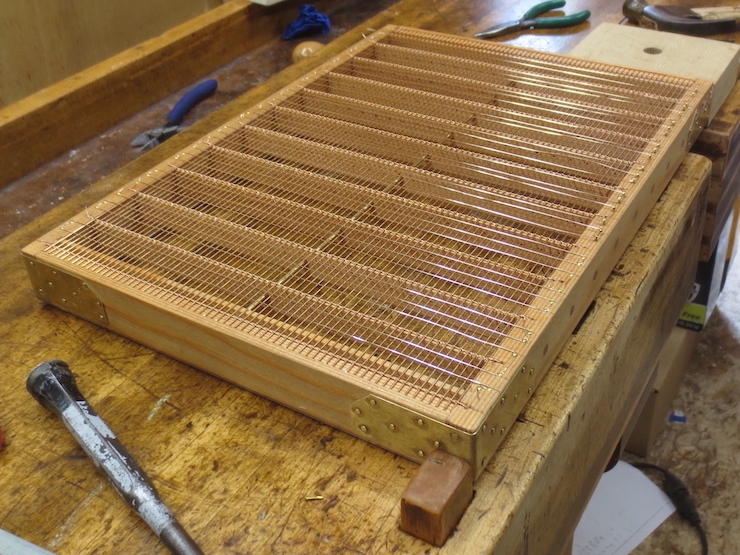
Next the top of the channel and the inner edge of the rim are machined to produce the final surfaces there. These are outlined in red in in the two pieces shown below. The piece on the left is only partially machined to better show the process above.

Some surfaces (outlined here in yellow, blue and white) will be machined later, after the joints are finished.

The next step is to trim the deckle pieces to exact length in preparation for cutting the elaborate deckle joints.

After all the deckle pieces have been trimmed square at one end the measuring beam is used to mark them for length. You may recall that this same beam was used to mark the lengths of the mould frame pieces. Using the same measuring device for both mould and deckle insures a good fit between them.

The stop (at the white arrow) is set so that the hollow ground blade cuts right at the scribed mark. Three 12″ x 18″ moulds are part of this batch, needing identical deckles. The stop is used to make all six of the long pieces the exact same length (then reset to cut all six of the shorter pieces). If only one mould of a given size is being made, opposite deckle parts (either both sides or both ends) can be clamped together and cut without using the stop. The important thing is that the two opposing sides of any deckle are cut to the exact same dimension.

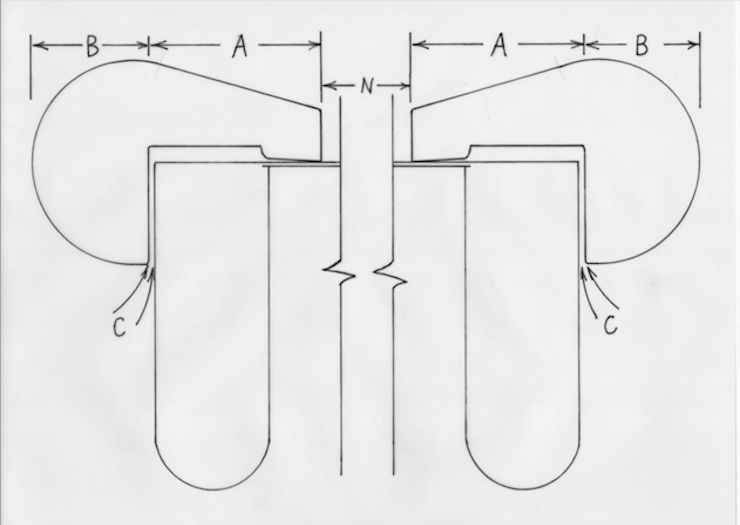
To calculate the lengths of the deckle pieces “A” + “B” is added (twice) to the intended opening of the deckle “N”. For my standard moulds the deckle overlap (A) is 3/4″ and (B) is 1/2″. This makes the total width of the deckle pieces 1-1/4″. Twice this equals 2-1/2″. Thus the short sides (or end pieces) for a deckle with a 12″ x 18″ opening should measure 14-1/2″ long and the long sides (the front and back pieces) should measure 20-1/2″. The clearance between mould and deckle shown at “C” has already been accounted for in the overall dimensions of the mould.

#28 Fit Wove Facing and Sew

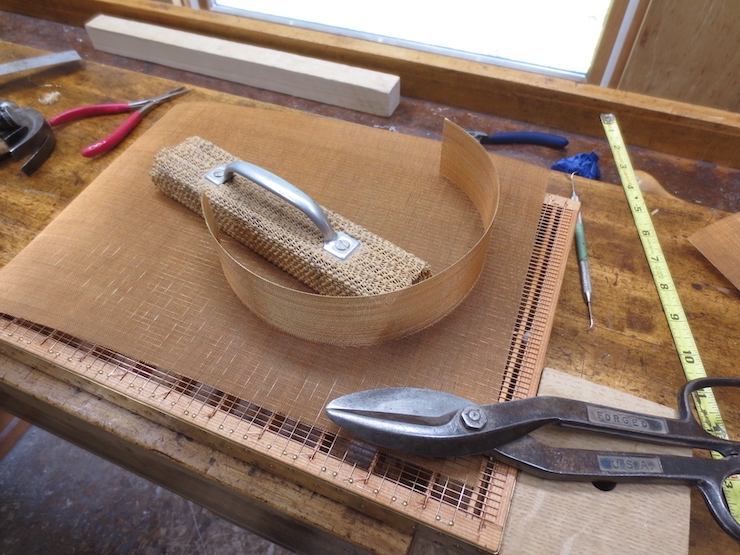
A piece of phosphor bronze ‘wire cloth’ is cut to the size needed. I have always used phosphor bronze for this though it is more difficult to find than ‘plain’ bronze or brass. Either of these would likely work well but are less durable. Paper mould wove facings typically are made from wire cloth in the range of 40 to 50 wires per inch, though I have seen finer. The wire cloth I have used was purchased from a Dandy Roll manufacturer. This wire seems to use a slightly heavier wire for a given mesh size than some brass and bronze wire cloth I have found.

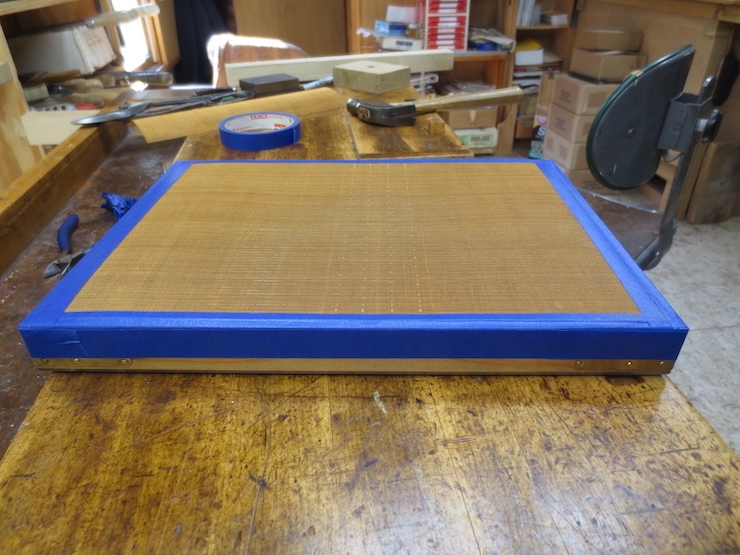
Care is taken to align the weave of the wire mesh with the grid wires since they must follow the ‘grooves’ in the wire facing. A few brass escutcheon pins hold the wove facing in place.

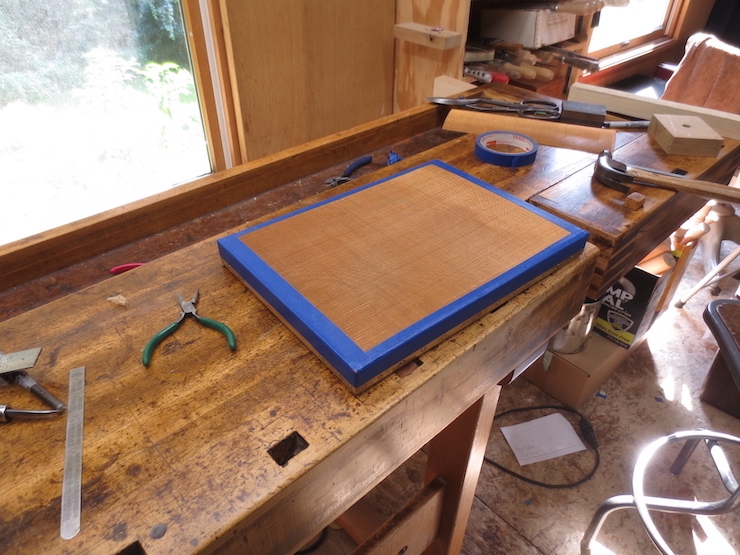
The tape protects the edges of the wire so it won’t get damaged while the mould is being sewn.

The sewing frame is adjusted to hold the mould a bit higher so that the row being stitched is near eye level. A piece of paper hangs from the cross bar and is backlit. The room can be dim. It is easiest to sew by seeing the wire in silhouette.

Another view. I wear a #4 optivisor while sewing the wove facing.

This is what the completed stitching looks like. The sewing wire crosses under* three laid wires (of the backing) between stitches taken over* two wires of the facing. The stitches are staggered, offset by one laid wire with each new row. This creates a diagonal pattern to the stitches. At the ends (not visible here) the stitches are identical for all rows (not staggered) and a ‘knot’ is formed, securing the sewing wire and tying the facing securely to the last ‘free’ laid wire of the backing. (This ‘free’ wire is actually the second wire, the first lies right next to the wooden frame.)

You can see that the two outer grid wires are sewn while the middle one ‘floats’, though it is held quite firmly in place between two layers of wires. I sew wove moulds with a .008″ diameter soft phosphor bronze wire. Each row is started from the middle of the mould, sewing from middle to right with one end of the wire and then middle to left using the other end. This makes it easier (less wire to handle) and keeps the wire fresher. Each sewing wire takes the form of a long spiral as it travels the length of one grid wire, passing under three laid wires, then coming up over the top and crossing two wires of the wire cloth, then passing once again under the next three laid wires, etc.

*Under” and “over” here refer to the mould in the upright position, not upside down as in this photo.

Four rows of stitches have been completed. You can see them just to the right of center.

To the left of this row of stitches you can just see a rib below the mesh. To the right you can discern the middle (un-sewn) grid wire nesting in a groove created by the wires of the mesh facing.

To keep the stitches as inconspicuous as possible they are sewn in a certain way. As a sewing wire crosses two wires of the mesh on top of the mould it crosses the first wire at its low spot. Then it takes a slight diagonal to cross the second wire at its low spot. As the row is stitched the openings that the wire passes through are chosen so that the sewing wire’s diagonal path crosses over the top in the same direction as the general path of the wire. If the wire is forced ‘backwards’ by passing through the wrong two openings it will protrude a little more and make a bigger ‘bump’ on the top of the mould.

This process is not as difficult as it sounds. When the mesh is viewed at an angle the square openings change to look like rows of alternating trapezoids, some pointing down, some pointing up. Once you figure it out you can use this trick to easily put the stitches in the right spaces.

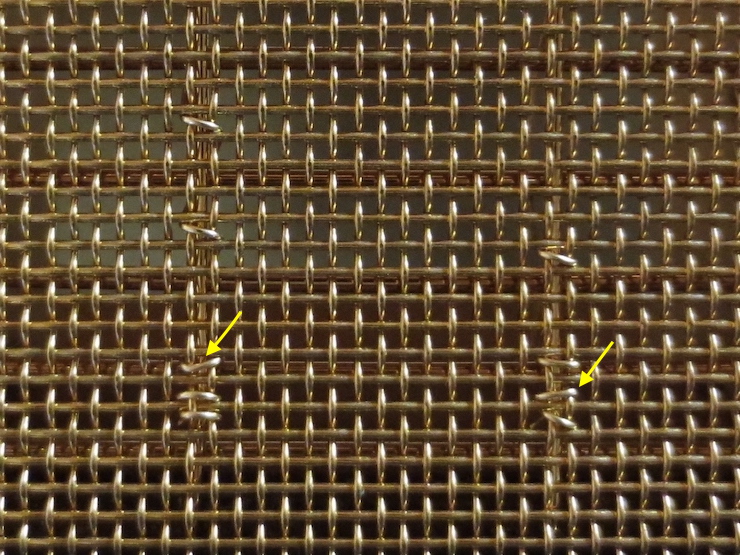
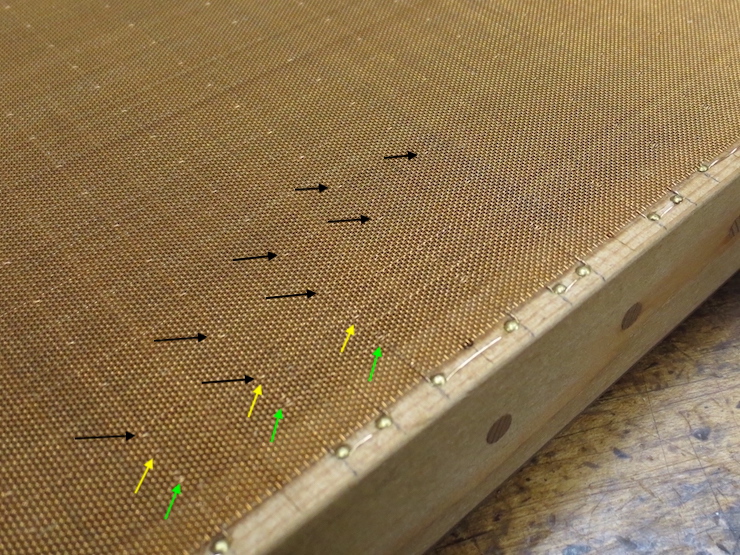
You can’t choose the openings when making the last three stitches to form the ‘knot’ so this process can’t be followed here. Visible in the photo are two stitches that were forced to cross ‘backwards’ by the low spots in the mesh, reversing their angle. These stitches (indicated by yellow arrows) ‘break the rules’ and as a result don’t lie quite as flat. It doesn’t matter in this case because this part will lie under the deckle and paper won’t be formed here.

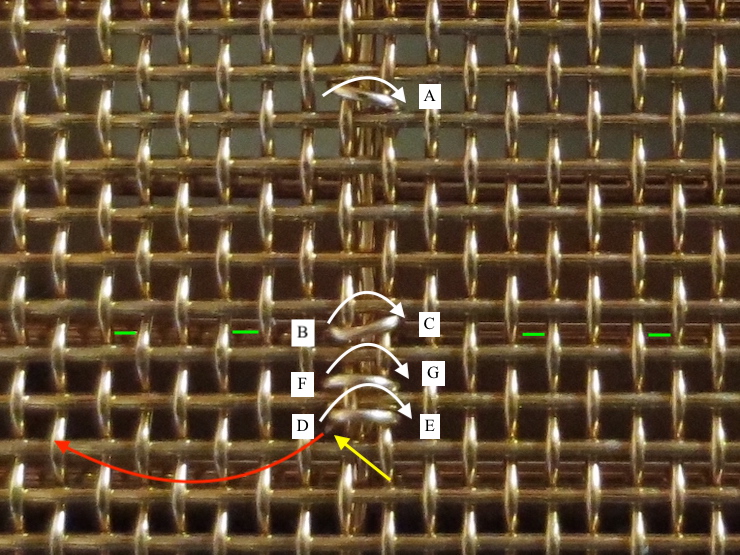
A view of of the ‘knot’ from above. To form the knot the sewing wire passes down through the ‘hole’ at [A] and comes up at [B]. It then crosses over two wires on top and down through [C] before passing back under to come up again at [D], crossing under the laid wire in the process. The sewing wire goes down at [E] and ‘reverses course’ to pass up at [F]. This time the wire is left a little loose. After the wire is pulled down through the mesh at [G] the end is poked under the previous stitch (between [E] and [F], not visible here) before passing up through [D] once more. The end of the sewing wire is then pulled which tightens the stitch that was left loose. This has the effect of trapping the wire near its end. The excess wire (represented by the curved red arrow) is pulled and rotated until it breaks off just below the surface (at the tip of the yellow arrow). The wire always breaks in the same place just below the surface due to the rotating action. This weakens the wire in this spot before it is pulled hard enough to break. Note that the stitches of the knot are directly adjacent (on both sides) to the last ‘free’ laid wire which is indicated here with green dashes. The knot ‘lashes’ the mesh facing down to the laid wire as well as securing the end of the sewing wire.

[

A view from below showing the sequence used to form the knot. The last stitch before the knot [A-B] is always located in the third space (located between the third and fourth laid wires) from the wooden frame.

Starting at [1] the sewing wire enters the opening right next to where the laid wire and the grid wire intersect. It passes over two mesh wires in the usual way and comes back down* through [2]. It then passes under* the laid wire and skips over a mesh to pass through the opening at [3]. After crossing the same two mesh wires on top it comes down through space [4] and ‘reverses course’ to pass through space [5], right next to the laid wire. For now this new stitch is left loose. This is so that after the wire is fed down through space [6] it can be poked through the loose stitch before passing one more time up through space [3]. You can see that the very end of the sewing wire is now held in place by the previous stitch. The knot has been completed; now the sewing wire is pulled tight and the end is rotated and pulled until the wire breaks. The red arrow points at the broken end of the wire.

*Once again keep in mind that in this photo the mould is upside down and that “over”, “under”, “up” and “down” may seem reversed.

In this photo the green arrows show the location of ‘knots’, where ends of the sewing wire are secured, straddling the last free laid wire, which can be seen beneath the wire mesh if you look closely. The yellow arrows show the row of stitches that fall in the space between the same two laid wires of the backing. The black arrows show the locations of ‘regular’ stitches, the stitches that secure the rest of the wove facing to the laid backing/grid wires. These are placed in a diagonal pattern visible here.

I hope this gives a fairly complete description of this process. I may have left out some details which would have helped explain things more clearly. Let me know if this is the case in this or any other post; I may be able to ‘fill in the gaps’ with more photos or text.

#25 Wove Backing

A wove mould’s backing layer is similar to that of a laid mould. I’m not sure why but wove backing wires are usually more closely spaced than those used for laid moulds. At least this was the case with the moulds I was able to examine when getting started years ago.

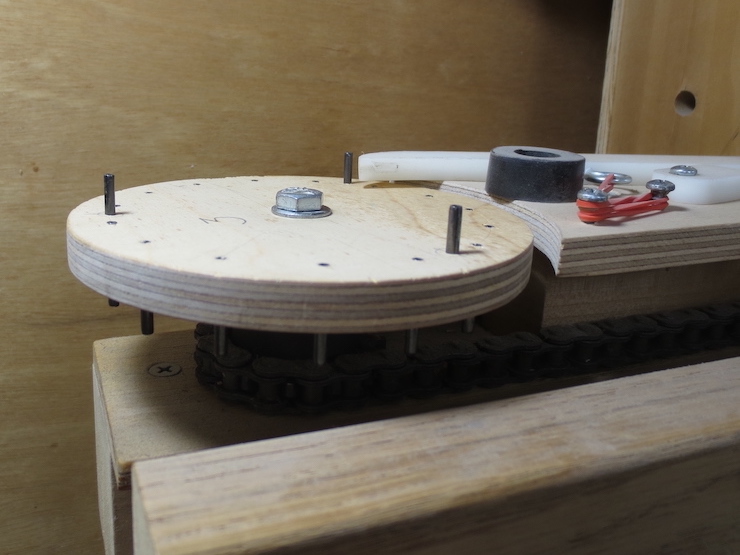
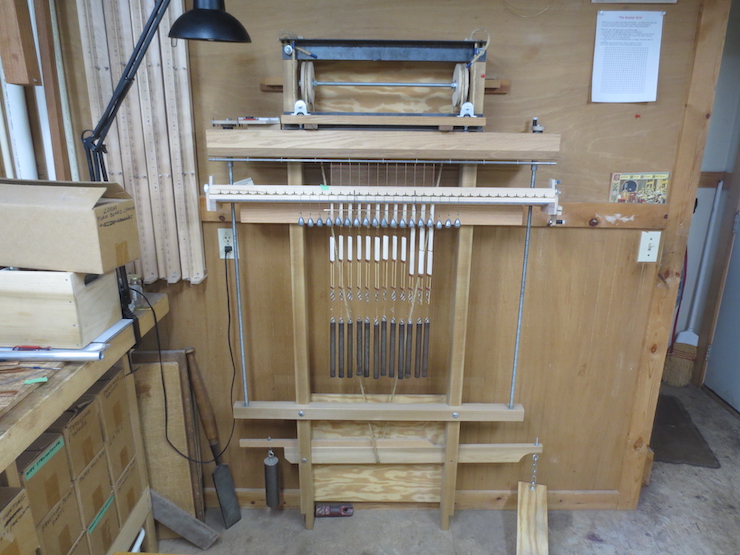
The counting wheel of the loom is changed to make a 7.8 wire per inch wire spacing. The wheel has 3 pins. The twin lead screws (you may remember) have 13 threads per inch so dividing by 3 gives 39 increments per inch. I turn the crank to count 5 of these ( audible as 5 clicks) before adding each new wire. (39/5 = 7.8) The straight (laid) wires used are the same diameter as those used for laid backing; .0254″ diameter. The chain wire is smaller; .013″ diameter.

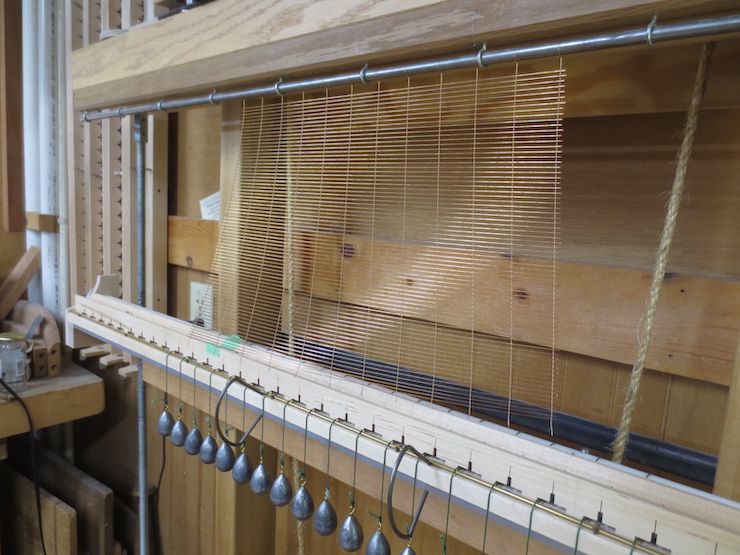
The first few inches have been ‘woven’ (twisted or twined might be be a better term) and a row of (white) wire spacers is being removed to free up more chain wire. The process of using the loom is covered fully in other posts and in a video.

The backing for this A4 wove mould is completed. The weights will be removed prior to cutting it off of the loom.

The bottom is cut off first.

The wove backing is ready to be fitted to the mould.

The ends of the laid wires are recessed in ledges at the ends and the chain wire rests in a groove there.

The backing is fitted. After adding tape at the ends and along the top to protect the wires the backing will be ready for sewing to the ribs.

A wove mould is sewn in two steps. First the backing layer is sewn to the ribs as shown here. In a later step the wove facing will be sewn to the backing.

The sewing process is very similar to that described earlier for laid moulds. A stitch is placed in every third space (pre-determined by the hole spacing) and the sewing wire is heavier; the same stock as used for the chain wires.

The backing has been sewn to the ribs and the mould is ready for the next step.

#26 Making the Grid for Wove Backing

The next step in making a wove mould is to add a wire that passes back and forth across the top to form a grid. This will support the fine wire screen that will be used as a facing.

In the photo above the grid is nearly complete; below are the steps needed to create it.

The spaces between the ribs are divided exactly in half and marked with pencil. Then these spaces are also halved.

Very small brass nails are hammered part way in for the grid wire to wind around. Notice that the pins are placed to one or the other side of the marks, depending on the course of the wire. This is so the wire will be located right on the marks. These nails are #19 escutcheon pins.

The .015″ diameter wire will be pulled off the spool as it is wound back and forth across the face of the mould.

Winding the wire. The wire was anchored at the far corner by wrapping it around an extra pin which was then driven down flush with the wood.

The other end the wire is anchored the same way.

As the nails are driven home the wire tightens and straightens.

A closer view. This is the first mould in which I have used three equally spaced grid wires between ribs. The two outer ones will be stitched in place as the wove facing is sewn down. The center wire is not sewn in place but is held in place by pressure between the laid wires of the backing and the underside of the wove mesh facing. The pressure pushes it into one of the many grooves formed by the warp and weft of the woven wire facing. The outer two grid wires are also pushed into grooves but are sewn firmly in place. I have seen this pattern on most wove moulds. Previous to this I have made wove moulds with only two grid wires between ribs, both sewn. (Perhaps I didn’t trust the ‘loose’ wire to stay in place.)

Skipping ahead a few steps to show how the grid wires will nest in ‘grooves’ created by the zig-zag warp and weft of the wire mesh facing. A single un-sewn grid wire in the center is held in place simply by being squeezed between the laid wires and the wove facing. It is flanked by two grid wires which have been locked in place as part of the process of sewing the wove facing to the backing/grid structure.

The grid is complete and the mould is ready for its facing.

#27 Mould Brass Sheathing

Many moulds made for use in commercial mills are fitted with metal sheathing. Since most of the moulds I make aren’t used this way I rarely use sheathing.

The mould used as an example here is a small wove mould made entirely of western larch, both ribs and frame. This choice of wood is an experiment. The purpose of making it a wove mould was to add that structure and the necessary processes to this series of posts. Sheathing was added to this mould so that that topic could also be included.

The sheathing is .017″ cartridge brass. I have a roll that is soft (annealed). Brass shim stock is easier to find but often too stiff for this purpose. It can be annealed with a propane torch, though.

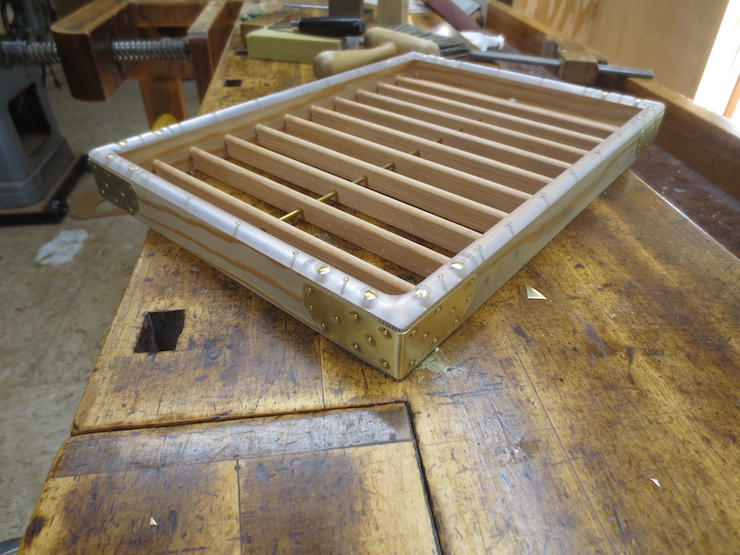
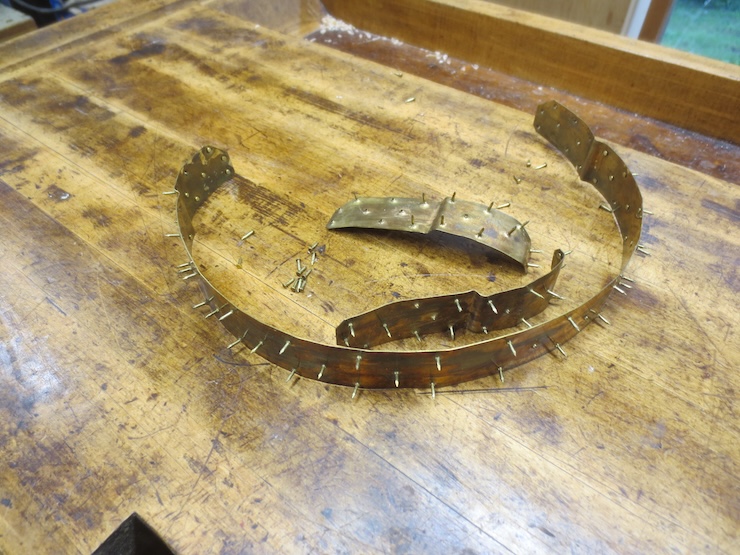
Typically the sheathing covers the entire front of the mould, wrapping around the corners. The other two corners have separate shorter pieces. Sometimes the sheathing is not symmetrical which puzzles me. Was this done for a particular purpose?

After the brass is nailed in place with 1/4″ brass escutcheon pins the metal is burnished down and the nail heads filed flat.

I ‘polish’ them with a sanding sponge to round off any sharp edges and make it look better.

The front has been finished.

The bottom side of the partially sheathed mould.

The remaining two corners each have a separate piece of sheathing.

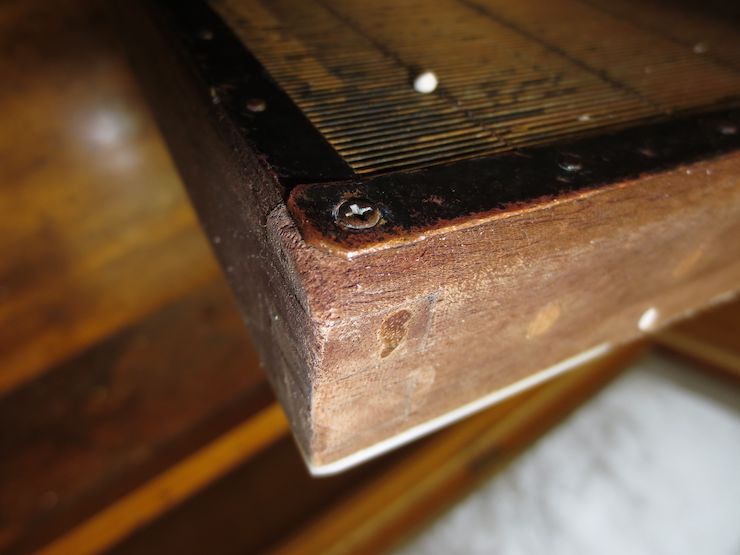
The purpose of the sheathing was probably partly to protect the wood from wear and partly to help hold the mould frame together in times before waterproof glue was available. It may have been partly to protect the vat person’s hands; I had a conversation with the man who used the moulds shown below in which he described the substantial calluses that he developed. The wood suffered too, being worn to a fuzz in the areas gripped during sheet forming.

Perhaps this mould would have benefitted from metal sheathing.

The wood is worn away from use.

The mould in these last photos is one of the few I’ve made that have been used in heavy production. These were used in pairs more or less continuously to produce about 500 to 750 sheets per day.

Removal of Sheathing

This mould was made of Western Larch as an experiment. It is the only one I’ve made. I fitted the deckle to the mould with the usual amount of looseness. Much later when we finally used it the deckle got stuck to the mould when the parts got wet. I opened up the deckle a bit but it still stuck so I pulled off the brass sheathing, which was surprisingly easy. Clearly it is important to account for the larger amount of swell when using Larch to make moulds.

#24 The Functions of Backing Wires


The function of backing wires in laid moulds

Following is my best effort at understanding why paper made on single faced laid and double faced laid moulds turns out so different. I think I’m on the right track but questions remain.

Single faced laid moulds make paper with distinctive characteristics. As paper is formed it becomes thin in the areas between ribs and thick in bands along and above the ribs. The cause would seem to be uneven drainage caused by the structure of the mould.

During the time taken to form a sheet of paper on the wire surface fewer fibers collect where drainage is poor and more fibers collect where drainage is good. The differences in good and bad drainage must be due to differences in the mould structure. I believe thicker paper along the ribs of a single faced laid is due to the vertical sides of the ribs having the effect of increasing flow there.

Surface tension prevents water from easily detaching from a horizontal surface (until enough accumulates to form drops). Water, as everyone knows, likes to run downhill and since the surface that is being drained (the mould) is basically horizontal there is little impetus for it to flow in any direction (there’s no downhill). Surface tension ‘sticks’ the water to horizontal surfaces until big enough drops are formed to be pulled off by their own weight. (I can’t explain why but I suspect this is not an efficient process.) But in the areas along the ribs a strong directional flow is created, as gravity encourages water to flow down the sides of the ribs thus drawing it away from adjoining horizontal areas. Since water flows strongly down the sides of a rib it builds up along its narrow bottom edge and streams off.

This seems to be an adequate explanation of the uneven nature of “antique laid” paper (paper made on a single faced laid mould). The structure of the mould, especially the interaction of horizontal and vertical surfaces creates areas of uneven drainage; poor between the ribs but improving with proximity to them.

I have a harder time convincing myself that I have an adequate explanation for the very even nature of paper made on a double faced laid mould.

Adding a second layer of wires to a laid mould (to make it a double faced laid mould) eliminates the problems of uneven drainage allowing sheets of even thickness to be formed. It is a little puzzling that the solution turns out to be so simple. Understanding why it works does not seem so simple. My first guess was that the extra wires simply isolate the upper facing by lifting it away from the ribs. I held this belief for a while, but now I think that the extra wires improve drainage and that the even formation of a double faced laid mould may be due to a combination of two factors; isolating (somewhat) the facing from the effect of the ribs, and improving drainage elsewhere. The extra wires might improve drainage simply by adding ‘pathways’, additional surfaces for water to flow along. In this scenario, the lower backing wires, being close to the underside of the laid facing are able to ‘catch’ and draw off water there. They would then function as additional routes for water to flow along. (But this isn’t completely convincing; there may be more ‘routes’ but they are all horizontal and still inefficient at creating directional flow.) Another possibility that occurs to me is that the two layers of wires (closely spaced laid facing wires and widely spaced laid backing wires) might create spaces narrow enough that surface tension could hold water between them, albeit briefly. If this were true (can it be possible?) the water could be drawn toward the ribs in a thick layer that would then turn and flow down their vertical sides.

Another possibility (that occurred to me while writing) is that the ‘vatman’s shake’ is not only instrumental in re-arranging the fibers in the paper being formed but also in helping drain the sheet by shaking the draining water sideways towards the ribs. But the shake is used for both single-faced and double faced moulds so clearly this can’t explain the different results from the two types of mould.

Fortunately it isn’t necessary to have a complete understanding of how moulds work in order to make (or use) them!


The function of backing wires in wove moulds

Backing wires serve a double function for wove moulds. The straight stiff wires provide a structure to support the woven wire facing while presumably working to improve drainage. ‘Wire cloth’ must be supported by backing wires; if sewn directly to the ribs it would soon sag between them from the pressure of couching.


#29 Copper Edge Strips and a few more details.

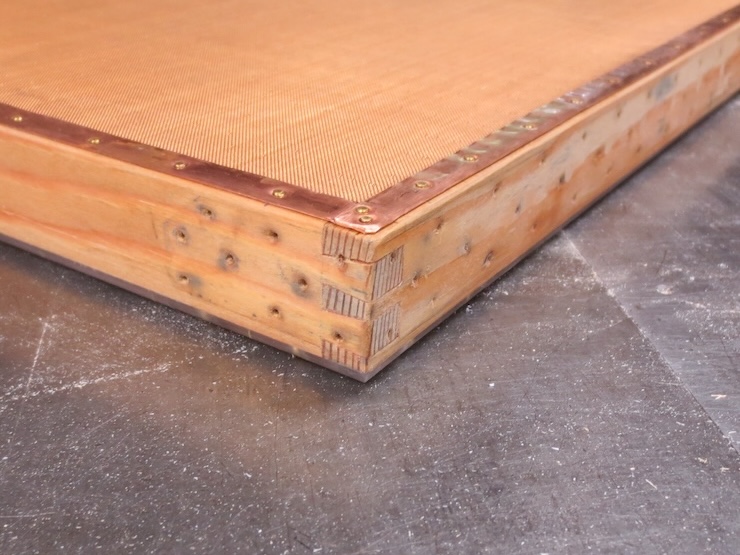
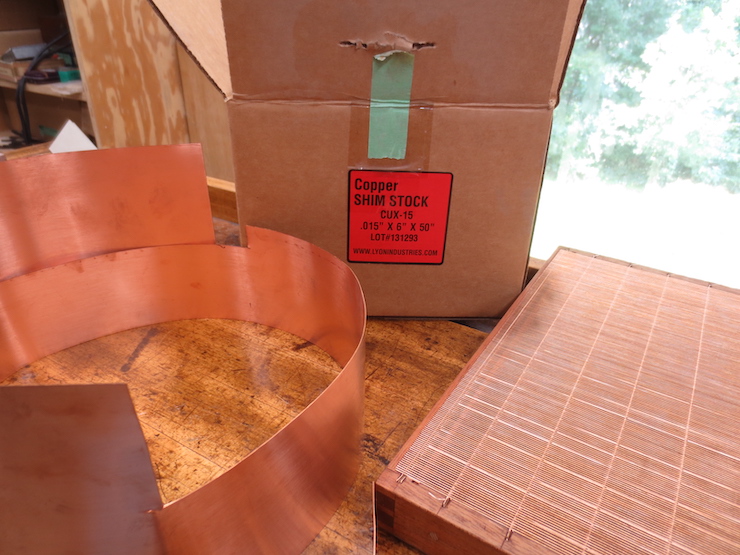
Copper shim stock .015″ thick makes good edge strips. These are needed to protect the edges of the laid and chain wires. But before the strips can be fastened in place there are a few more steps to be done.

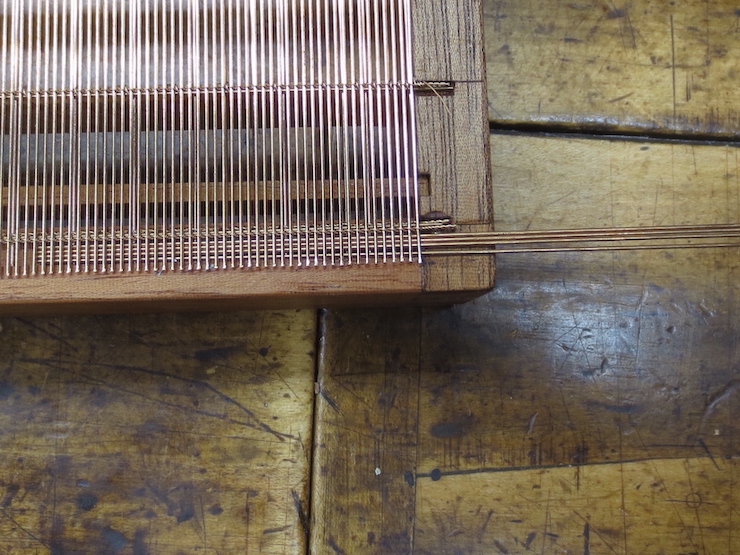
Bridge wires are inserted between the laid facing and the laid backing at both ends. These add support to the top wire layer so it won’t be distorted as badly when the strips are nailed down.

Here you can see one bridge wire trapped between the upper and lower chain wires. It extends into the notch at each end along with the chain wire twists. The other bridge wires are shorter, just long enough to fill the space between the layers above the lower ledge. Cross section drawings in a previous post show this more clearly. (Finishing The Mould Frame)

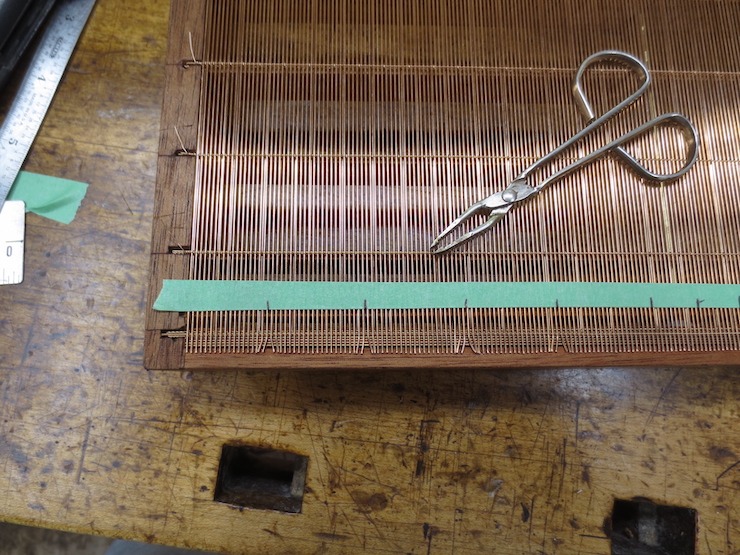
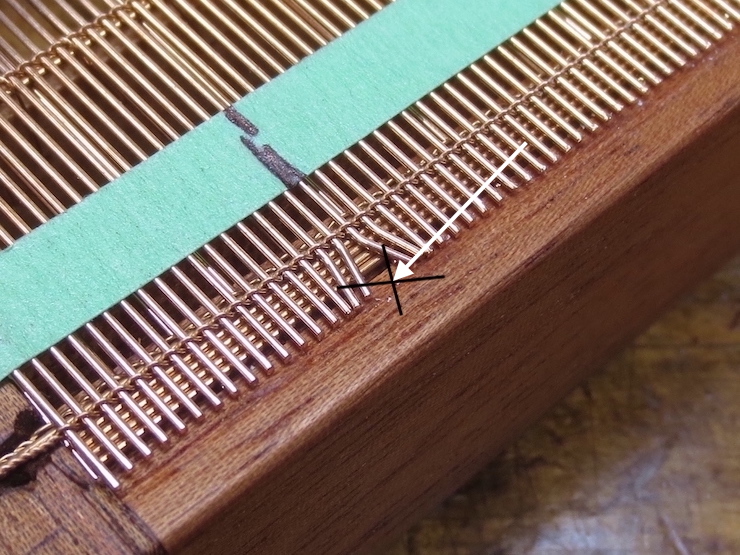
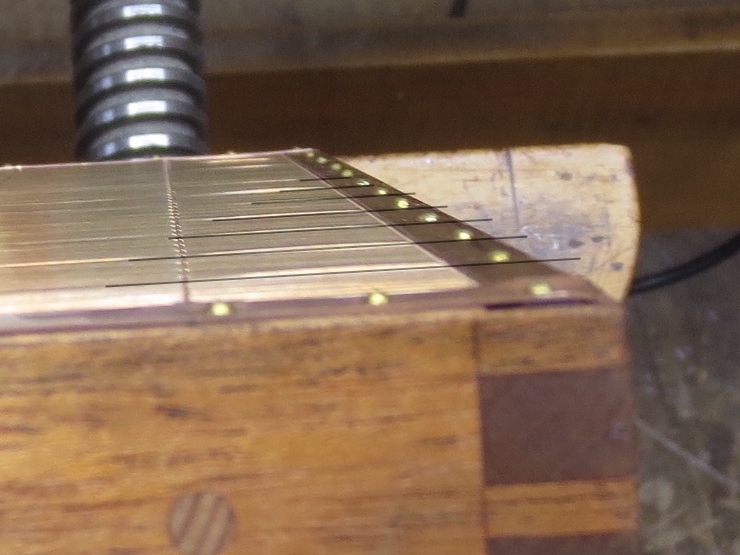
The locations of nails are marked and laid wires are bent sideways to make room for the brass escutcheon pins that will be hammered in about every inch.

“X” marks the spot where a brass nail will enter the wood.

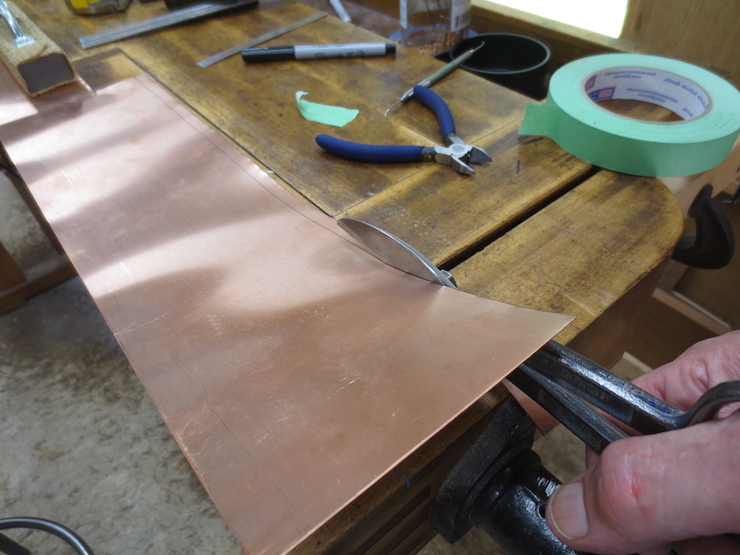
Strips are cut from the shim stock. Running them over a sanding sponge rounds off the sharp edges that are left.

The ends of laid wires are now hidden but marks on the tape indicate where spaces have been created for the nails.

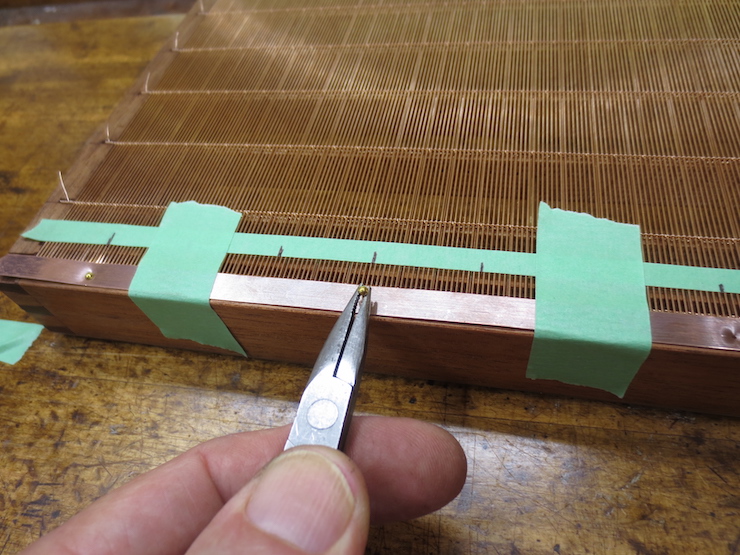
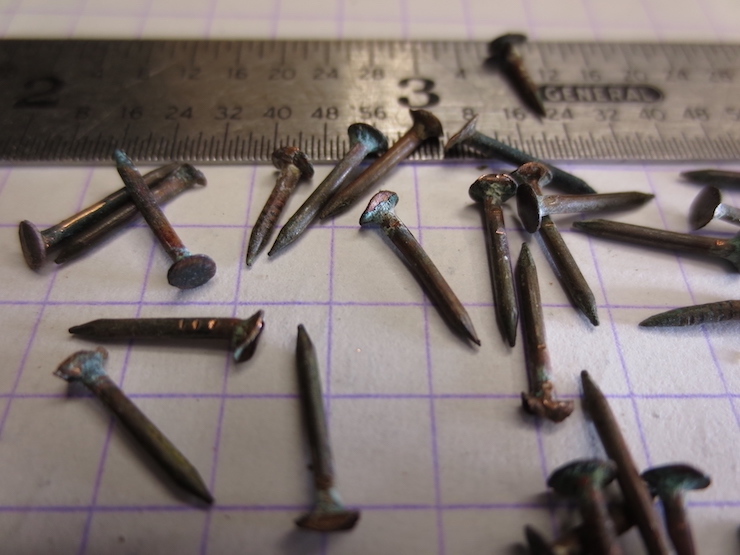
A sharpened nail set (below) is used with a small hammer to pierce the copper and start holes into the wood. These cross-grooved needle nose pliers are used to hold the nails while they are started with a hammer. On the ends of moulds every third nail is 3/8″ long. The rest are 1/4″. The corner nails are 1/2″ long. The nails are #18 brass escutcheon pins. They are .050″ diameter with small domed heads. British moulds typically use copper wire nails with flat heads. The ones I have measured are made of 1mm (.040″) wire. I have not been able to find a source for these.

This is the altered carpenter’s nail set that is used to pierce the copper strip.

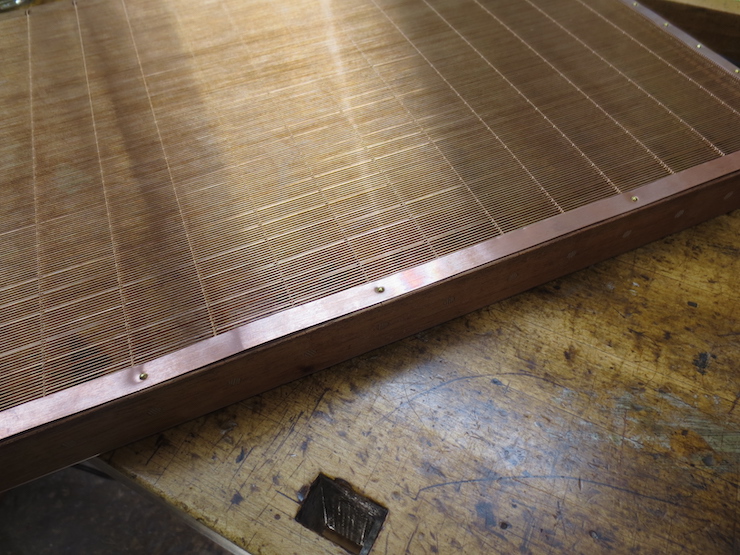
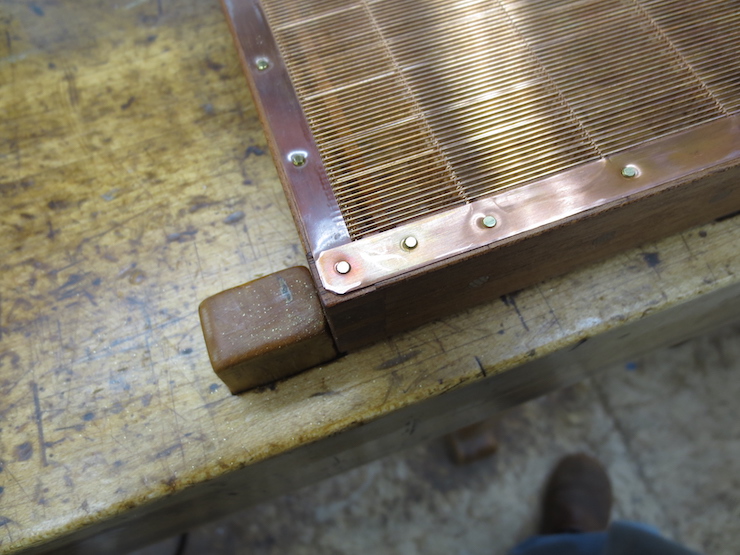
The end strips have been attached, protecting the ends of the laid wires along both ends of the mould. Two more strips are applied parallel to the laid wires to protect the fragile extensions of the chain wires.

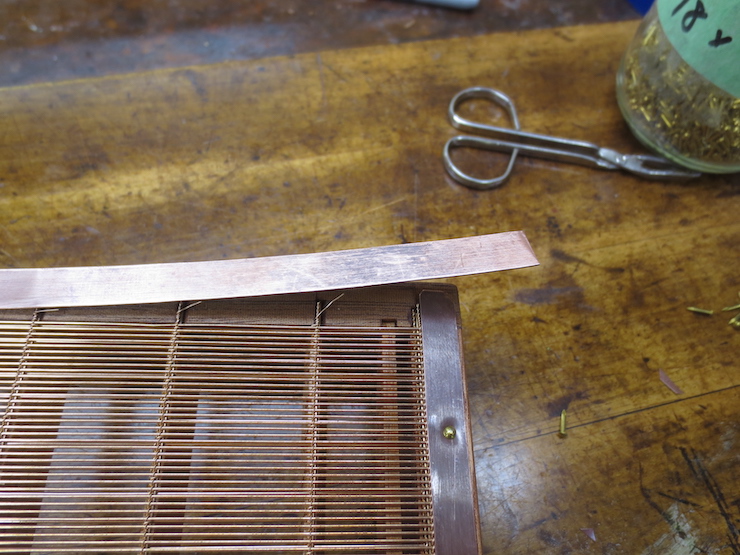
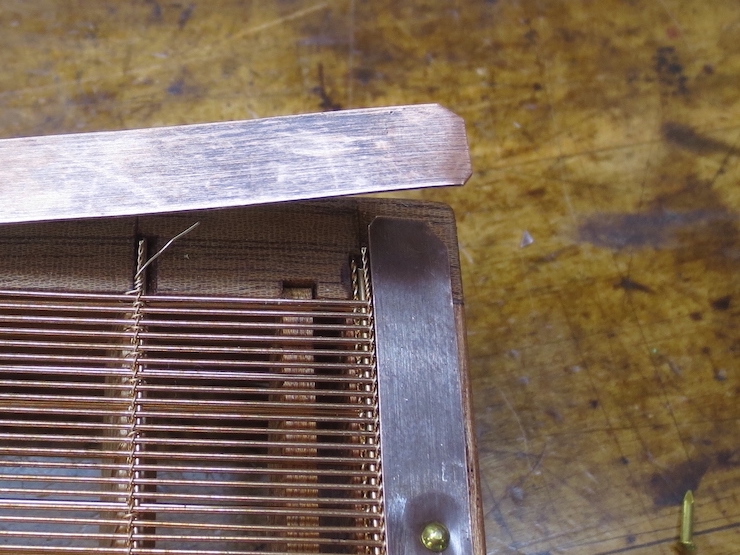
The bottom strip has had its outside corner snipped off a bit farther in than the upper strip. After both strips are nailed in place the corner of the upper strip can be burnished down over the lower one.

Along the sides a nail is placed just to one side of every twist. These nails are 1/4″ long.

Nails sometimes loosen with use. They can be tapped back down or if necessary replaced with the next longer size. On occasion I have screwed the edge strips in place with tiny #2 flat head brass screws. (Slightly larger #3 screws were used on the four corners.) This works very well but adds considerable time and expense.

After all the nails are hammered in the soft copper is burnished to lie tightly against the wood.

As mentioned the upper strips are burnished down at at the corners

Even with the support of the ledges and bridge wires the force of the nails causes laid wires to distort.

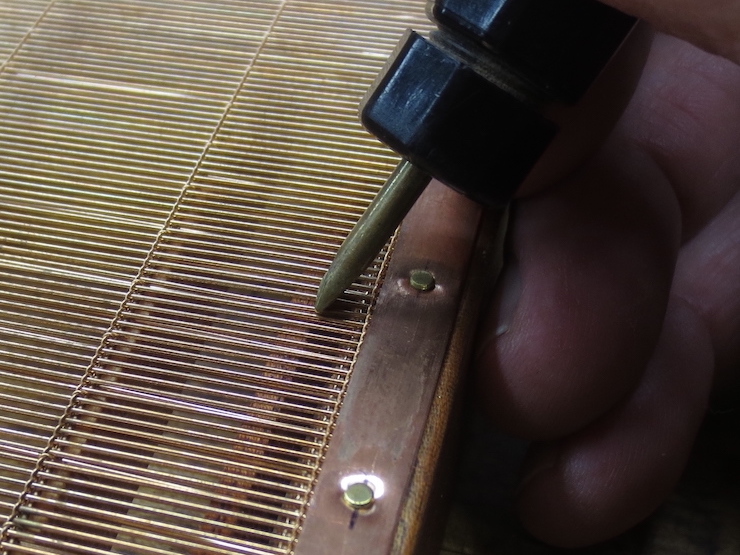
This tool is just a piece of brass rod clamped into a file handle. The end is blunt and the sides tapered like a screwdriver. It is used to poke and prod the laid wires, bending them a little to make them lie fairly straight again.

The tops of the escutcheon pins are carefully filed off to leave clearance under the deckle rim. A misdirected stroke with a file could easily destroy a chain wire!

The mould is finished (but needs a deckle)!

Some of the tiny copper nails extracted from British moulds during repairs.

Paper Mould Sold

This is one of the moulds being constructed and documented for this blog.

The net proceeds from the sale of this mould will be donated to The University of Iowa Center for the Book Windgate Challenge Grant. For details visit: https://book.grad.uiowa.edu/UICB-2020

The mould sold for $3049.00! As soon as eBay deposits the net amount in my account I will send a check to UICB. Check out the link above if you wish to donate.