#2 Sharpen Tools

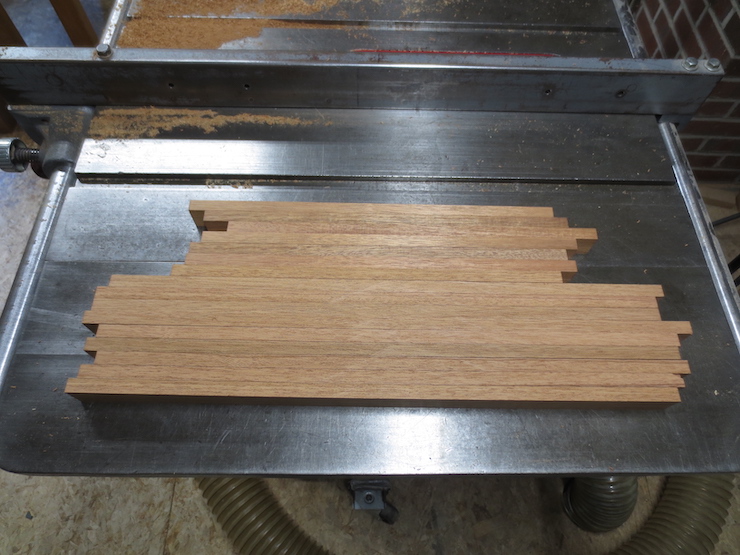
The wood for moulds, ribs and deckles has been seasoned, straightened and trimmed to near final dimensions. At this point I pause to get the necessary tools tuned up and ready to go. (I’ll post general information first, and include more detail at the end for those who are interested). These are current sharpening methods for the tools I depend on the most.

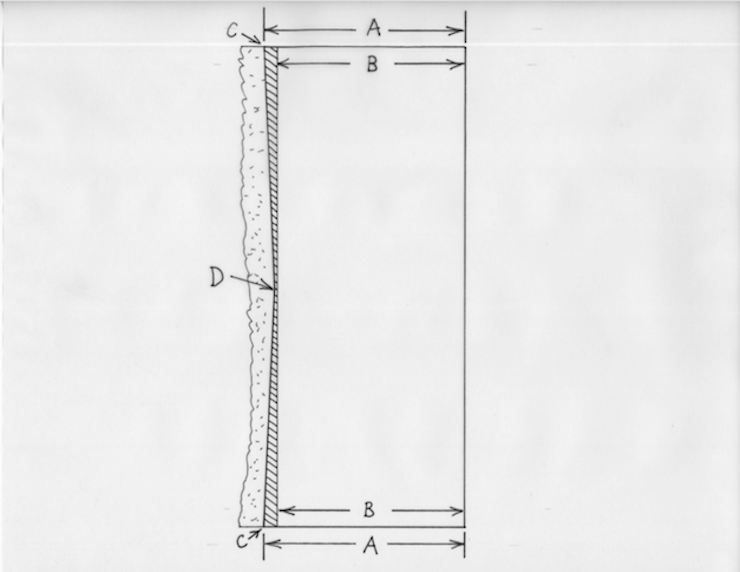
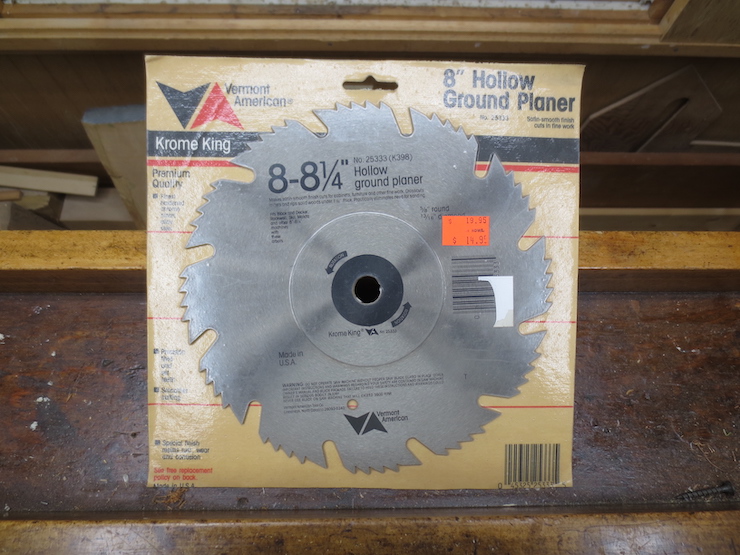
This 8″ Hollow Ground Planer saw blade plays a major role in my method for making paper moulds. Many sharpenings have reduced the diameter of the saw which started out exactly the same as the new one behind it.

I found a few of these on Ebay. I don’t know if they are still made.

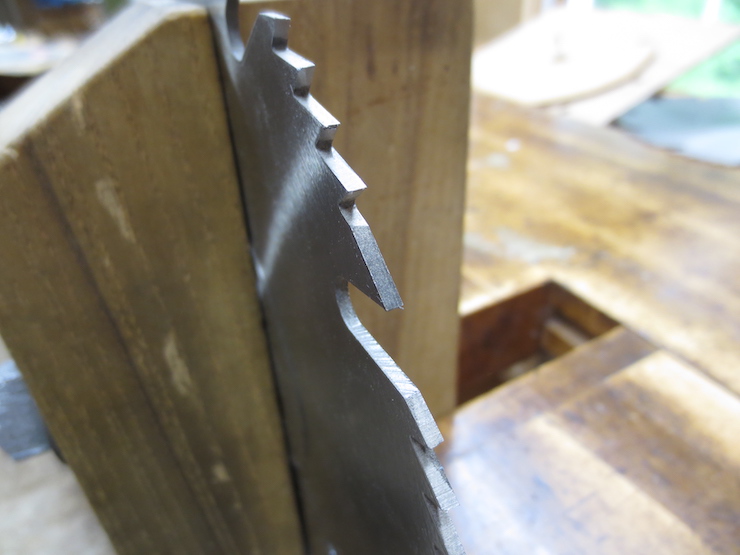
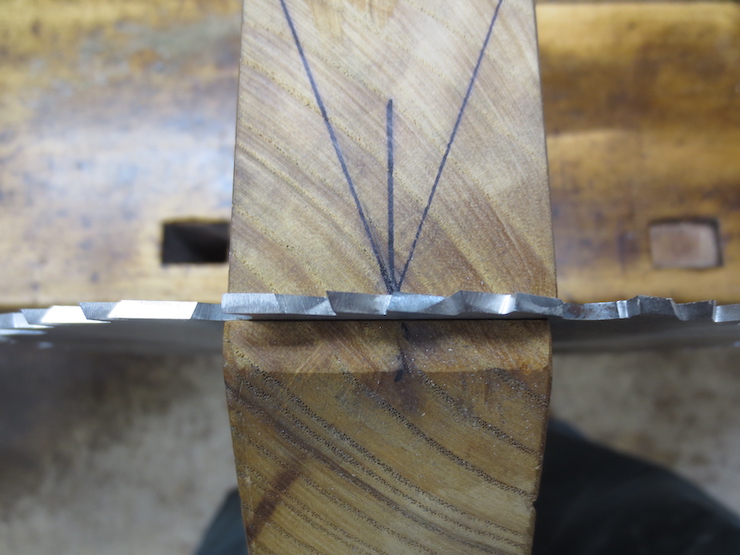
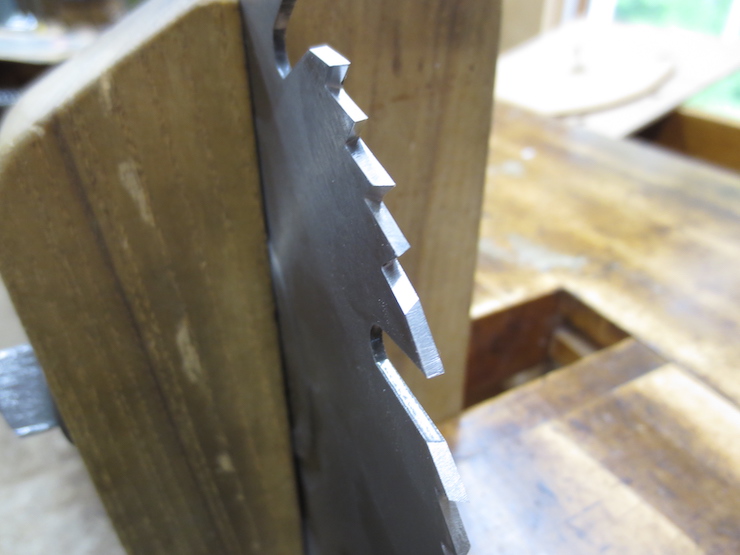
When the saw is new the teeth are all filed nearly straight across like this and it doesn’t cut well.

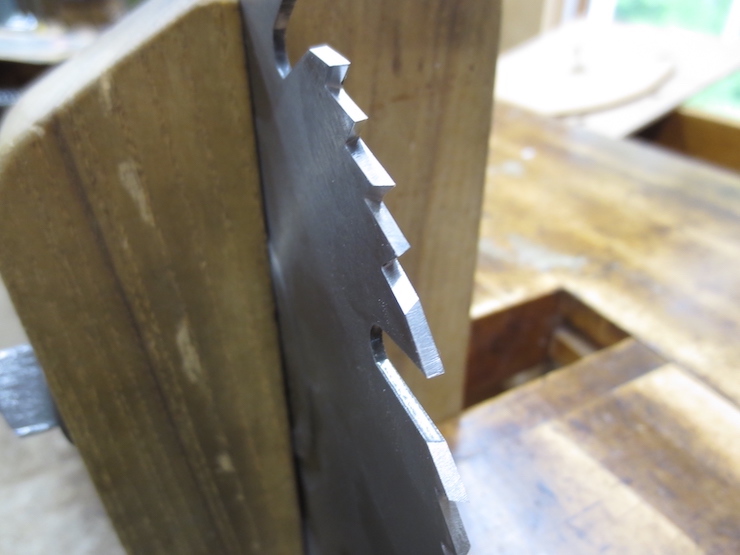
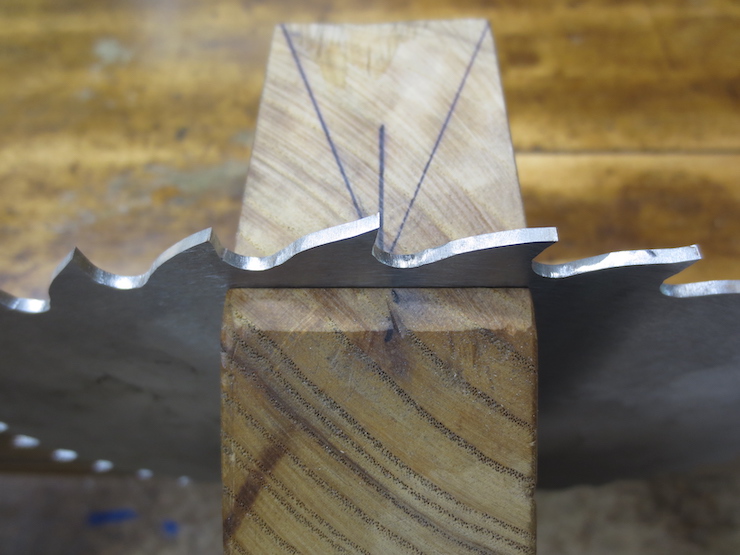
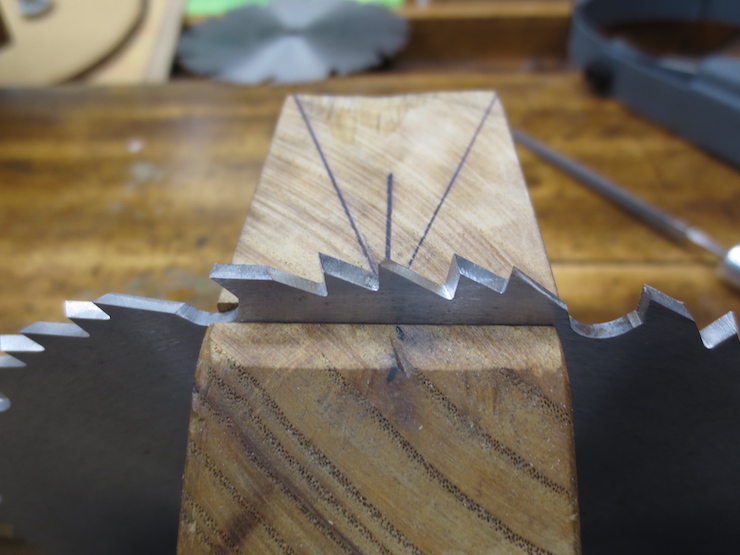
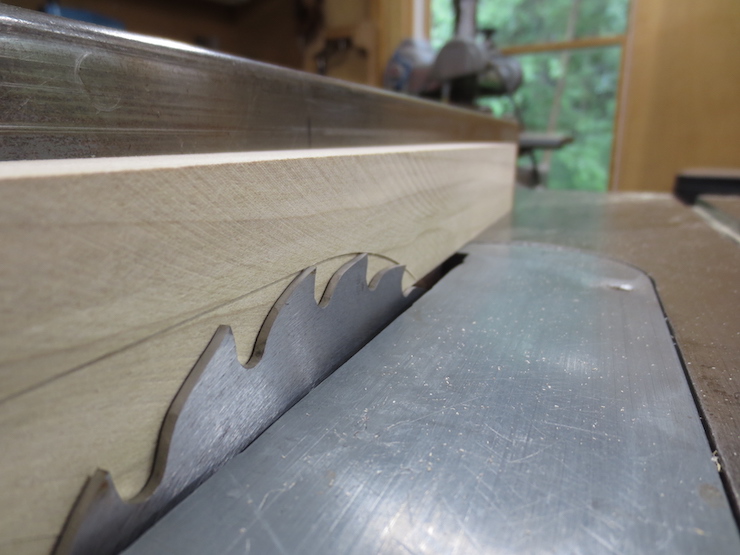
The teeth should be filed at 15 degrees like this. Every fifth tooth is a raker which is filed straight across and at a lower level to cut slightly below the tips of the cross cut teeth. This blade cuts very smoothly and I use it a lot for the finer work making moulds. Steel isn’t as hard as carbide but is less brittle so the the teeth can be shaped to sharper points. It seems to cut more freely and with less chip-out on the relatively soft woods used for moulds.

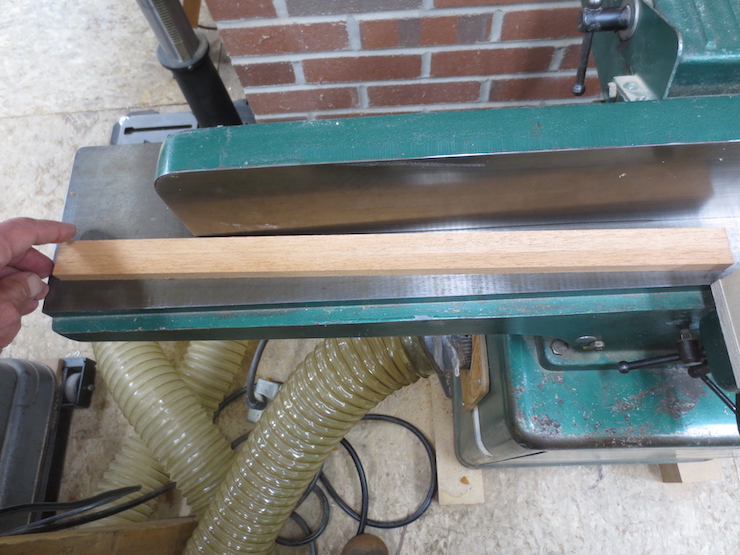
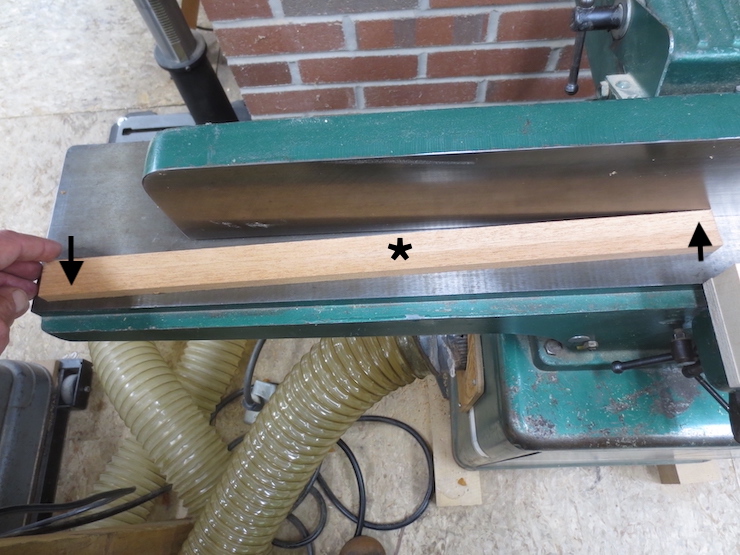
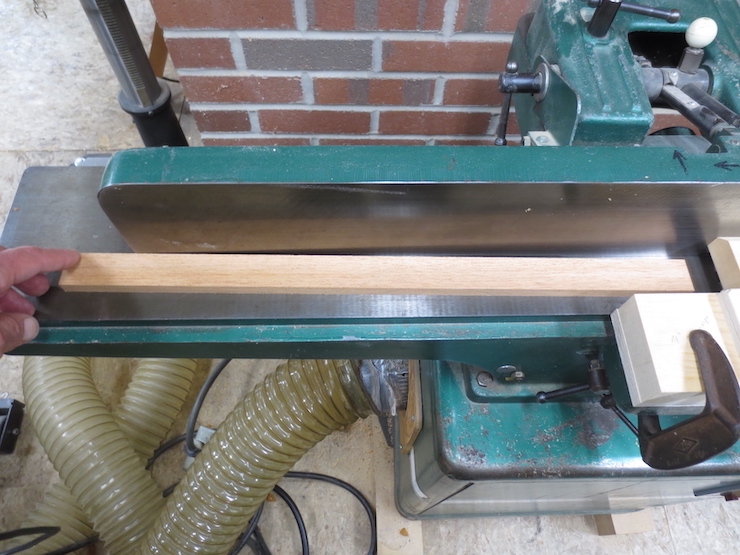
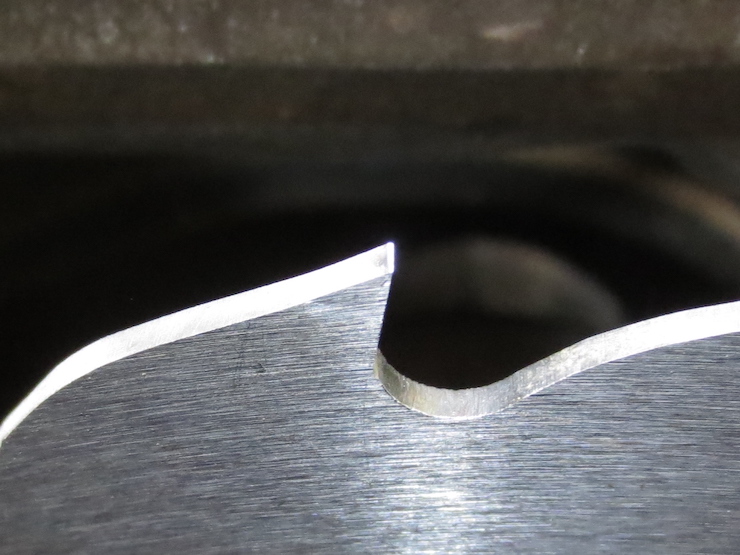
This is a rip saw. Its teeth are all shaped like little chisels and it is used for cutting wood parallel to the fibers (‘ripping’). I’ve learned how to use it in combination with a sharp, well-tuned jointer to create perfectly straight pieces of perfectly even and consistent thickness. This and the hollow ground planer are the only two saw blades needed for making moulds.

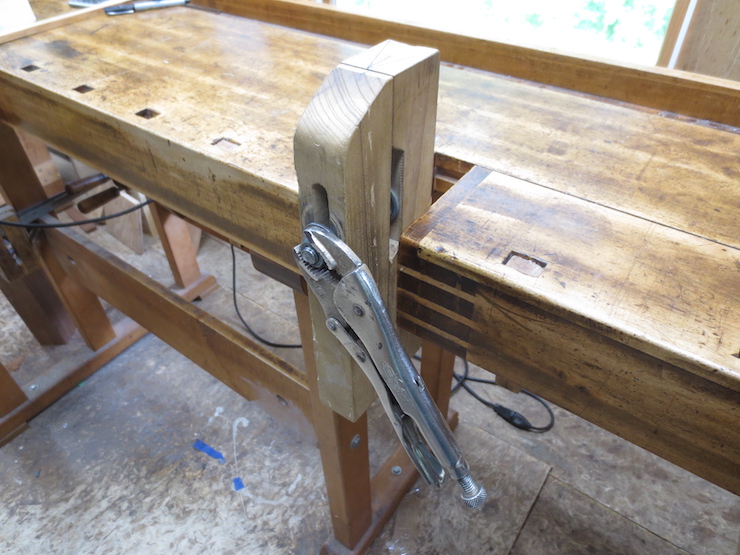
This is my home-made saw filing vise which is used to keep both types of saw sharp.

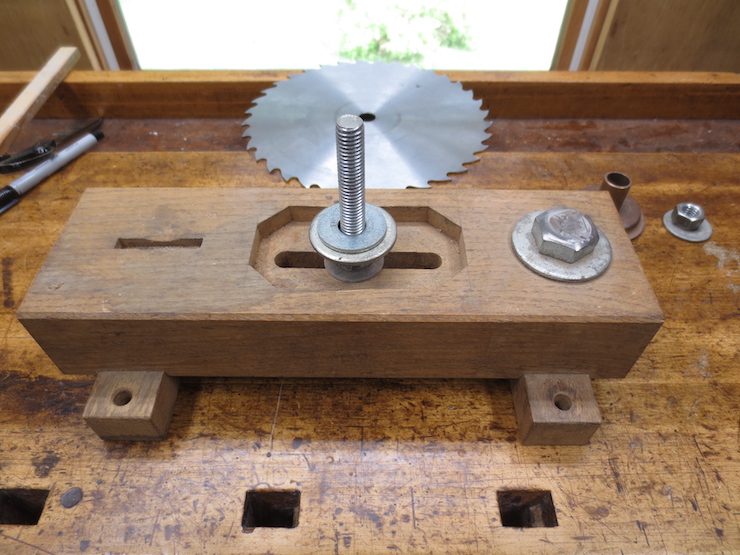
This is a home-made stake and anvil that I use occasionally to put ‘set’ in the teeth of the rip saw. Used with a hammer and punch this tool is used to bend the tips of the teeth to create set. The cut made by a saw must be wider than the saw’s body to prevent binding. The anvil is just a hardened bolt with its outer edges ground off to provide an angled striking surface.

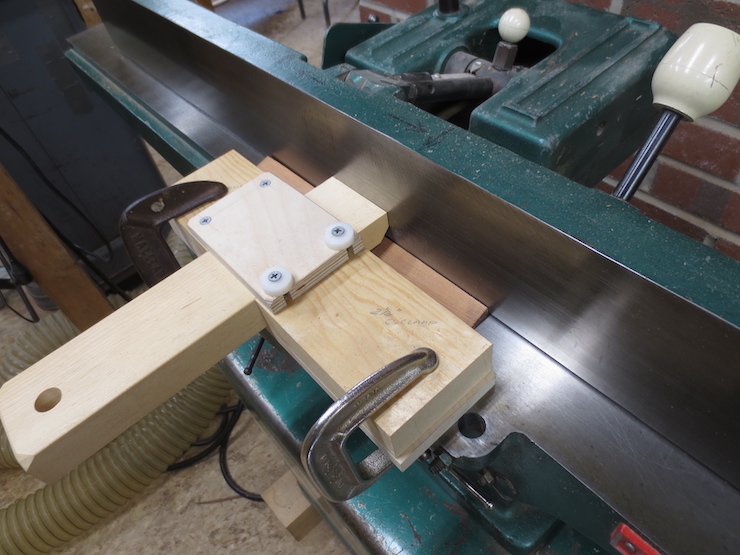
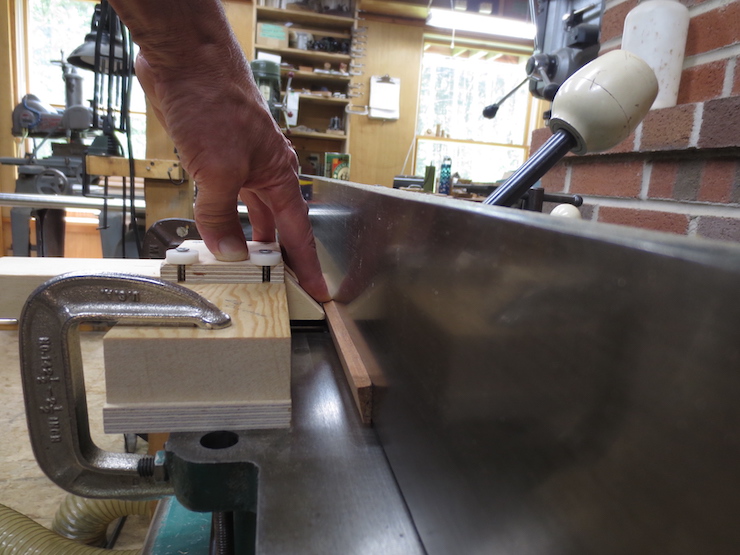
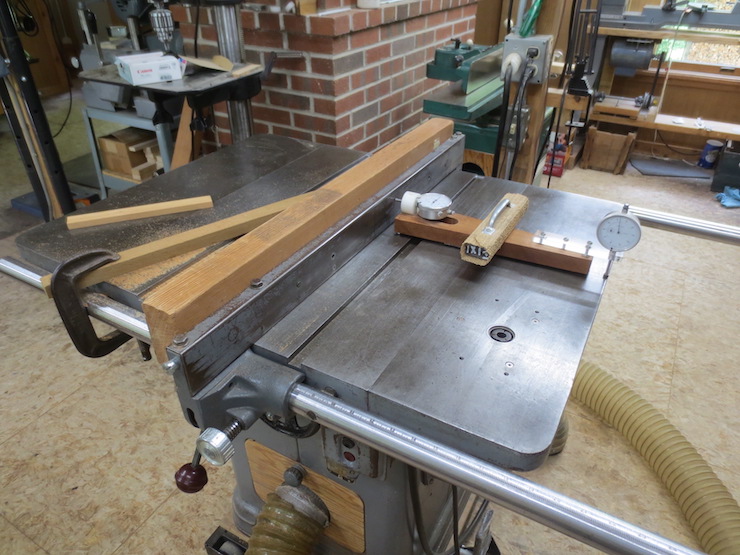
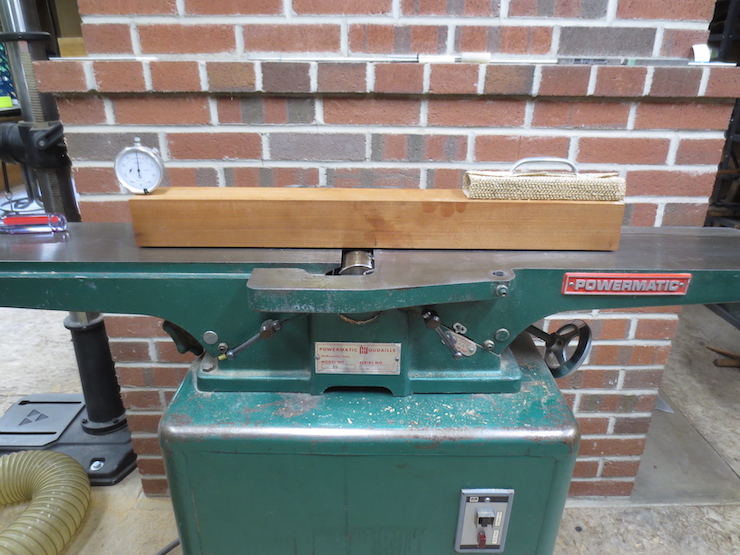
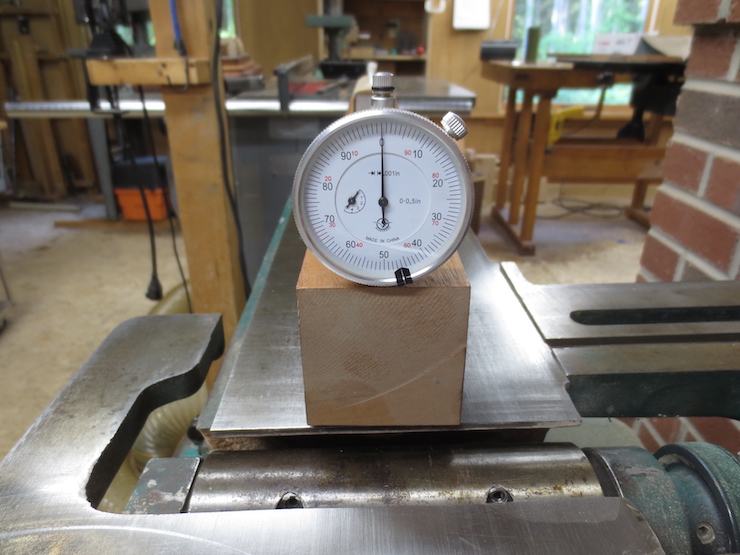
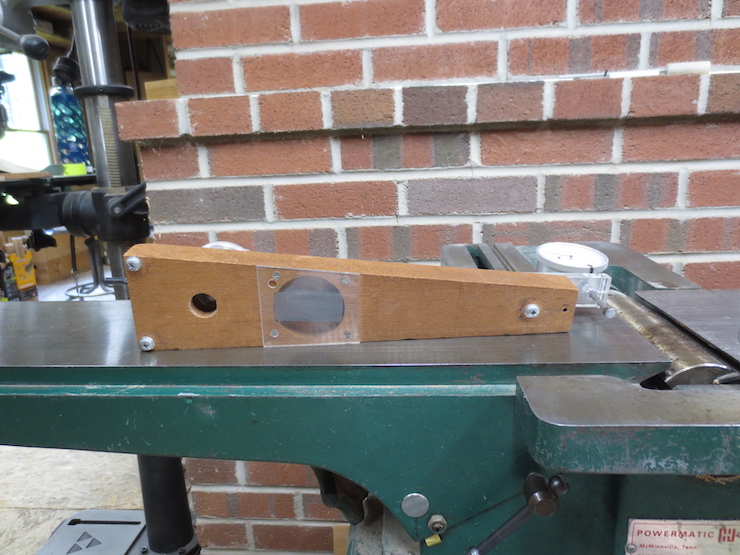
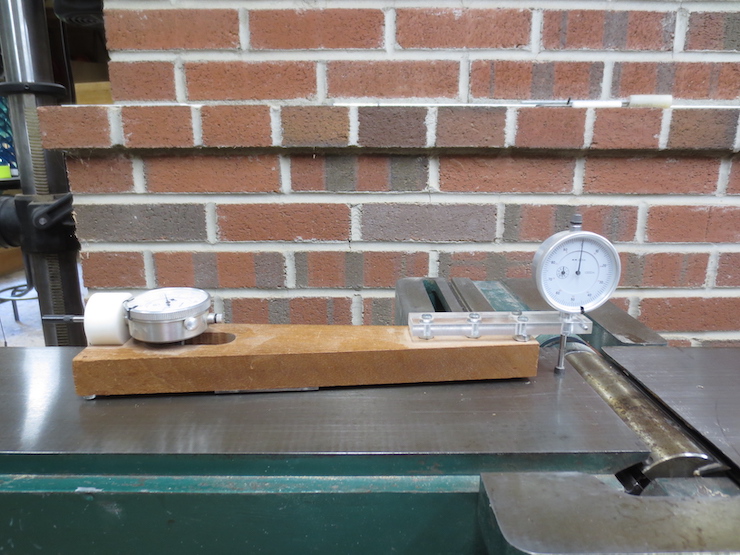
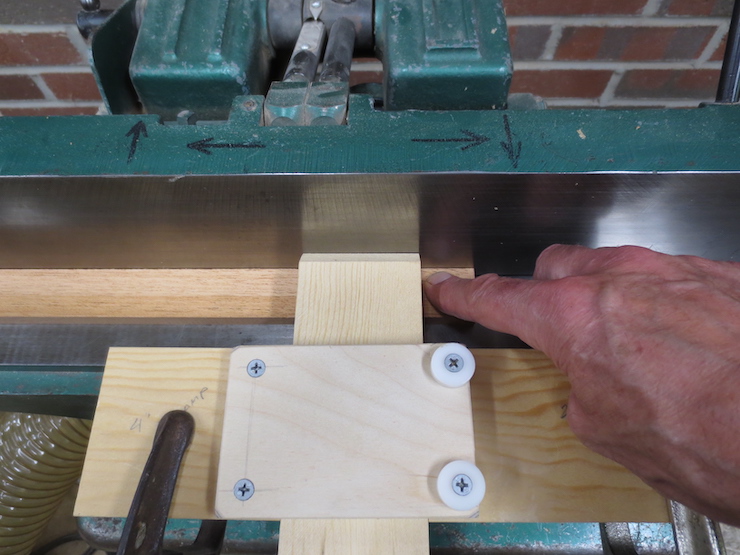
A very sharp, well tuned jointer is essential for this method of making moulds. On top is a very simple tool that holds a dial indicator to check for proper alignment of the in-feed and out-feed tables of the jointer.

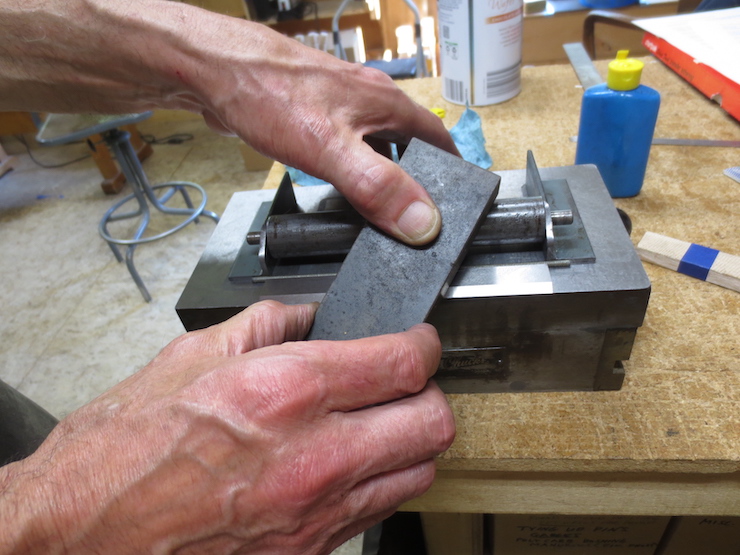
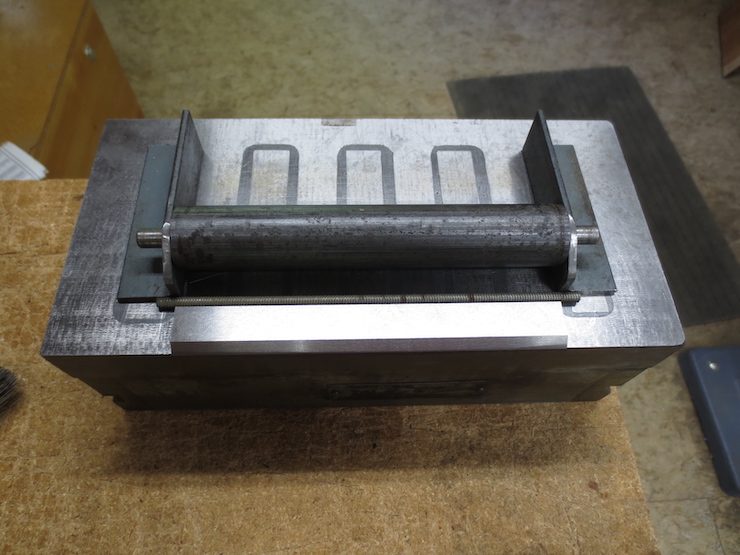
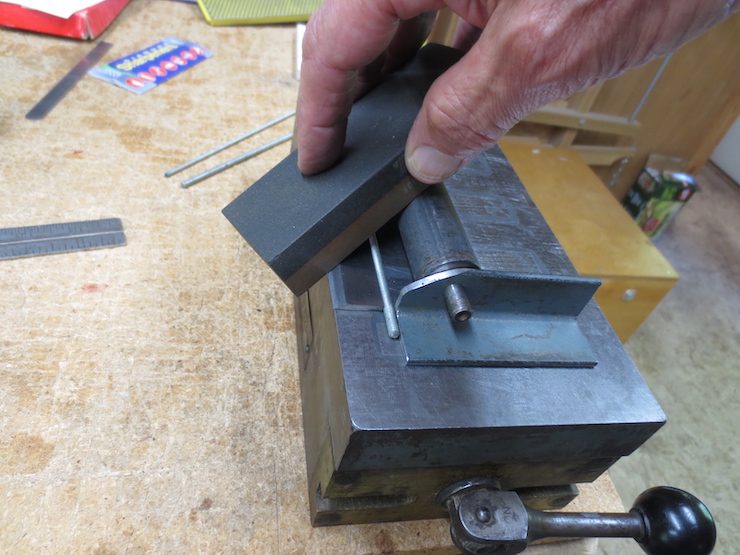
There are countless ways to sharpen. I have recently discovered a very effective way to hone jointer knives. I purchased an old surface grinder some years ago to help me make bookbinding tools. It came with a magnetic chuck, shown here dismounted from the machine. The top surface is perfectly flat and can be turned into a powerful magnet with the turn of a lever. This can hold the jointer knife as well as this roller assembly firmly in place to create a controlled honing angle. A more detailed description is given in the second part of this post.

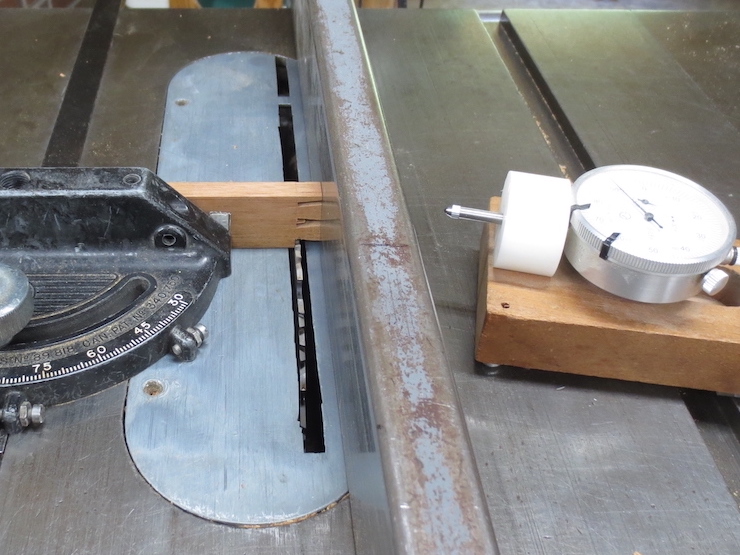
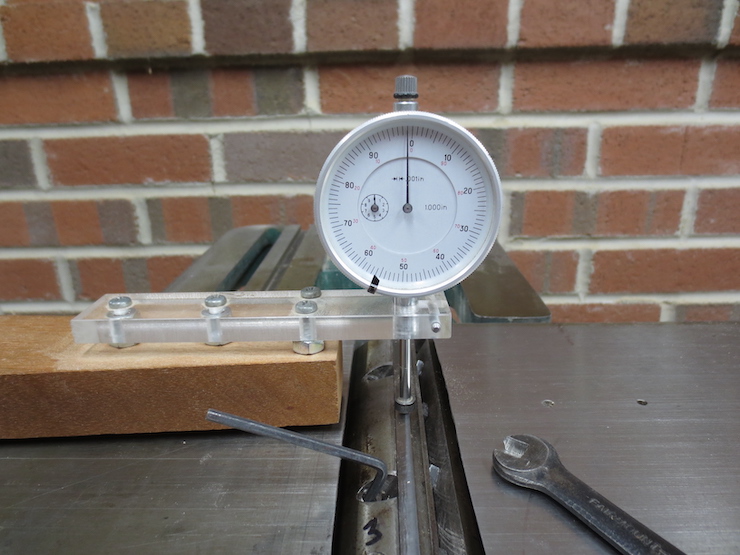
Another simple shop-made device holds a dial indicator for setting the jointer knives. This tool also gets used a lot for making small adjustments when using the tablesaw, jointer and router table.

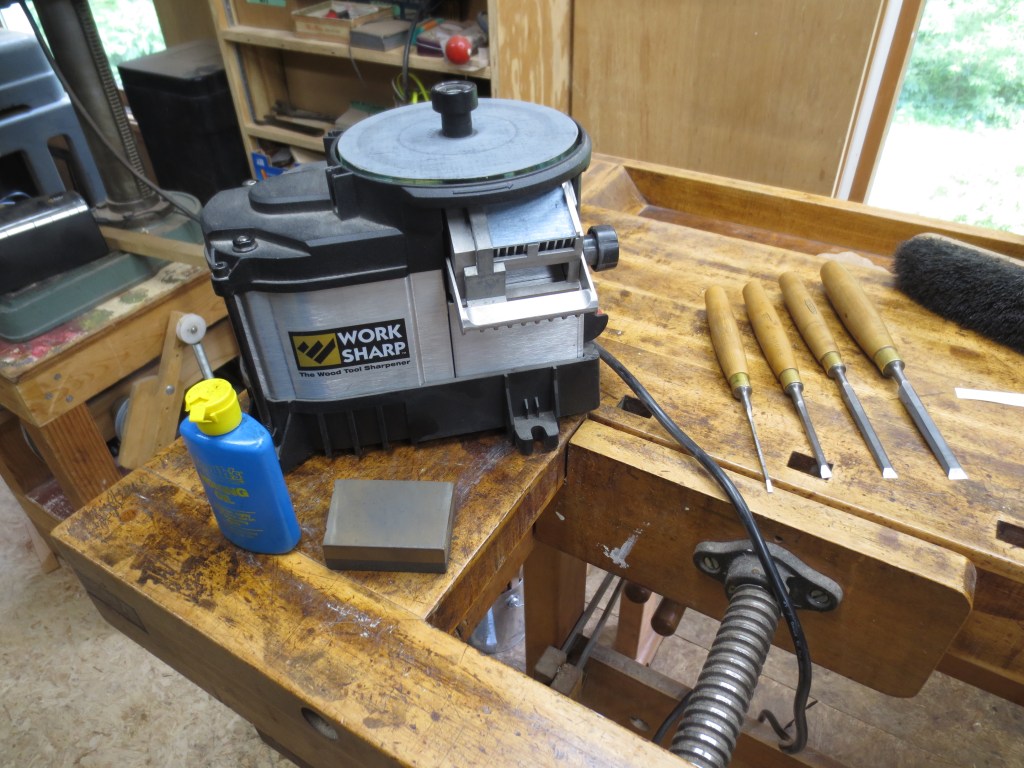
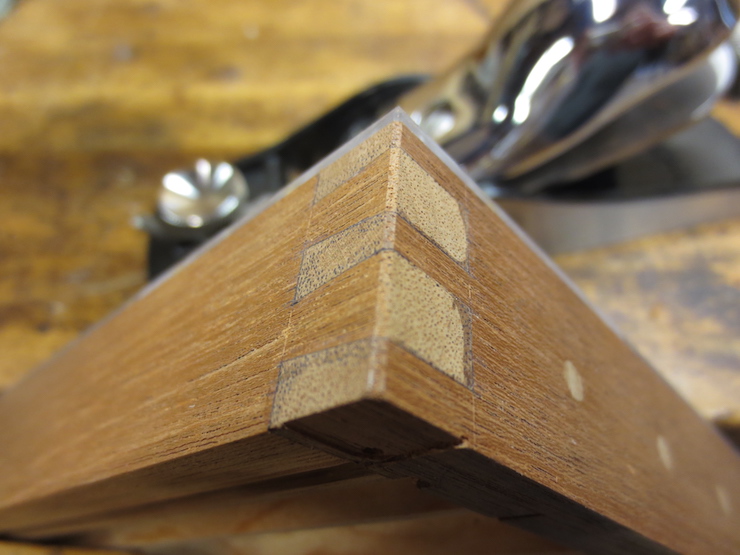
This machine works very well for sharpening chisels. I’ll use the four chisels shown for paring the dovetail joints of the mould frames and for detail work on the deckle joints.

A Deeper Dive…

The information given above just scratches the surface. Below is more detail for those who are interested. There is still much more to know and to discover.

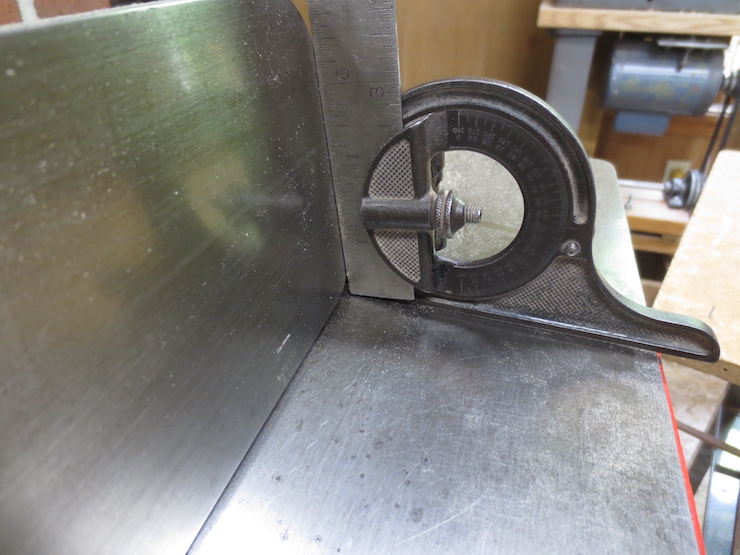
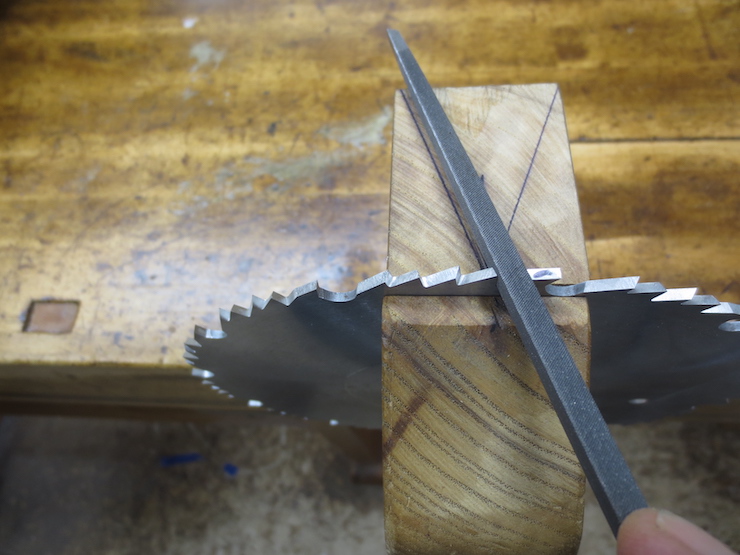
Marks on the saw vise show the correct angle to hold the file. The saw must first be ‘jointed’ on the tablesaw. The saw is set for exactly 90 degrees and lowered so the teeth are just below the table surface. A carborundum sharpening stone is held directly over the saw blade. With the machine running the saw is raised EXTREMELY slowly until a few sparks are visible. (Dim the lights). This will dull the teeth slightly so that all are at the same height. The teeth should be altered the smallest possible amount. Only enough to show a tiny shiny spot on each tooth (minus the rakers).
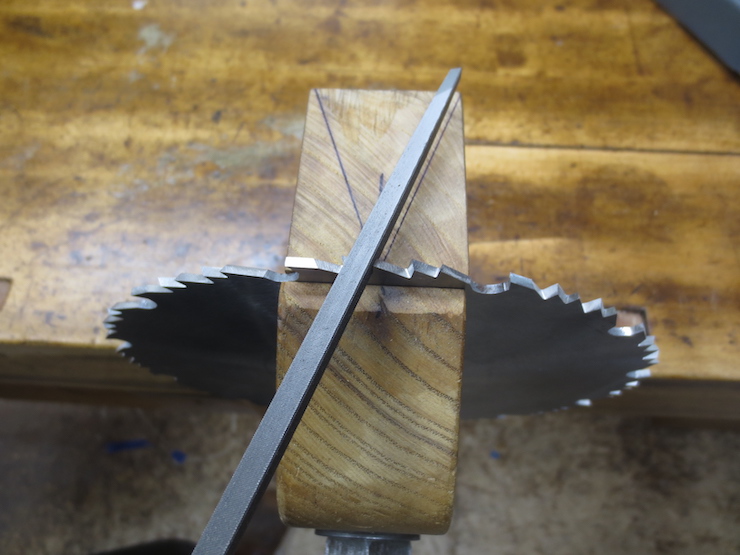
Teeth are filed alternately on both faces until the shiny spots just disappear, leaving the teeth sharp and all at the same height. The raker teeth must be jointed in a different way with each tooth held at top center in the vise. Careful adjustment and a file used with a block of wood joint the cutting edges about 1/64″ lower than the other teeth. Then they too are filed sharp until the jointed spots disappear. The angled teeth slice the wood fibers like little knives while the straight teeth rake out the waste between like little chisels. Since the higher, angled teeth contact the wood first the the fibers are sliced, not torn, leaving a clean surface.
The saw gets reversed in the vise to file alternating teeth.

I rub the file on a file card frequently. I spray a little WD40 on the card which helps the file cut smoother without chattering.

This rip saw is much easier to sharpen. Here, it has been jointed on the tablesaw. You can see the shiny spot that now needs to be filed away.

First the front faces of the teeth are dressed smooth. Here the saw is positioned with a tooth at top center. This way you can angle the file to feel the correct relief angle while filing. The narrow margin visible along the edge of this tooth is where it was jointed. This saw has very little set remaining and that will soon need to be addressed. Less often a saw also needs to be ‘gummed’ which means the gullets between the teeth are filed deeper and the teeth re-shaped as needed.

The tops of the teeth are filed until the shiny part just disappears.

The saw vise can be adjusted for different diameter saws.

The stake and anvil are adjusted with shims so the blade sits flat on the anvil (a large hardened bolt head that has been ground to a slight bevel at its edges). A tooth is positioned to hang over the edge just enough to be bent slightly with a punch driven by a hammer blow.

The center bolt can be moved for different diameter saw blades.

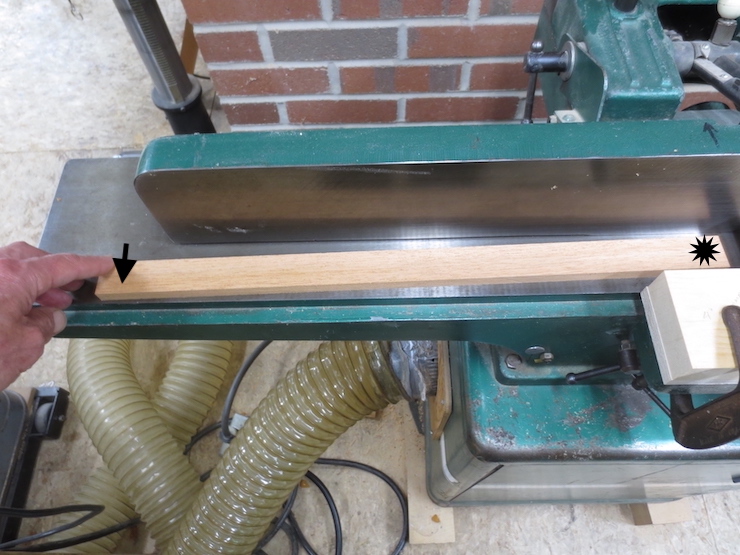
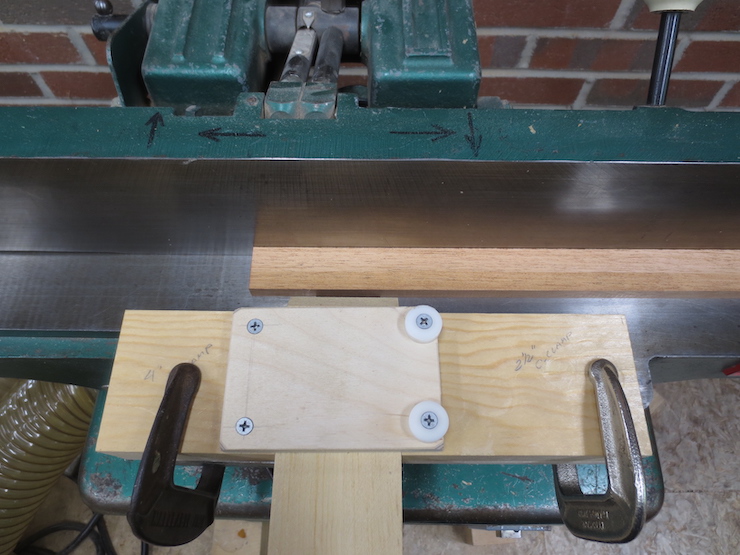
This tool is just a sturdy piece of wood as long as the longest table with three screws on the bottom. A hole at the far end holds a dial indicator which is adjusted to agree with the other three points to define a plane. You can then move the beam around to measure misalignment of the jointer tables. They should be exactly parallel to each other (even when set at different levels). Once you get the machine aligned this step doesn’t need to be repeated. I mention it here because it is important for the machine to be set up well for the precise work needed to make moulds this way.

The dial indicator ‘zeroed out’. Assuming the table is flat the tips of the three screws and the tip of the dial indicator together agree to define a plane. The beam can be moved around to check alignment since the spring loaded tip of the indicator will move up or down, measuring differences in thousandths of an inch.

Moving the beam along the in-feed table shows variation from parallel of the out-feed table. Here it registers zero at the front edge of the out-feed table.

Here the indicator registers zero at about the middle of the out-feed table. This is as far as it can go without having a screw drop off the edge. (The pencil mark indicates the location of the two middle ‘feet’). The weight keeps the three screw feet contacting the surface of the in-feed table. By referencing the flatness of the longest table the dial indicator can measure deviation over about half that length.

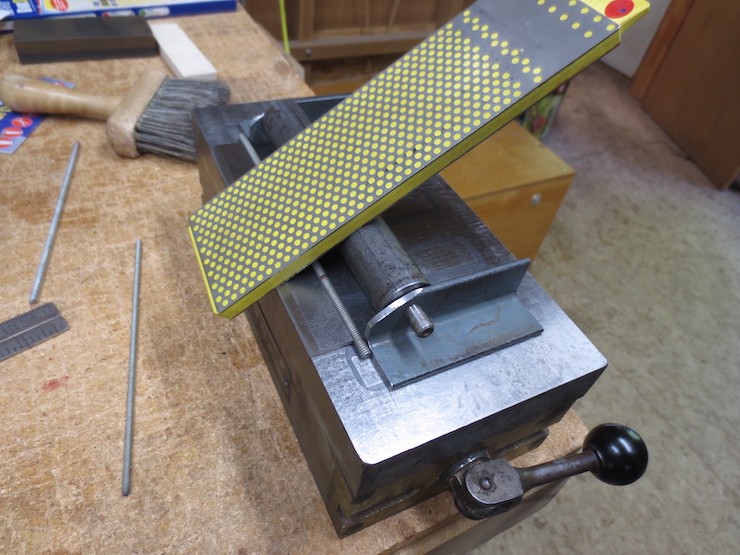
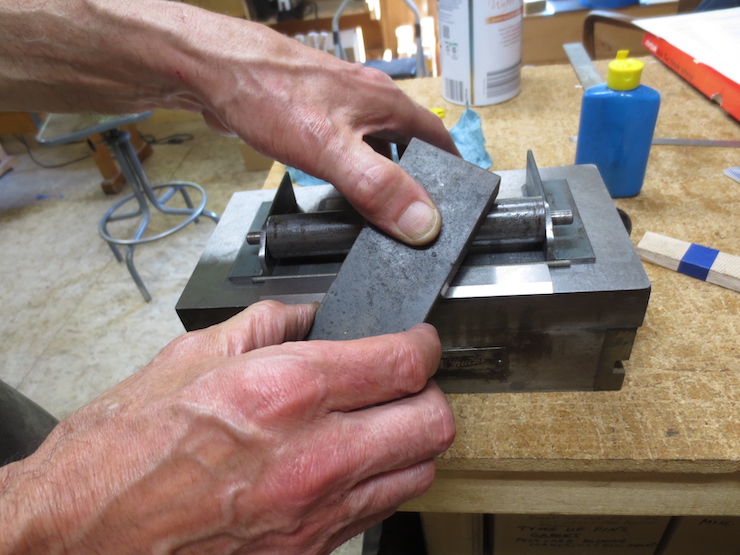
The jointer knife honing jig that relies on this magnetic chuck, mentioned previously. The roller is the core of a defunct printmaking brayer that I found in my scrap box. I carefully drilled the two pieces of angle iron so the roller is held parallel with the flat surface of the magnetic chuck. It is also important that both ends of the roller are set back exactly the same distance from the front ends of the angle irons. These bump up against a piece of rod which in turn rests against the back of the jointer knife being honed. Everything is locked into place when the lever actuates the strong magnets in the chuck. This establishes a honing angle which can later be altered slightly by inserting different sizes of rod. In place above and below is a piece of 3/16″ diameter threaded rod which defines the first (shallowest) honing angle.

The knife is first honed with a diamond plate.

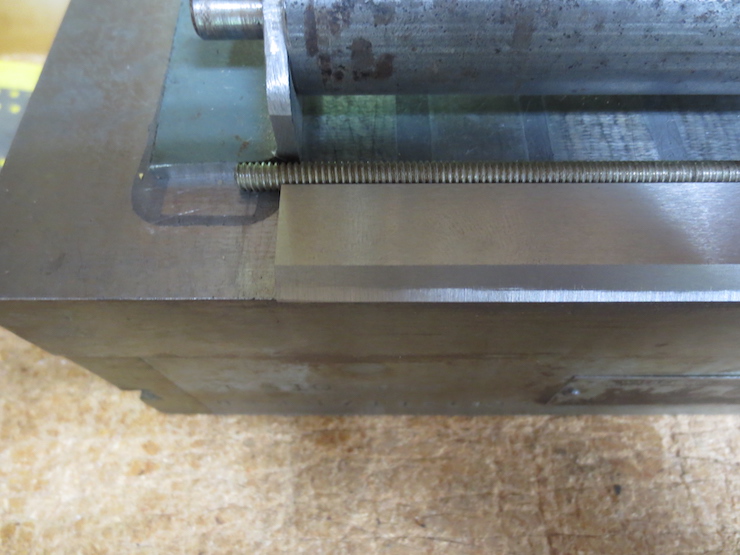
The results of using the diamond plate.

Swinging the lever from right to left de-magnetizes the chuck. This has enabled the first rod to be replaced with a smaller (5/32″diameter) rod. This moves the roller closer to the sharp edge of the knife to establish a slightly steeper angle so this India stone can remove the scratches left by the diamond plate, but only at the very edge.

Now an 1/8″ rod makes the angle a little steeper still so this Washita Arkansas stone can polish the edge further.

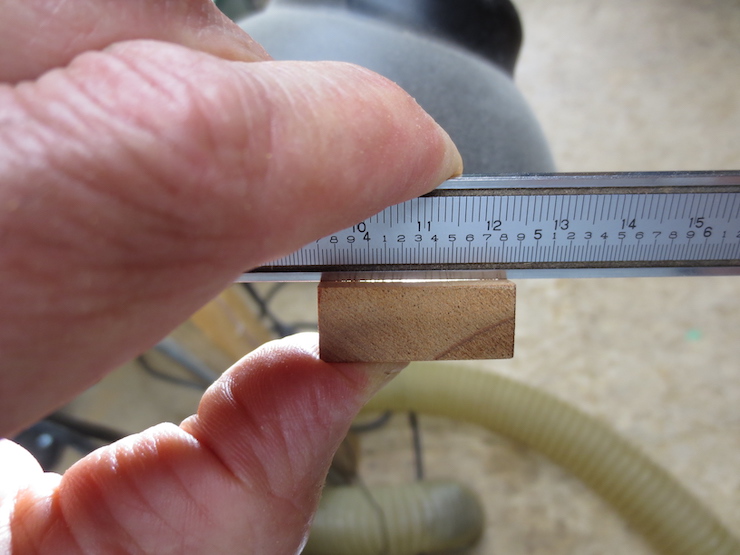
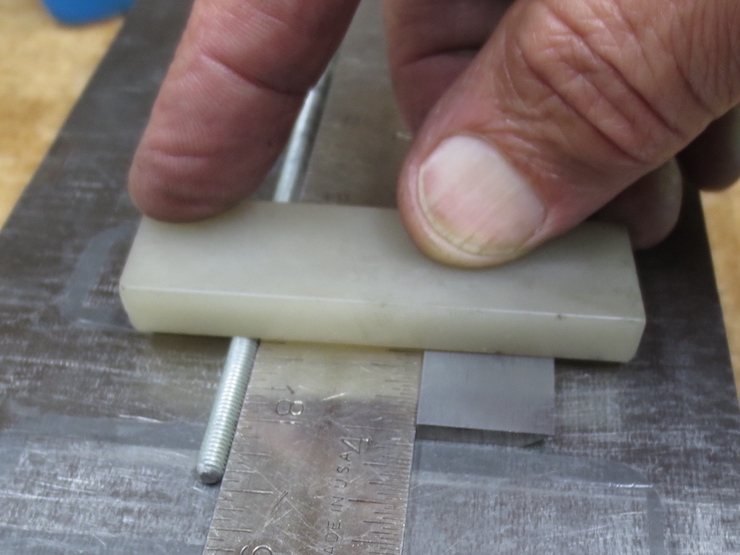
To remove the burr the knife is placed bevel side down. The magnetic base holds the knife, a 1″ wide rule and the 5/32″ rod firmly in place so this Arkansas slip stone can polish a very shallow micro bevel on the flat side of the knife to take off the burr. Few woodworkers will have access to a magnetic chuck. But I thought it deserved mention since it works so well.

A simple home-made dial indicator fixture which I use all the time. Three screws on the bottom establish a plane. A dial indicator mounted at one end measures vertically and one mounted at the other end measures horizontally in thousandths of inches. A magnet helps hold the fixture in place. I often place a weight on the top of the tool for this purpose, too.

The dial indicator is zeroed out on the out-feed table.

Then it can be moved over to set the knives at the same level.

#1 Season and Prepare Wood for Moulds, Deckles and Ribs

Mould Frame and Deckle Wood

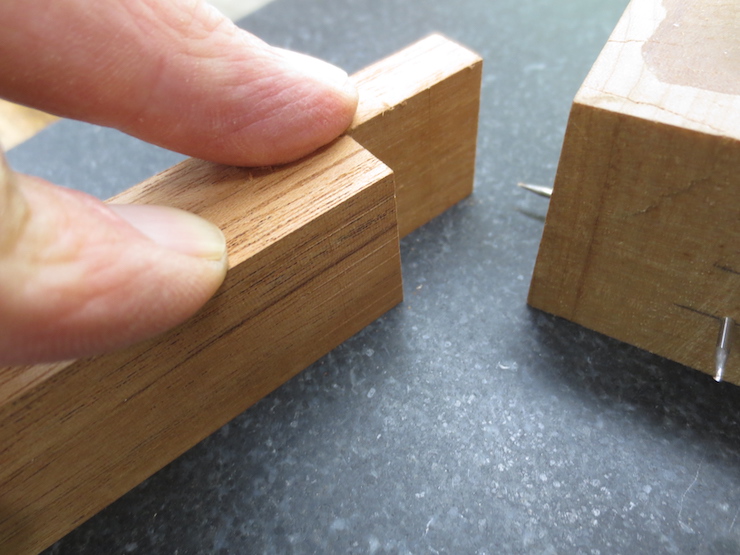
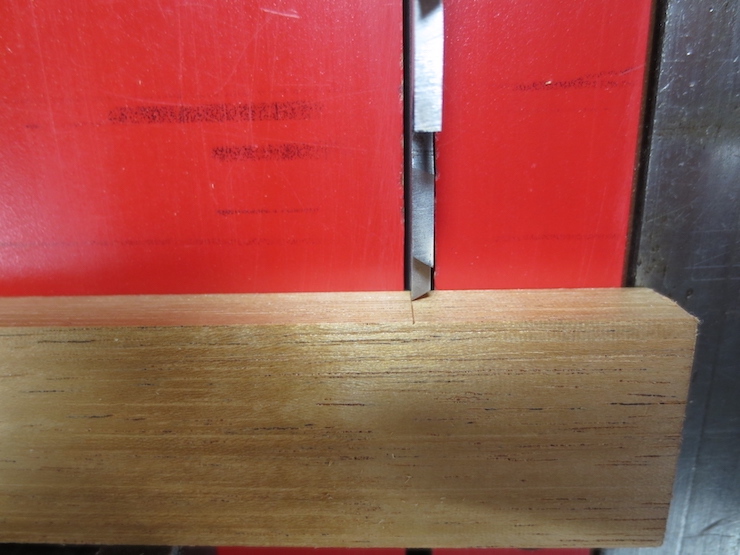
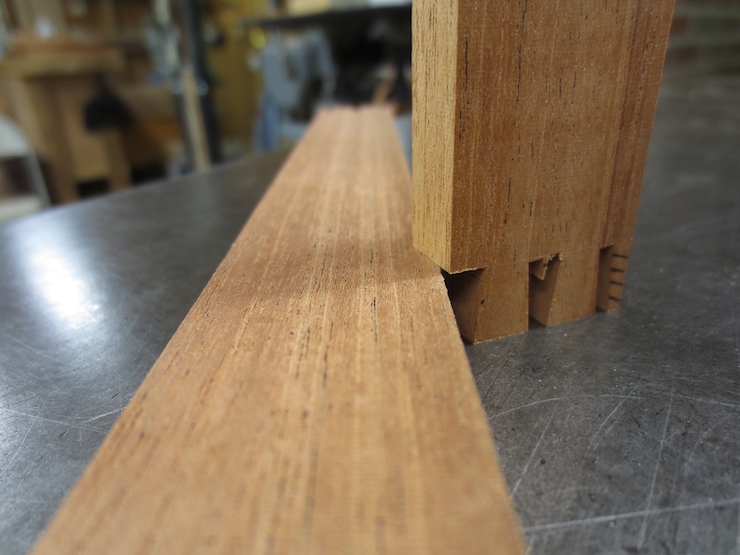
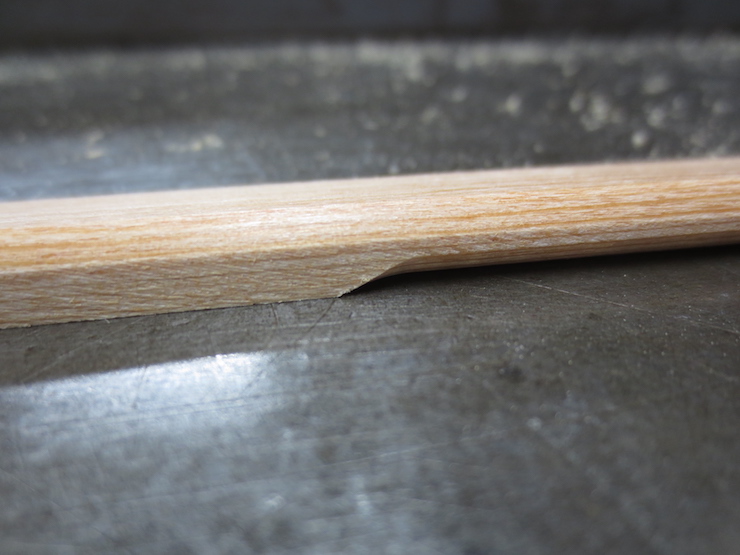
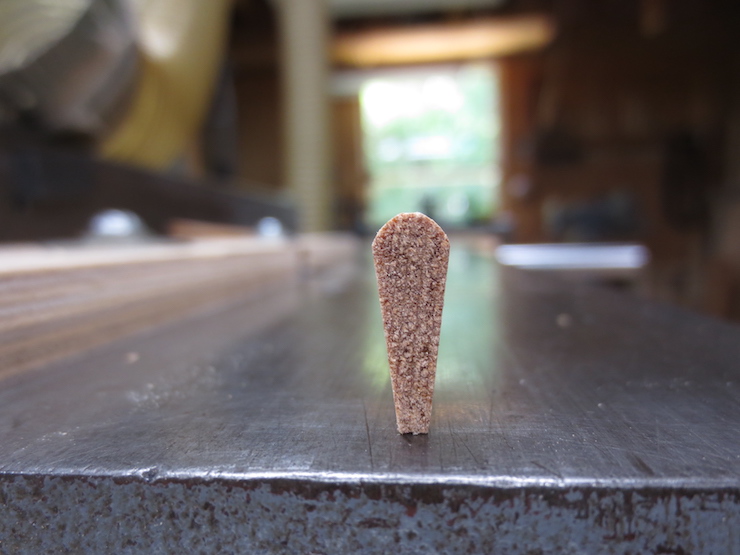
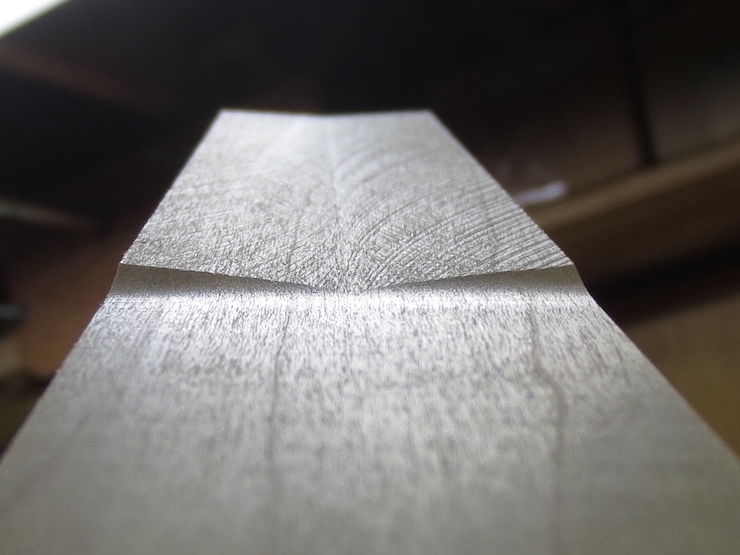
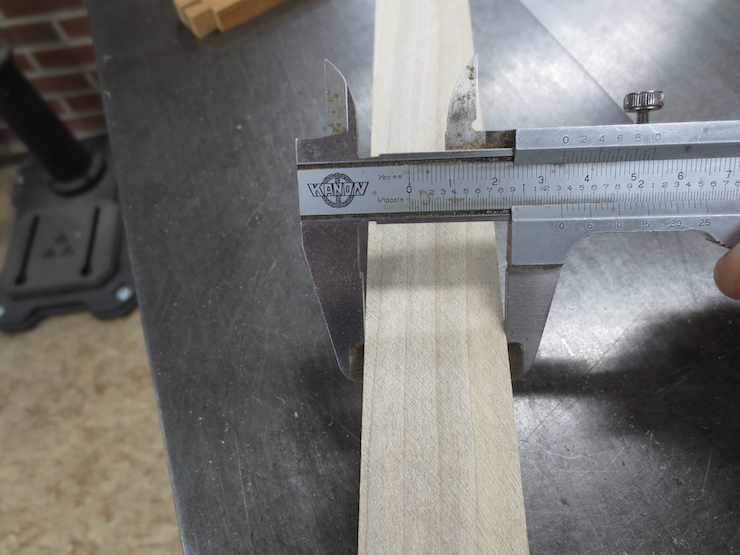
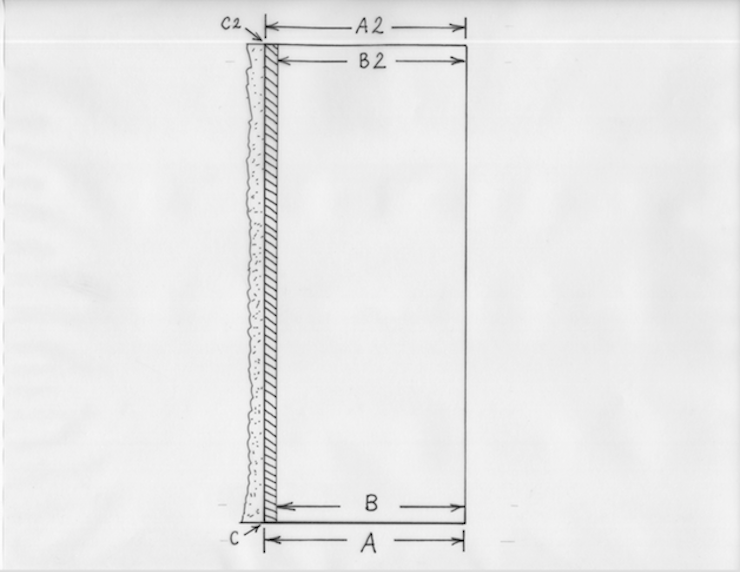
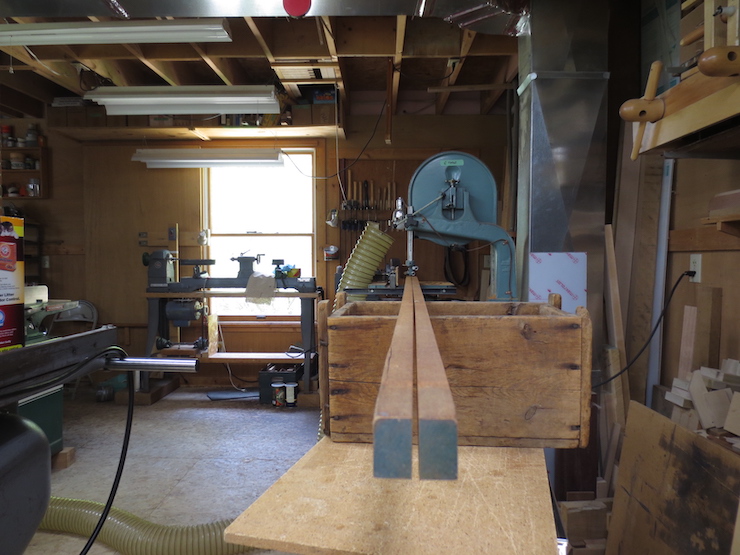
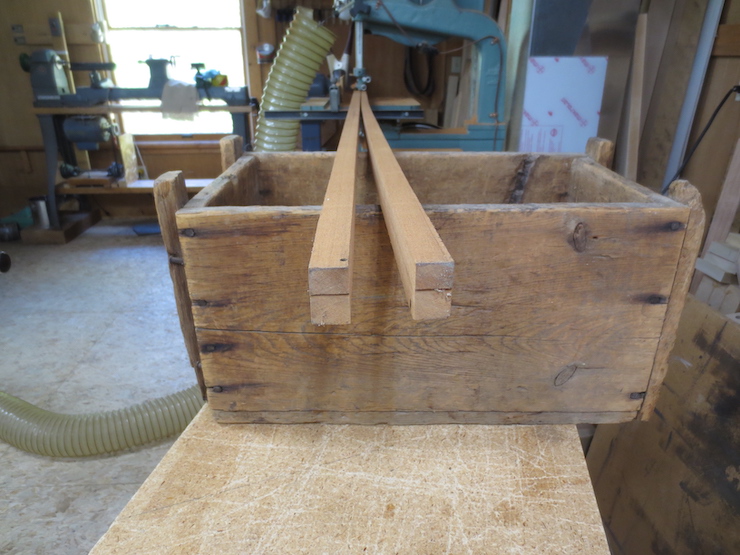
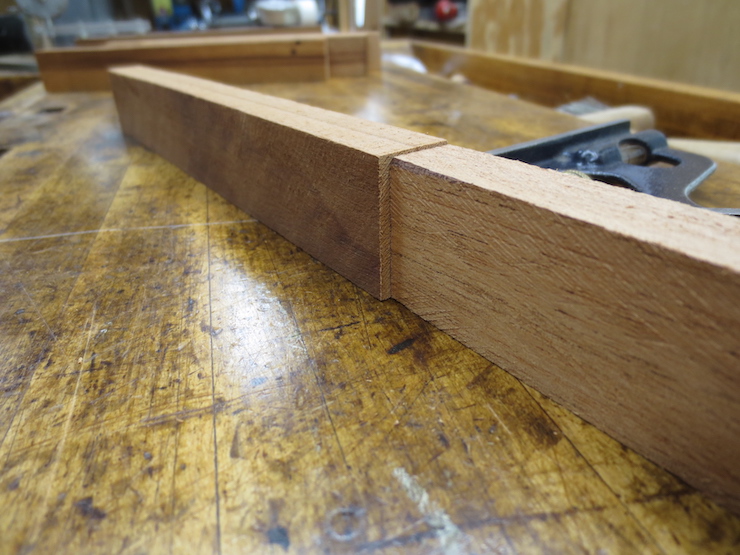
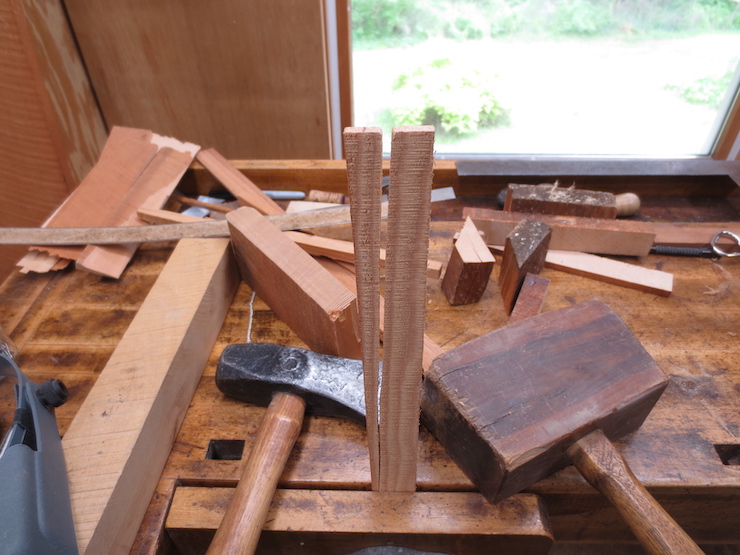
Wood usually contains internal stresses. If the trunk of a tree grows at an angle reaction wood will develop on the bottom or top to strengthen the tree. A windstorm may damage a tree causing different growth patterns, introducing internal tensions. Improperly drying wood can also introduce stresses. None of these are good for woodworkers. Most are not apparent until you begin to work with the wood. When it is sawed into narrower widths the release of internal tensions will usually cause wood to change shape. Sometimes this is very slight as shown above. If you are very lucky there is no discernible stress and the wood will hardly change at all.

This wood, originally from the same large plank, shows greater tensions being released. The wood I use is marketed as “Genuine Mahogany”. I don’t know the exact species. It is good for mould frames and deckles. It has little difference between tangential and radial shrinkage and swells relatively little when wet. And it is soft enough to receive brass and copper nails which is important for mould making.

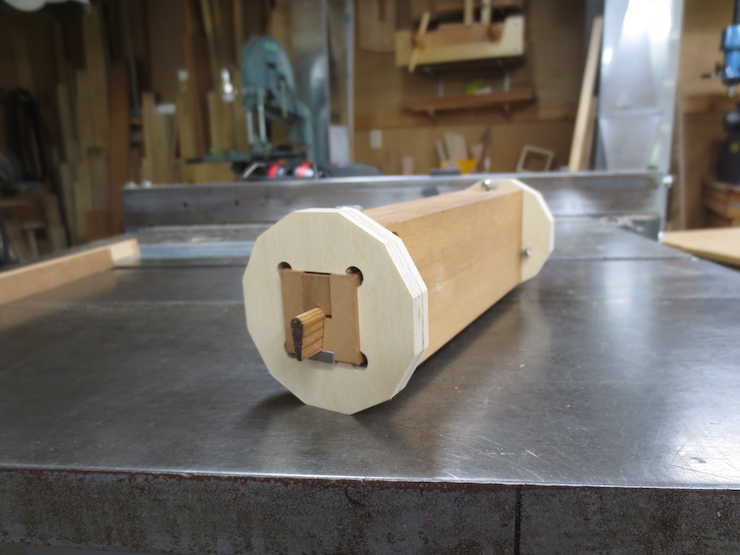
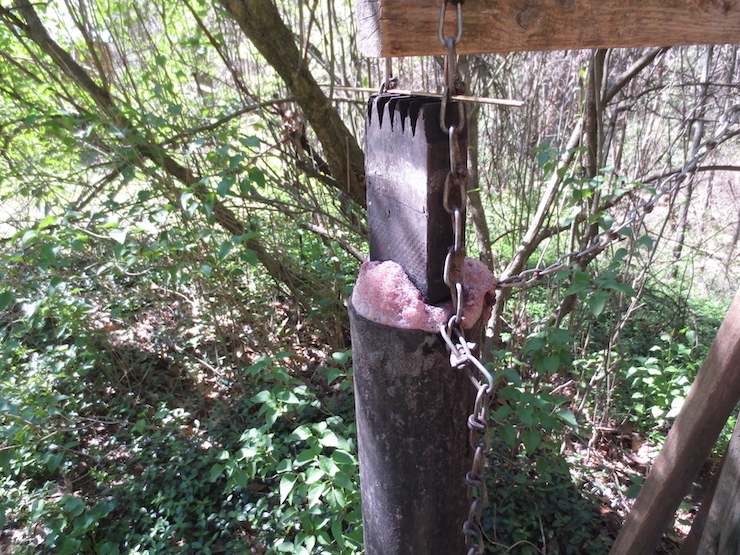
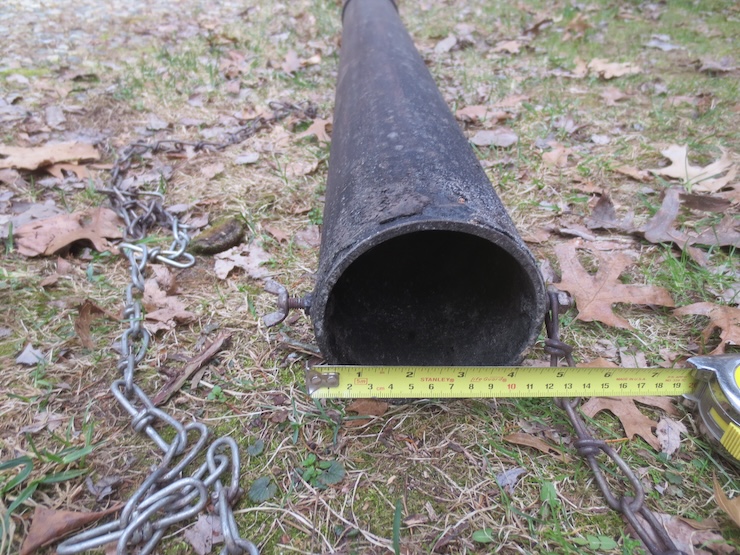
Boiling wood for mould parts helps to release stresses. Lignin, the substance that binds wood fibers together, softens with heat, allowing the fibers to shift slightly. This boiling tank is made from a 4″ diameter piece of iron pipe. The bottom end is threaded and bushings are screwed in place to reduce it so that a 110 volt water heater element can be screwed in. I bring the water to a boil with the wooden parts submerged then unplug it to let it rest for an hour or so. Then I bring it back to a boil before removing the wood. More information about the boil tank can be seen at the bottom of this post.

This also tests the wood. If the wood warps or twists badly it is not good for making moulds. If the wood barely changes you can be more confident that the wood will not warp or twist during the life of the paper mould. Many, many hours of work go into a mould, making it prudent to test and prepare the wood ahead of time. I prepare the frame and deckle wood in several steps. It gets boiled, allowed to dry, straightened (jointed, in woodworking parlance) and trimmed smaller. Later it is boiled and dried again and jointed and trimmed a second time. I sometimes add an extra boil for the L-shaped deckle stock. In the process you will get a good idea how the wood will behave and with luck gain confidence in it.

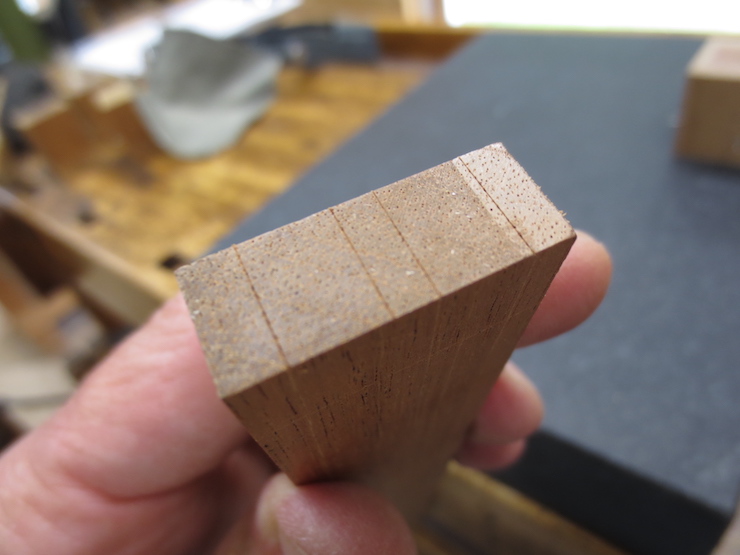
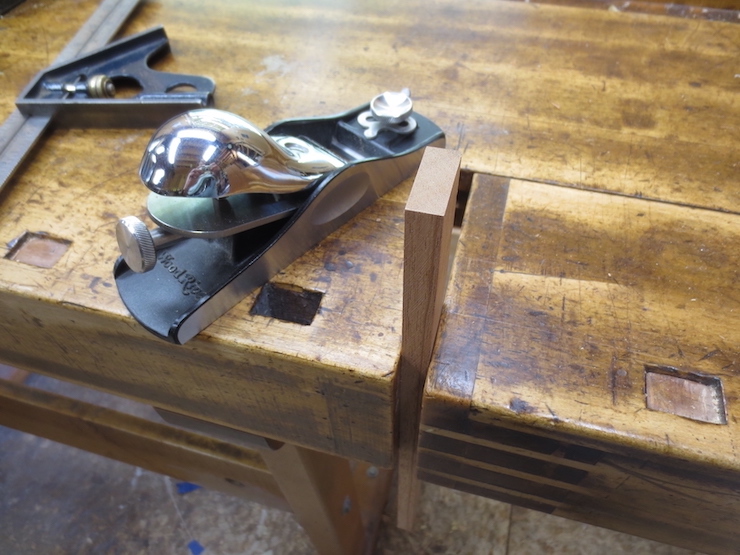
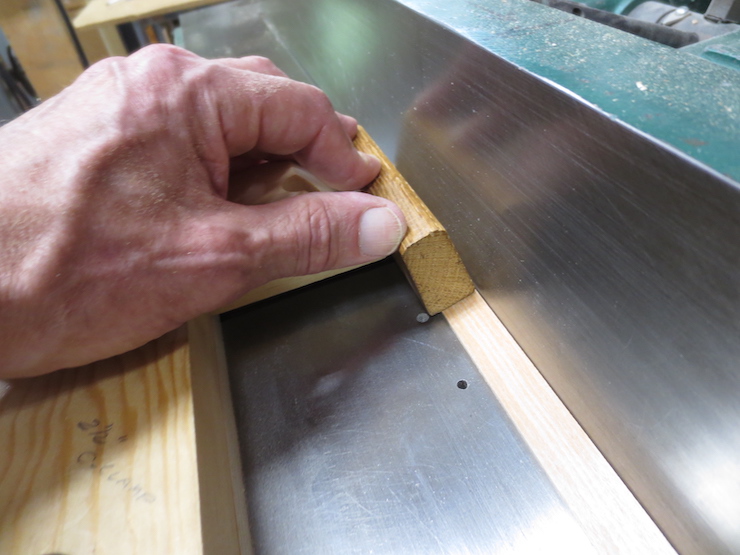
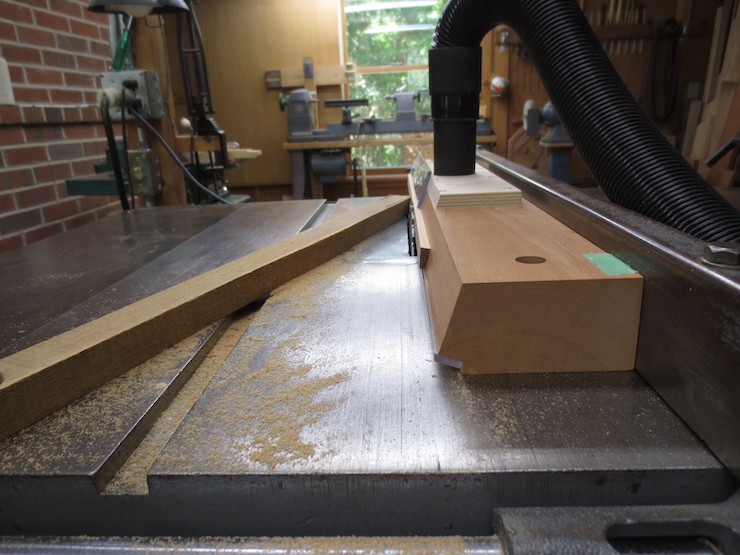
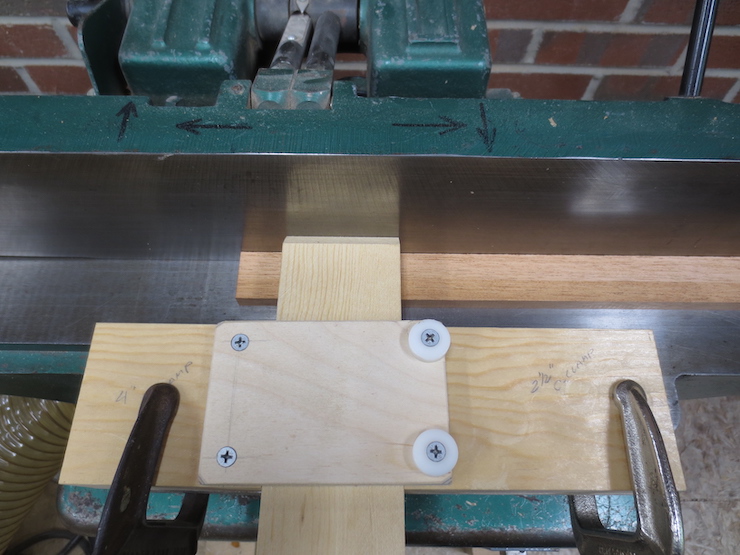
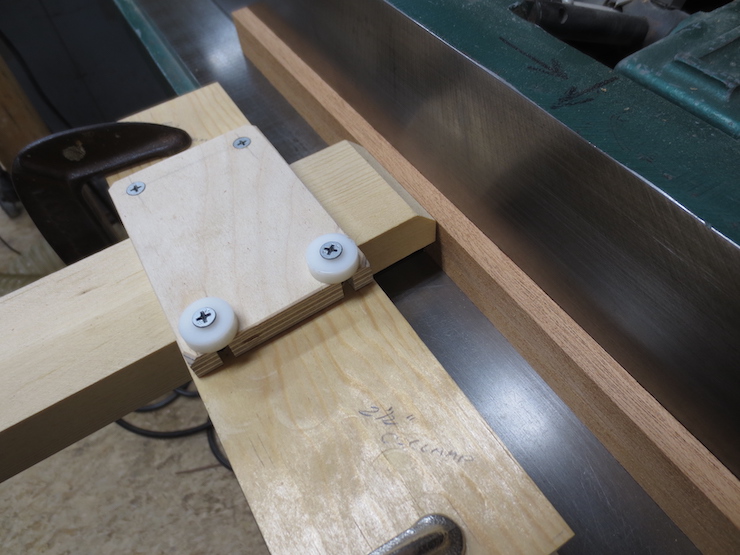
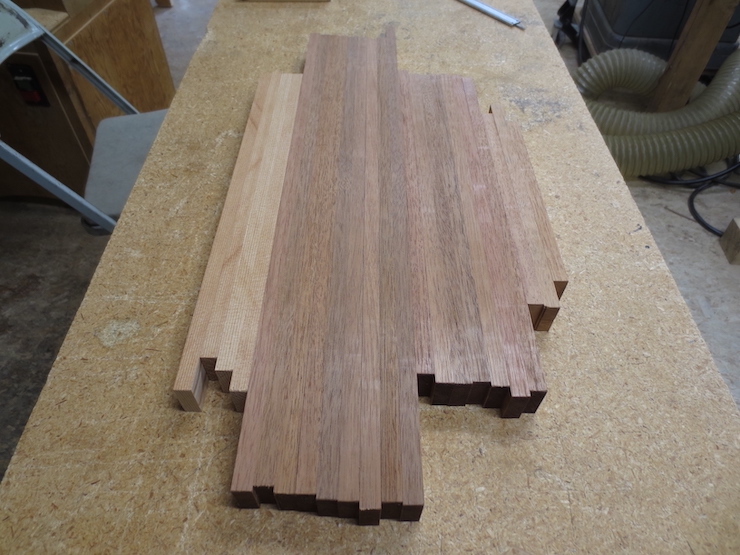
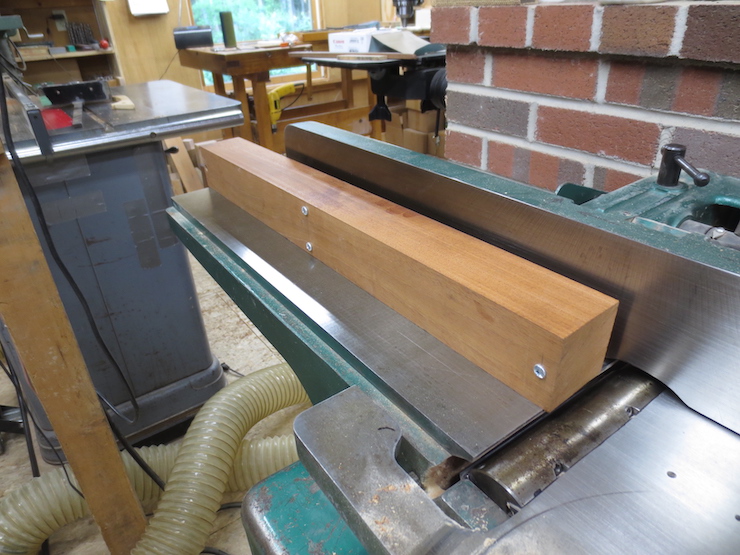
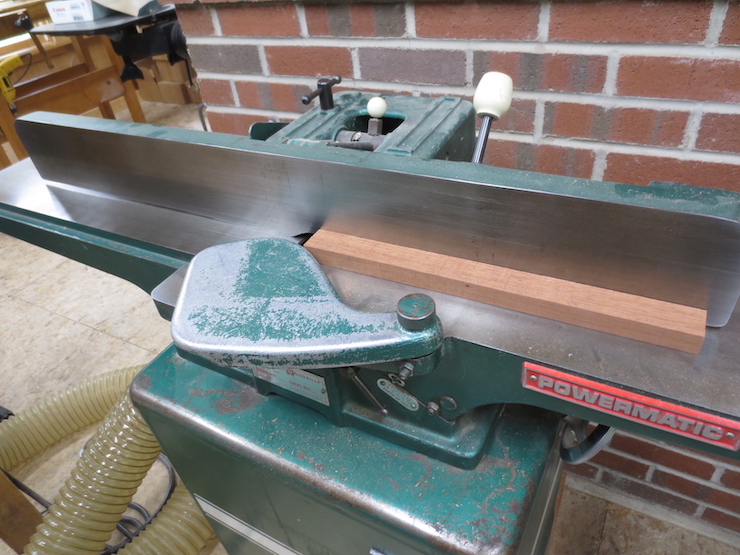
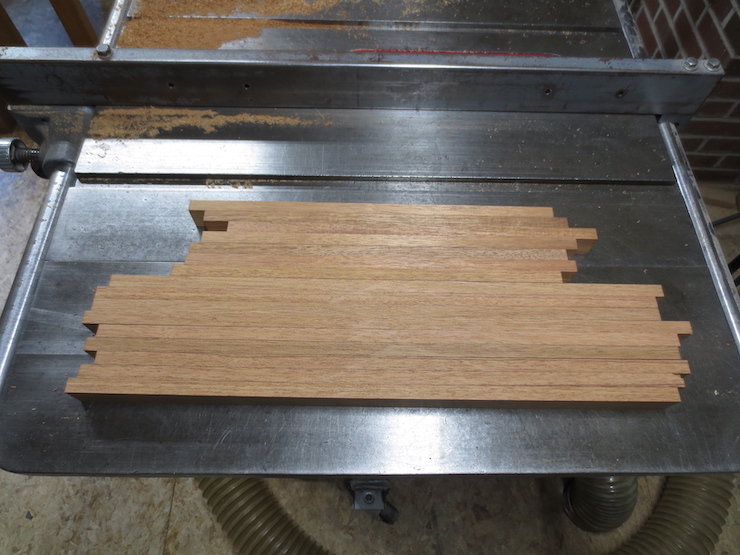
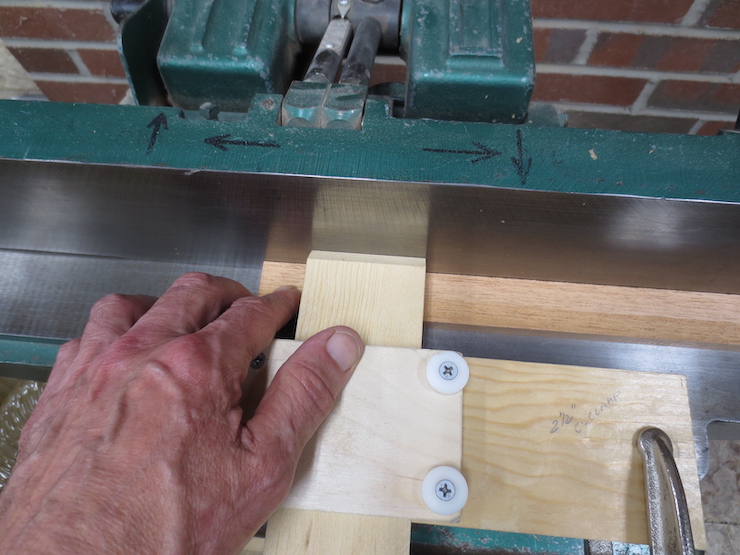
This wood has been boiled and allowed to dry. Two sides of the wood are now jointed (made straight) using a power jointer. This removes any warp or twist.

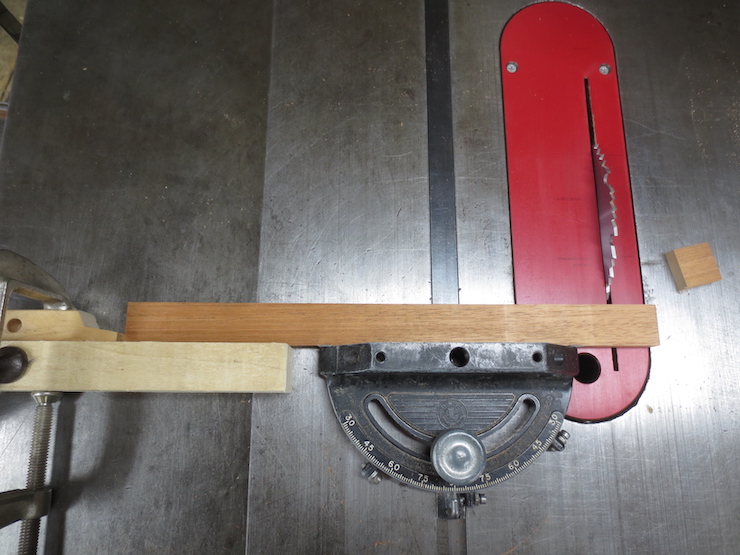
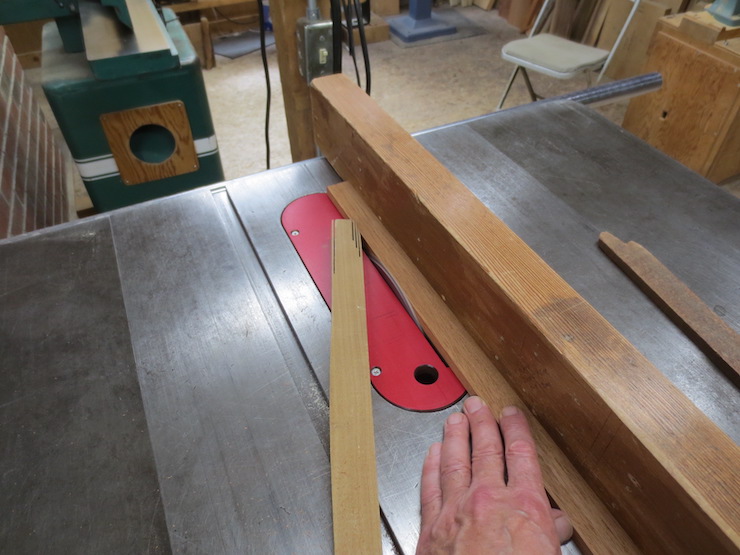
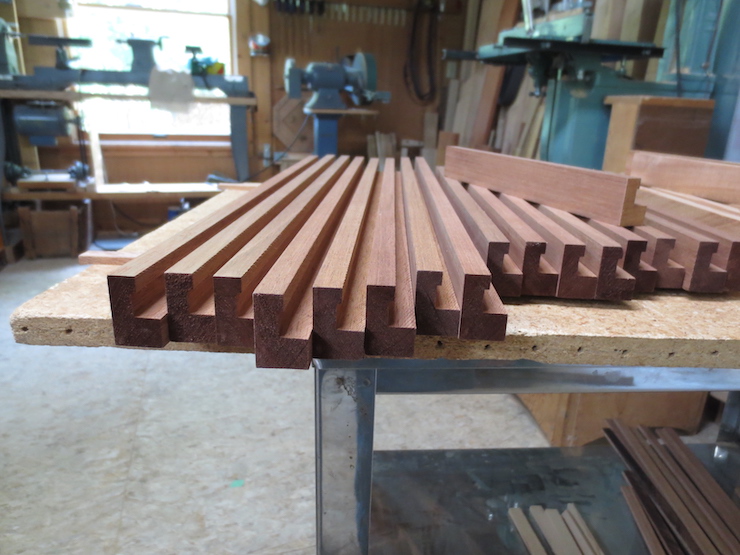
A tablesaw has been used to trim the other two sides parallel with the jointed sides. Thus the wood gets a little smaller with each step. The internal tensions are gradually reduced as the wooden parts get closer to their final dimensions. The time and work actually spent preparing wood this way is not great. However you must plan ahead a few weeks to allow for drying between steps.

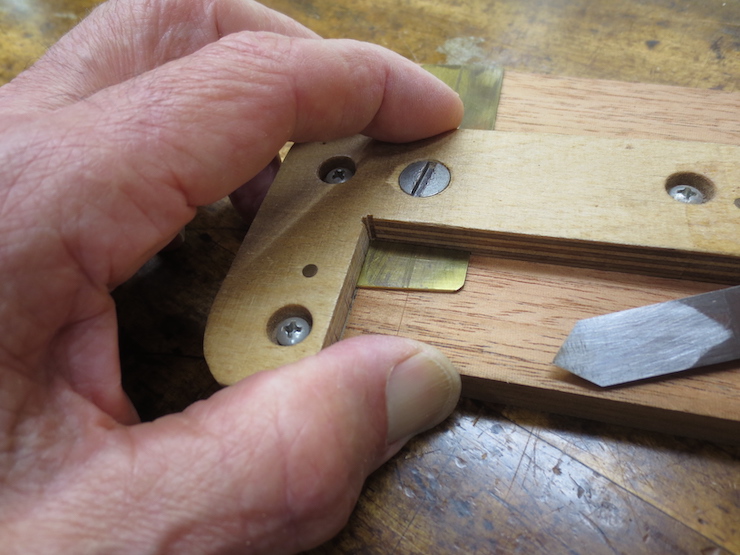
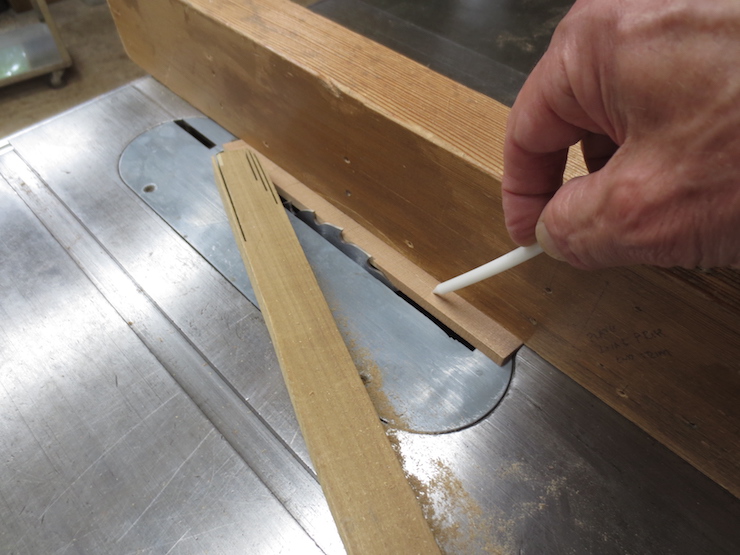
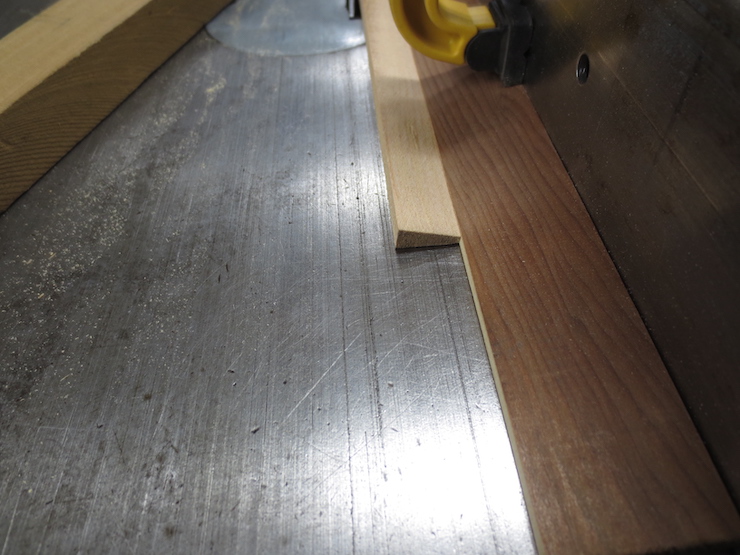
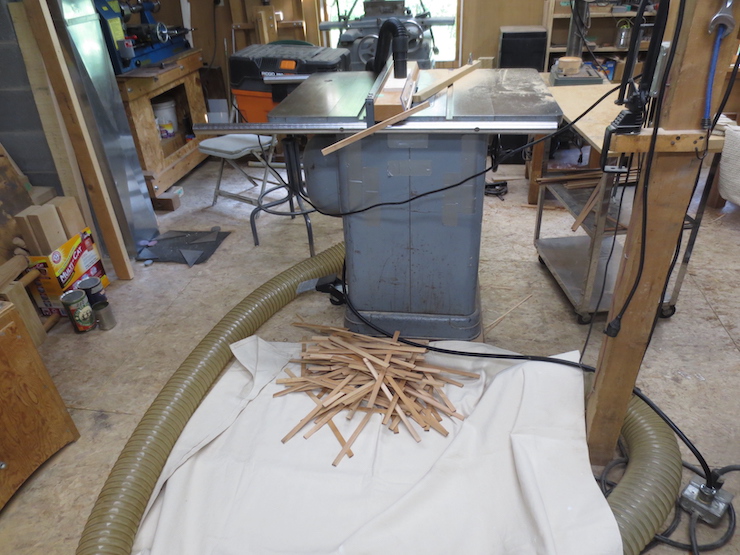
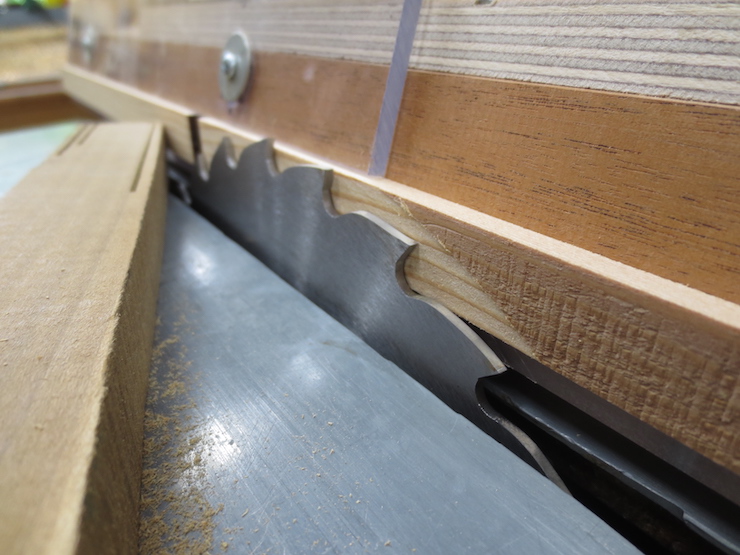
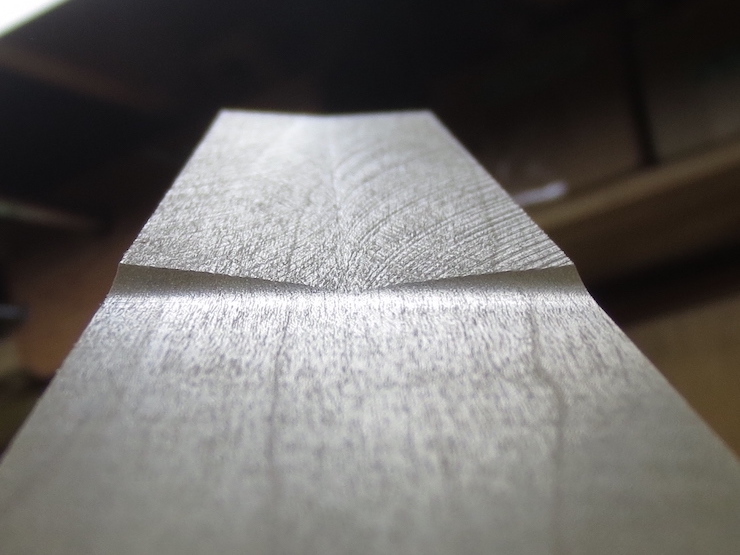
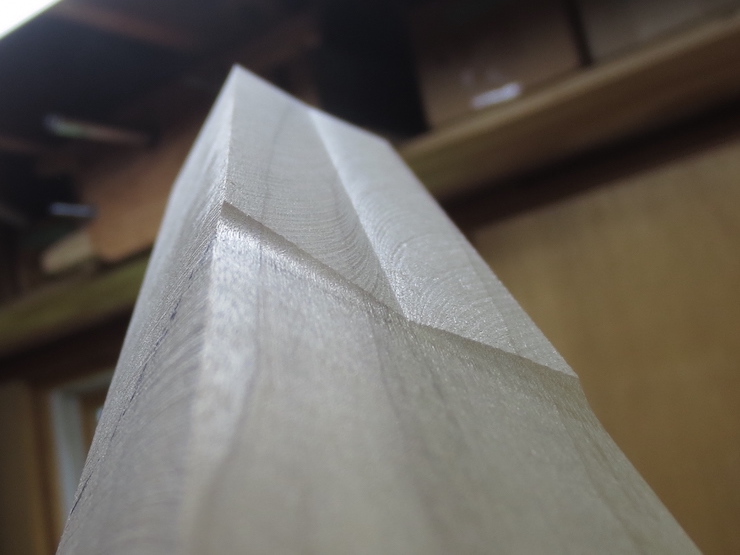
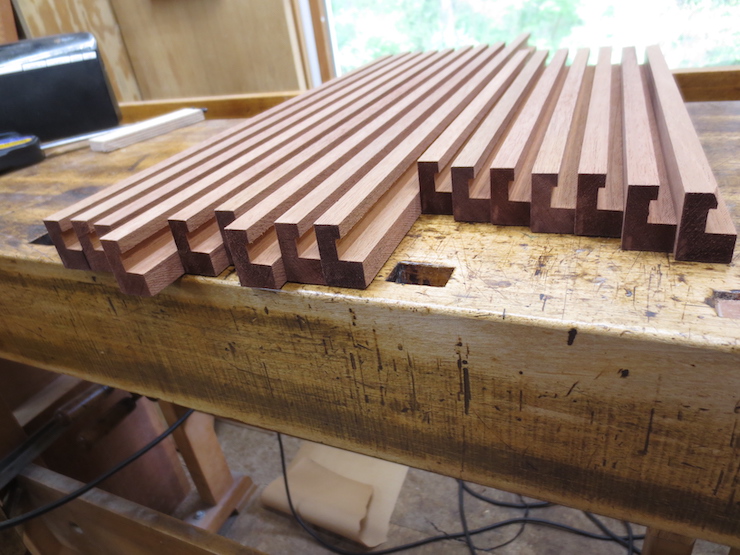
Deckle stock is prepared in the same way but it is shaped into a rough L cross section. In this photo the small scrap pieces that were sawn out remain very straight. This is a good indication that this wood is relatively stress-free.

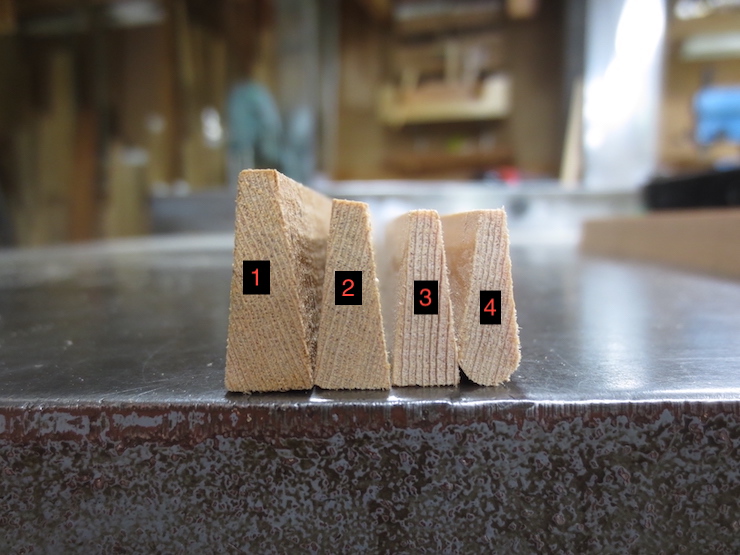
Here, the shape of the deckle has been further refined; very close to its final shape but still slightly oversized.

This frame stock has been boiled and straightened twice. After drying out fully it will be ready for final shaping. Now the wood is still only rough shaped! To become a paper mould it will be further shaped very precisely and with very sharp tools. This will be described in future posts.

Rib Wood

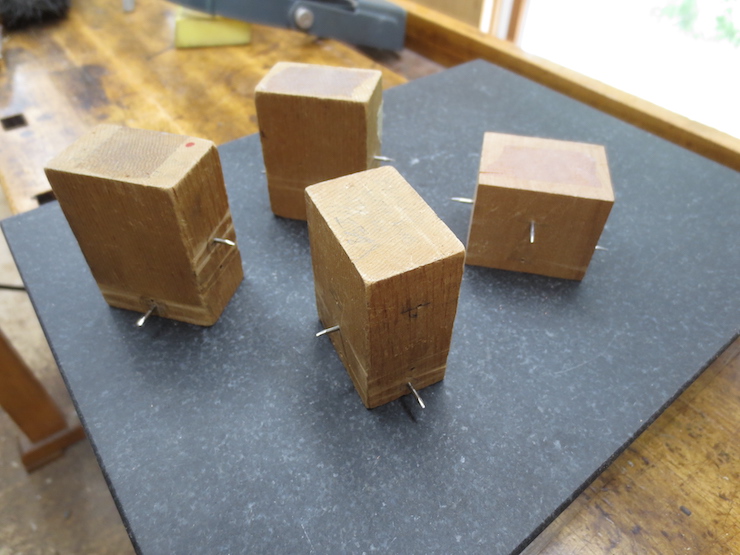
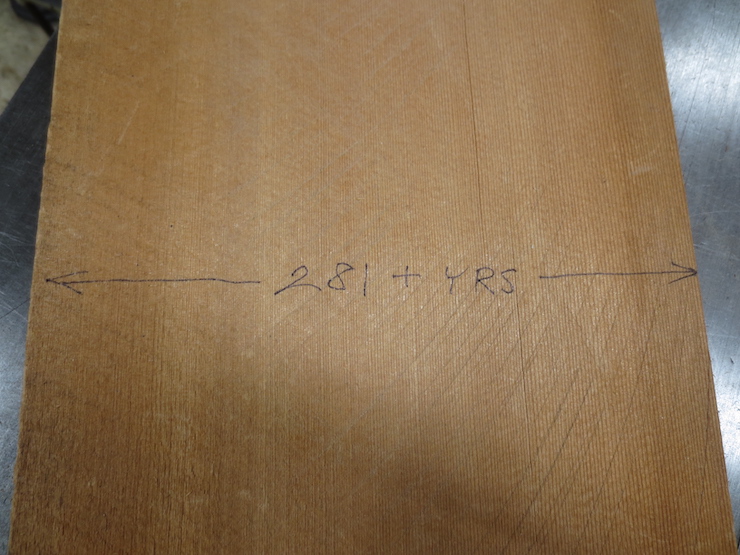
This is a plank of vertical grain Western Larch, a deciduous conifer also called Tamarack. I use this species for making ribs for moulds. I have Jim Croft to thank for this. He lived in Idaho where larch grows. He had it specially sawn for me with the growth rings in the ‘vertical’ orientation (approximately 90 degrees to the wide face). Larches can die and remain standing for many years without decaying. With the aid of my Optivisor and a pin I counted the rings. This tree was well over 300 years old when it died (the heart of the tree is not in this plank). It must have grown in a dense stand; the growth rings are miniscule. This makes great rib wood. Even with this old growth wood I use only the outer, finest grained wood for ribs. (I am spoiled). I feel a little guilty cutting it up into little pieces. Before Jim provided larch I would comb through stacks of clear white pine at my local lumber yard looking for perfect boards.

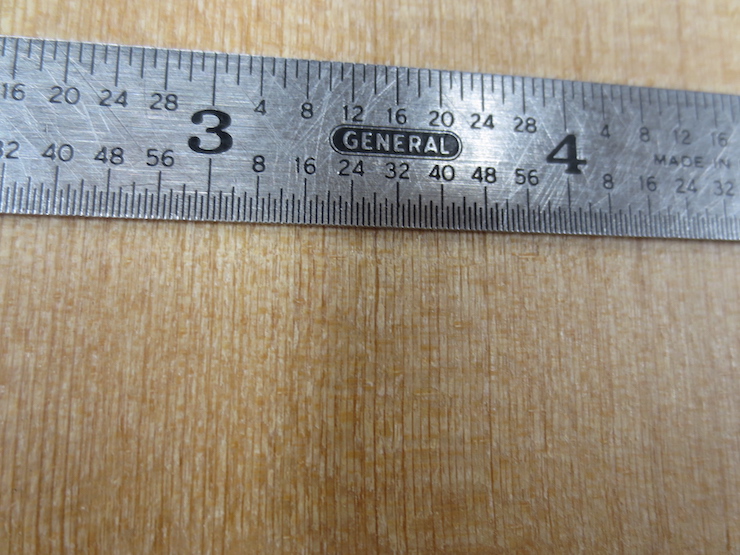
This tree only gained about 1/32″ to 1/16″ in diameter per year! As a result of growing so slowly and in a dense stand this wood has practically no internal stress.

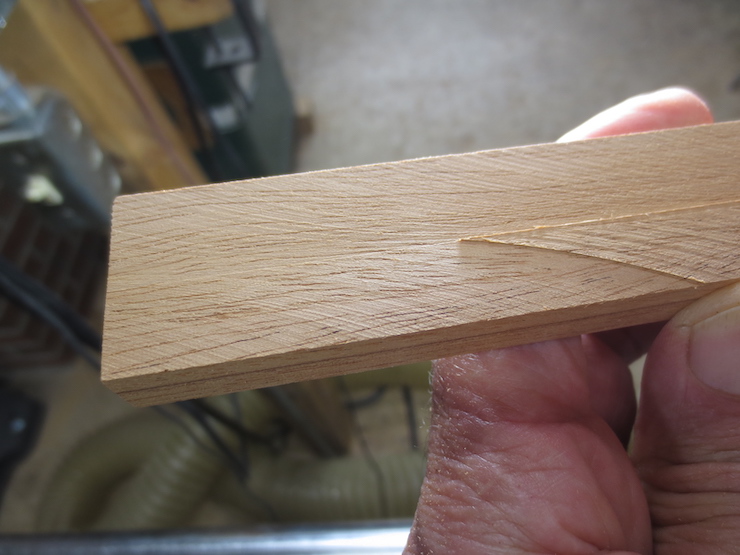
It is easy to see if a vertical grain plank has been sawn parallel to the growth rings. It is harder to tell if it has been sawn parallel to the trunk in the other orientation. Here I have split a scrap of the plank and found grain ‘run-out’. This is best avoided for delicate paper mould ribs. I will re-saw narrow sections of this plank to eliminate the run-out before sawing out the tapered ribs.

Here the wood has been re-sawn to eliminate the run-out. This piece had a crack that shows the orientation of the grain. I drew a line to accentuate this. The cracked part won’t be used for ribs; there is solid wood on the other side and the other blanks had no cracks.

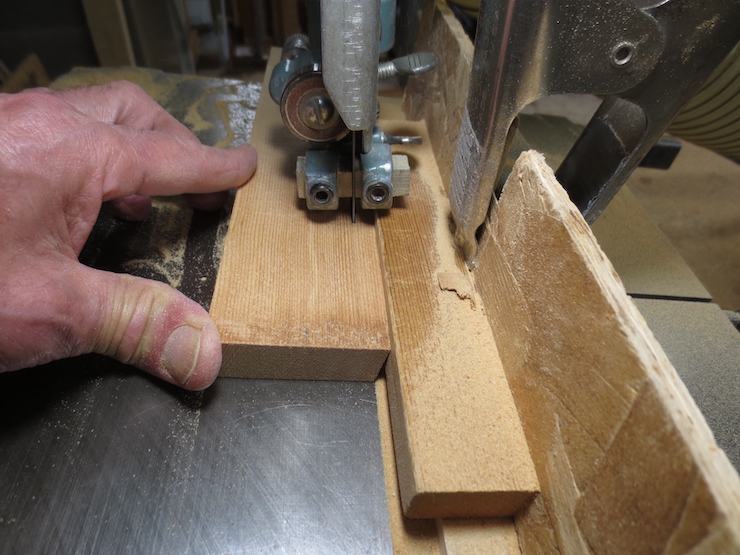
The prepared blanks are sawn into tapered rib shaped pieces. I cut these pretty close to final dimension since the wood is so stable.

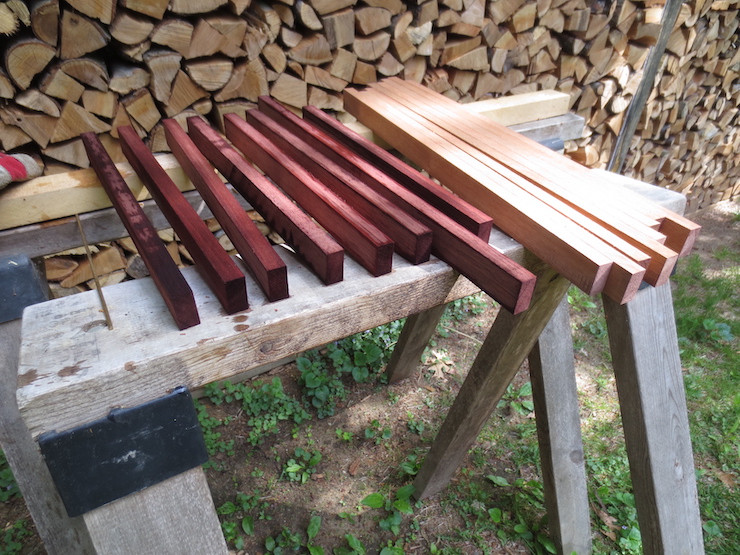
Rib stock for a couple of moulds. In Britain these are called bars but I have always called them ribs.

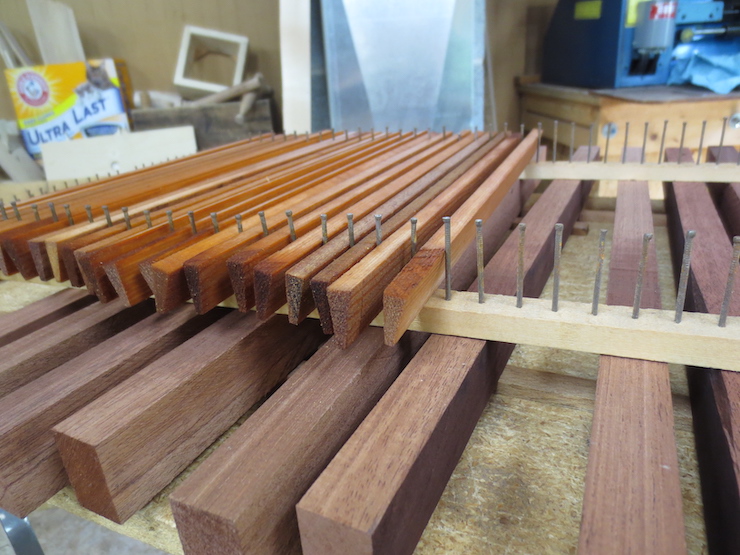
Rib stock only gets boiled once, just to test for warp and twist. This wood turned out great. After boiling I stack the pieces so that air can circulate all around.

Boil Tank

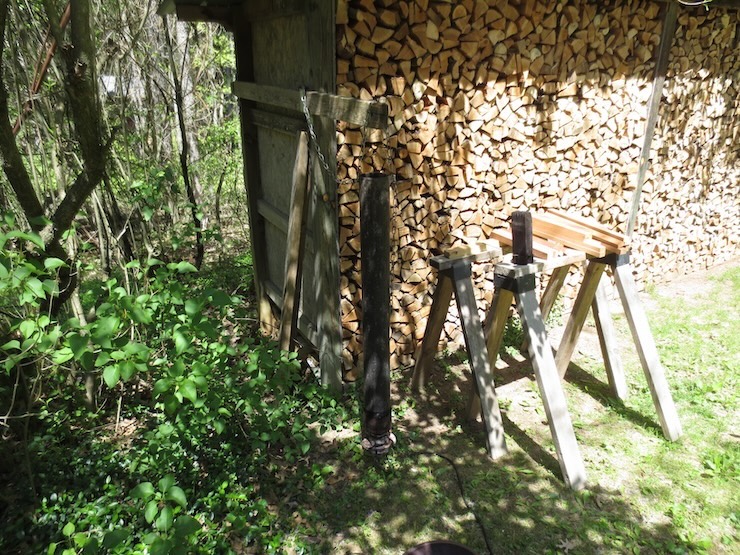
Here the boil tank is hung from a suitable brace outdoors. The tank is heavy. I have boiled wood indoors but the tank can boil over and make a mess. For safety always unplug the cord before touching the tank when loading or removing wood or adding water to it. If the tank is neglected and boils dry the wood will be scorched and the heating element will fail and need to be replaced.

The mould wood is held down by this block.

A rod holds it down so the buoyant mould wood stays submerged.

To make the tank a piece of 4″ cast iron pipe was purchased with threads cut on one end. A connector was threaded onto that end. A pair of bushings reduce the diameter of the threaded hole to a 1″ NPT (National Pipe Taper) internal thread to fit this standard 120 volt water heater element. A drain fitting was installed at the bottom of the tank. Make the tank longer than the longest piece of mould wood that you will use.
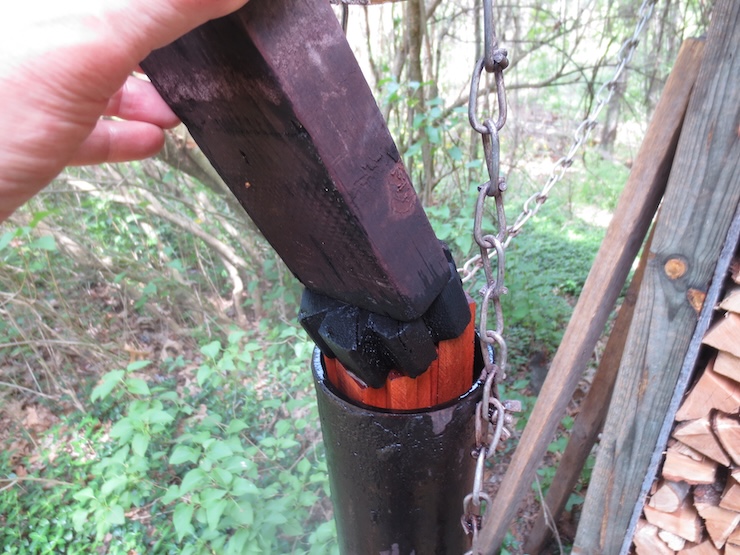
This pipe has a 4″ interior dimension. The pipe was drilled for two threaded studs which are used to hang the tank with chain.

#20 Making Laid Facings

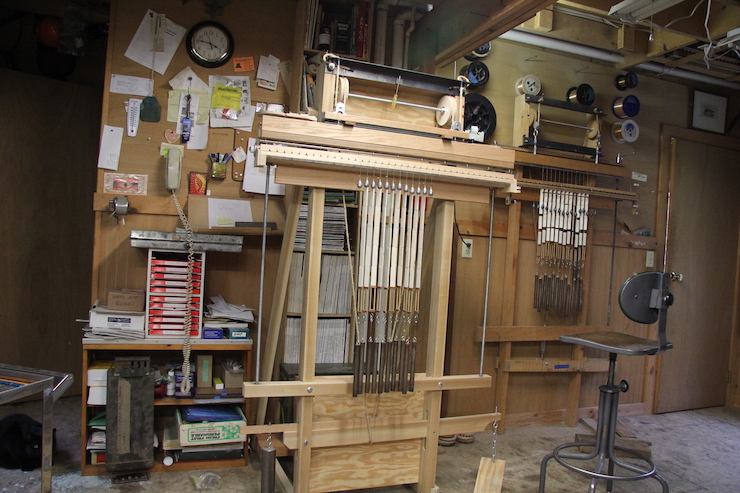
For a detailed look at how this loom functions go this site: paper.lib.uiowa.edu/epm*. Here you will find an extensive list of related internet links. Near the bottom of the list select “Z3”. It will take you to a video that I made of the process of making a laid facing on this loom. The quality of the video is not great but it was the best way I could think of to explain the workings of the loom.

*This is a companion website to the book “European Hand Papermaking” by Timothy D. Barrett. It is published by The Legacy Press (www.thelegacypress.com). The book includes an appendix on mould making that I contributed.
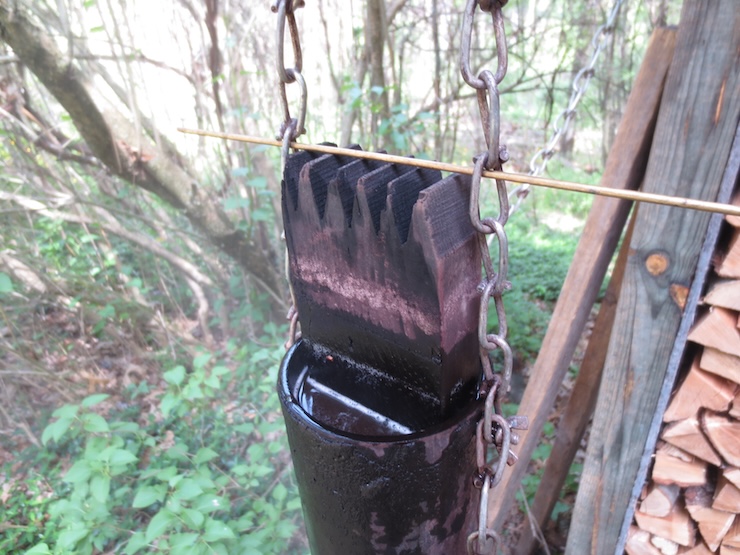
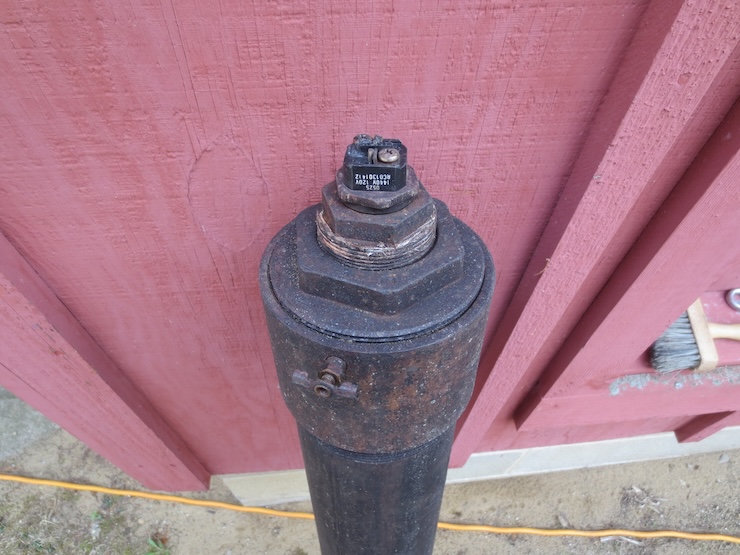
Photo by James Kleiner

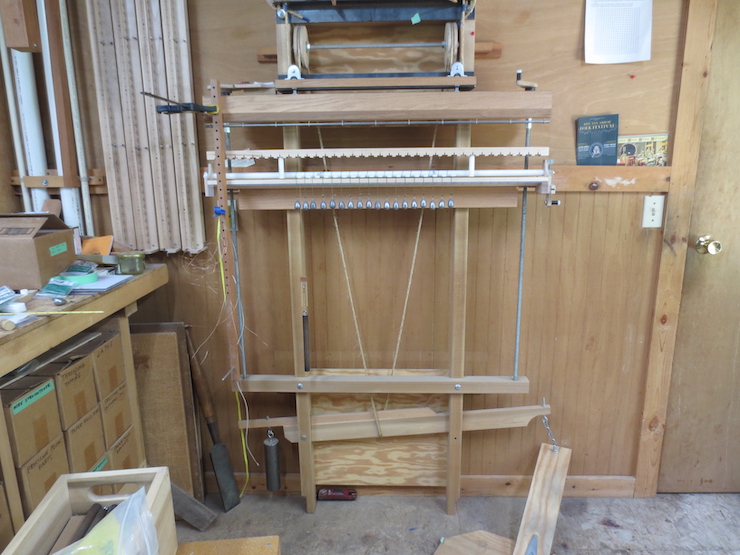
In the foreground is my current loom which I made in 2011. In the back is the original loom which I used throughout the main part of my career making moulds; 1982-2012. The new loom incorporates many improvements though both work on the same principles.

Chain wire is measured out for setting up the loom.

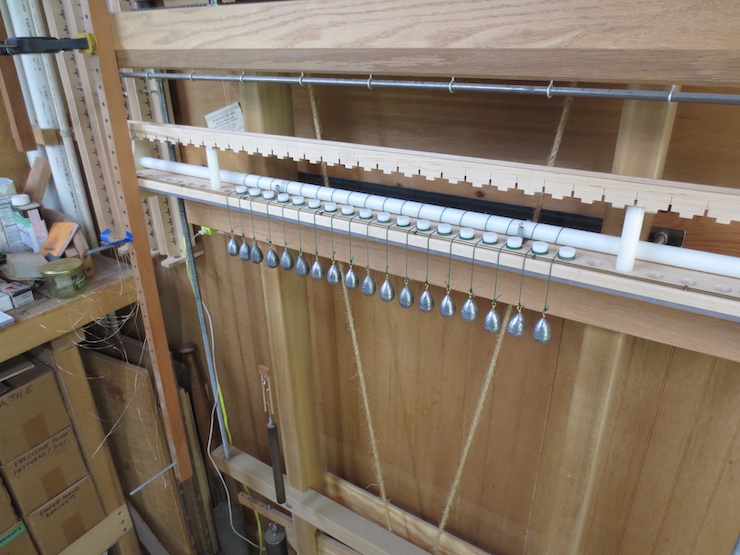
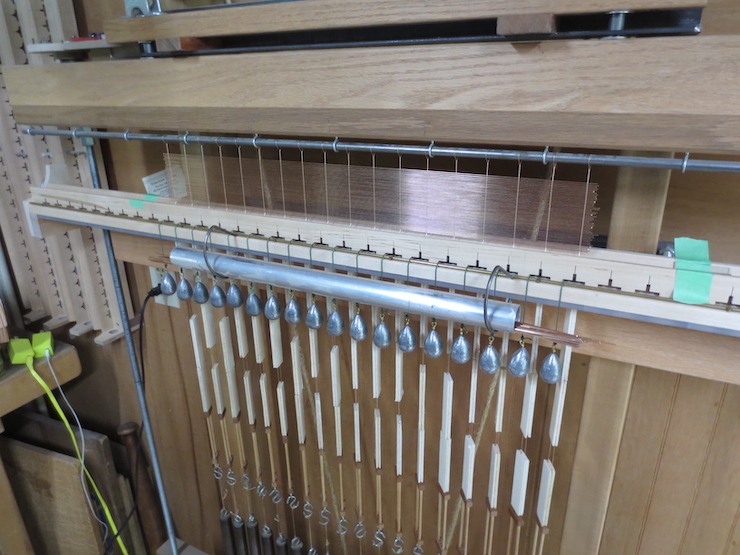
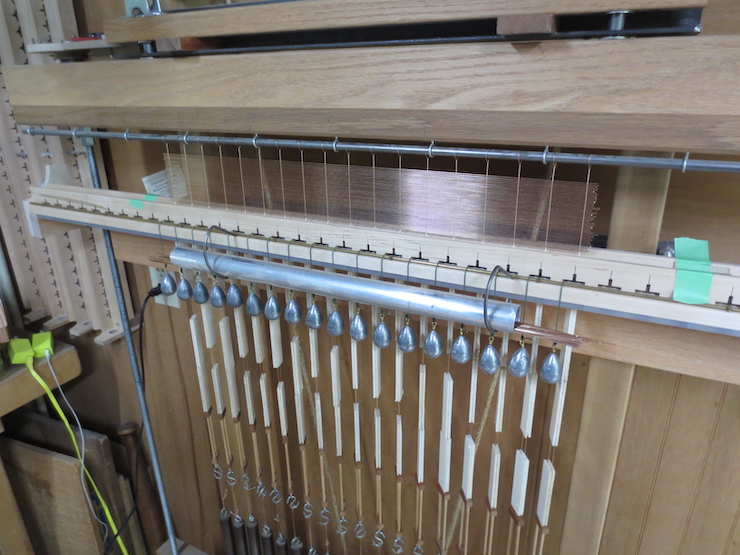
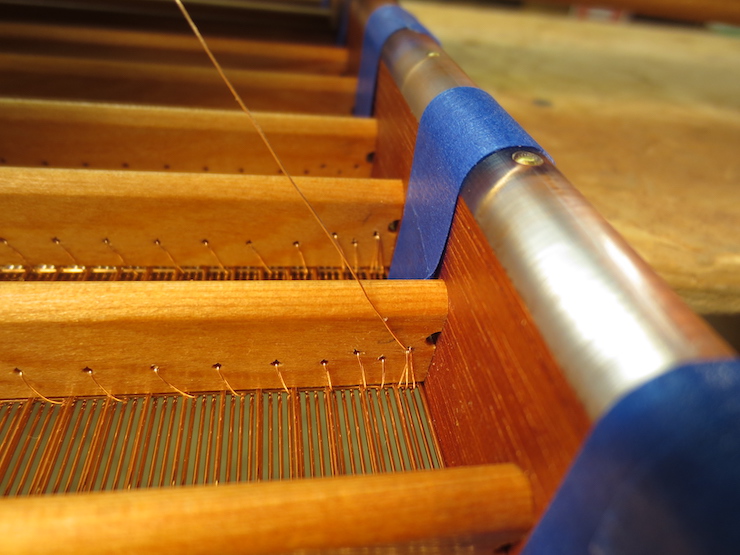
Each length of chain wire is draped over the steel rod visible along the top of the photo. The wire’s ends pass through a slot in the wooden wire trough and down through a pair of holes in a plastic spindle. Then they pass through holes in a ‘wire slide’ and are secured by twisting the ends tightly together. A one pound weight is attached at the bottom to hold each wire taut. (Later each wire will become a ‘pair’ as the two halves are twisted. They resemble tiny chains as they twist around the laid wires, thus the name).

Setting up the loom involves adding a weighted wire for each of the spindles. The length of the wire and number and spacing of spindles varies depending on the size of mould being made.

The wooden ‘wire trough’ has been elevated while the loom is being strung up. In use the trough covers the spindles. The spindles are driven clockwise as the weights are reeled in by a crank. The weighted cords slip as they are unreeled so the spindles do not reverse direction.

Foam board spacers have been added to separate the wires below the twisting mechanism and a couple dozen laid wires have been added, partially completing this facing. Each time a laid wire is added a crank turns all of the weighted spindles simultaneously, twisting the chain wire pairs 1/2 turn. This action incorporates one laid wire into the facing. Next, a different crank is turned to lower the entire twisting mechanism (spindles, weights, wire trough etc.) a specific amount, the measure of one laid wire and one space. These steps are repeated over and over until the laid facing is complete. The video gives a clearer idea of how this works.

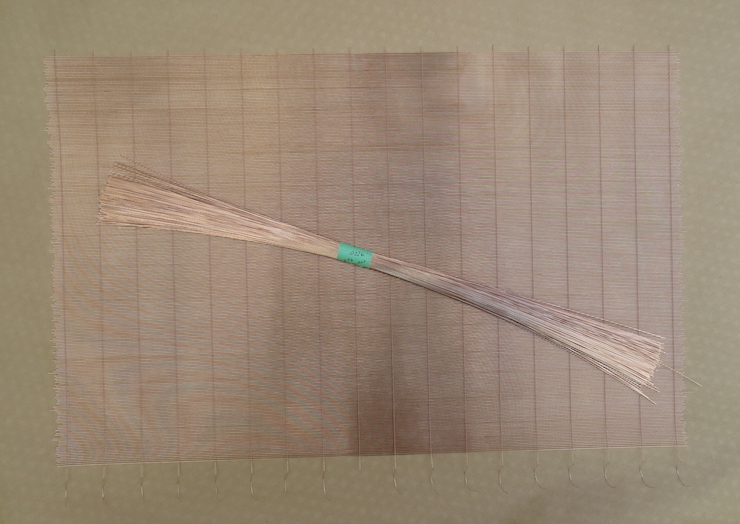
This facing is complete. A bundle of laid wires is shown which will be made into another facing.

This facing has been cut off the loom. It will become part of a mould being documented for this sequence of posts. Laid backing wire will be covered in a later post. More later!

#19 Straightening Paper Mould Laid Wires

I am leaving the original text in place but commenting in bold text to update the information. I have recently straightened all of my different sizes of laid wire using only one bank of rollers to remove the cast. All of the wires were straight enough for making laid facings for moulds.

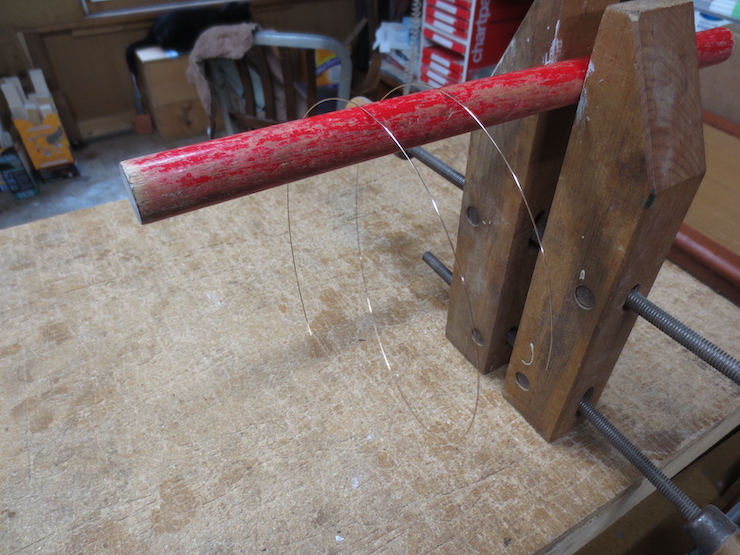
Wire can be purchased in coils or on spools. In either case the wire comes off curved. In order to make a laid paper mould facing or backing it is necessary to make it much straighter.

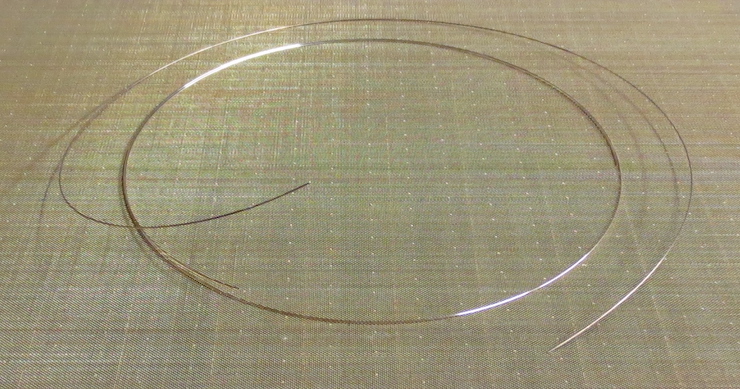
Above, a piece of .0226″ diameter 1/2 hard phosphor bronze wire right off the spool resting on some of the same wire that has been run through a straightener and cut into lengths. While not perfectly straight, the processed wires can be made into a laid facing.

The major curve of the wire is called ‘cast’. This corresponds roughly to the diameter of the spool or coil. Another way that the wire is curved is called ‘helix’. The helix can vary, from very slight as shown above, or very steep as shown below. This extremely steep helix (below) was from a very small spool of hard (spring) wire and would likely be unusable if only the cast were removed. I now purchase only 1/2 hard wire for making laid wires and it comes on large spools. I believe that the combination of softer wire on a large spool makes it more likely to work well even if no attempt is made to remove the helical part of the curve.

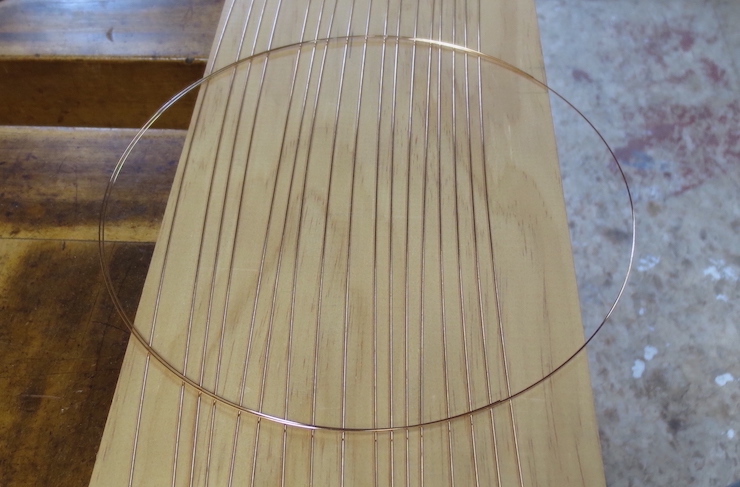
The same two pieces laying flat. The smaller circle of wire is the 1/2 hard wire mentioned above, while the larger circle is spring tempered wire of the same diameter. This wire has a more pronounced helix shape and won’t lay as flat.

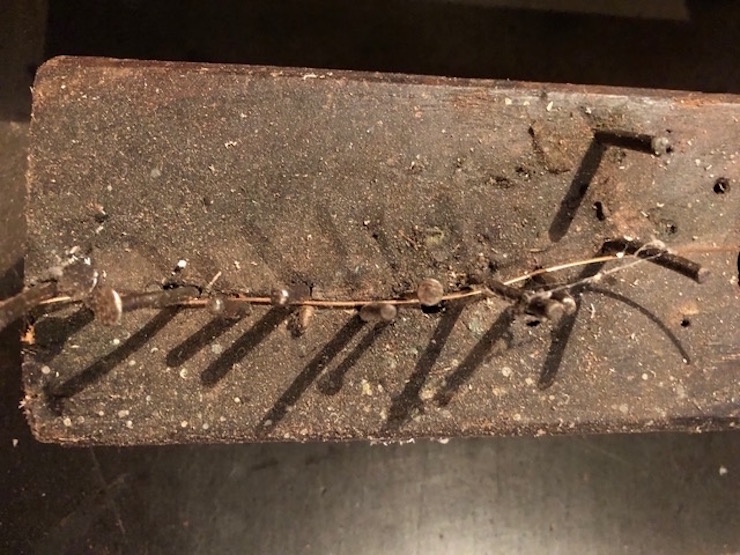
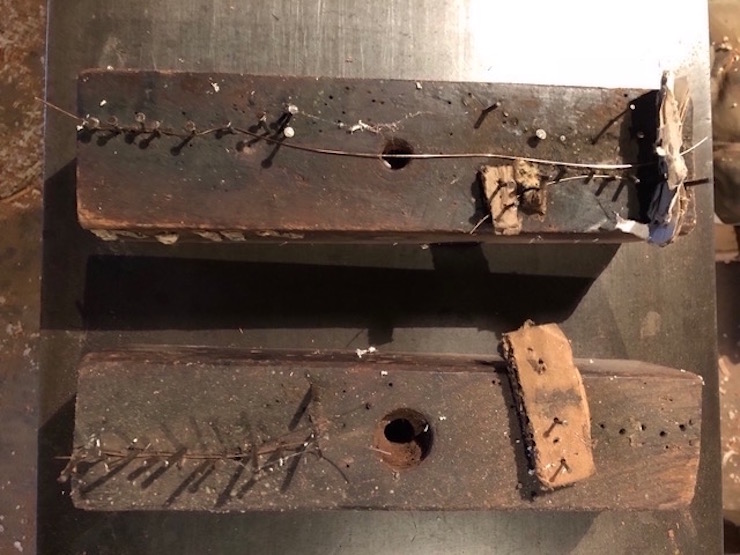
A traditional way to straighten wire. The wire straightening blocks above and below are from Ron Macdonald’s collection of tools. These photos were given to me by Serge Pirard who studied with Ron and made moulds using many of Ron’s tools.

I tried to straighten wire this way but soon gave up! In the two photos above it seems evident that only the cast is being removed.

Above and below are photos sent to me by Sergey Nasaev of Russia.

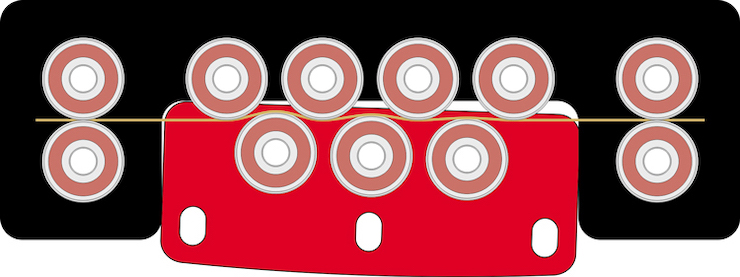
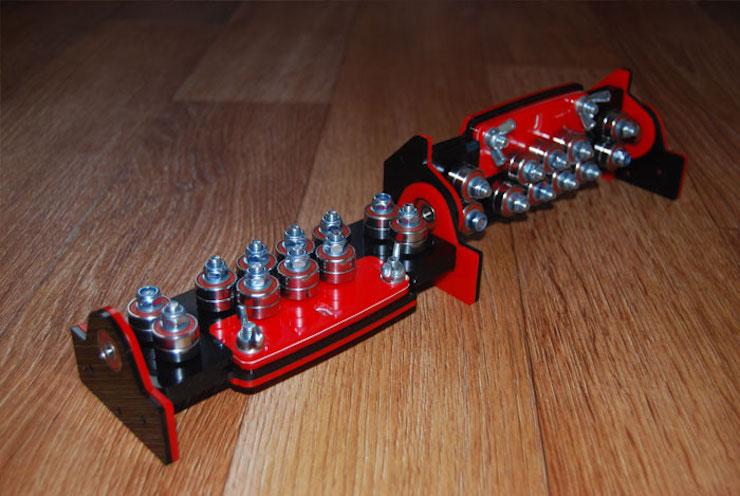
This is the wire straightener that I made using the information sent to me by Sergey. Ball bearings are stacked in pairs to create grooves which guide the wire back and forth to remove the cast. I expected that the wires should come out almost perfectly straight, like the pre-straightened wire I had been using for years. So, I was a little frustrated at first when the wires weren’t as straight. In retrospect this turns out not to be necessary or even desirable. If you try to make perfectly straight wires this way you may go crazy!

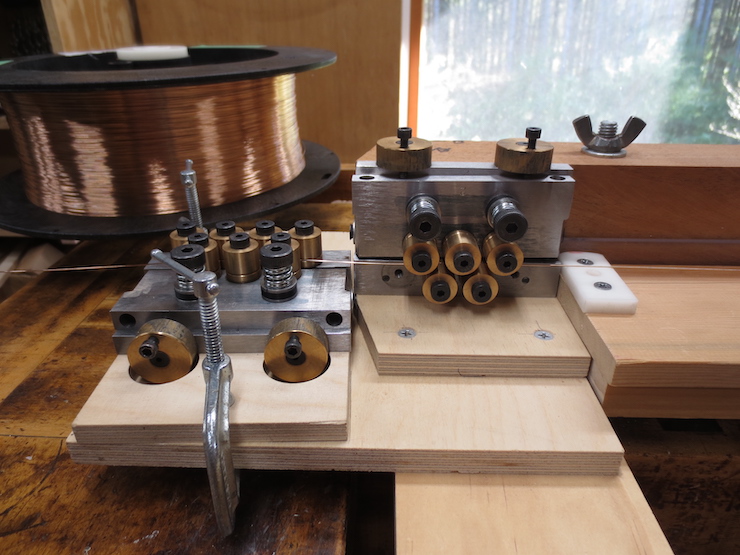
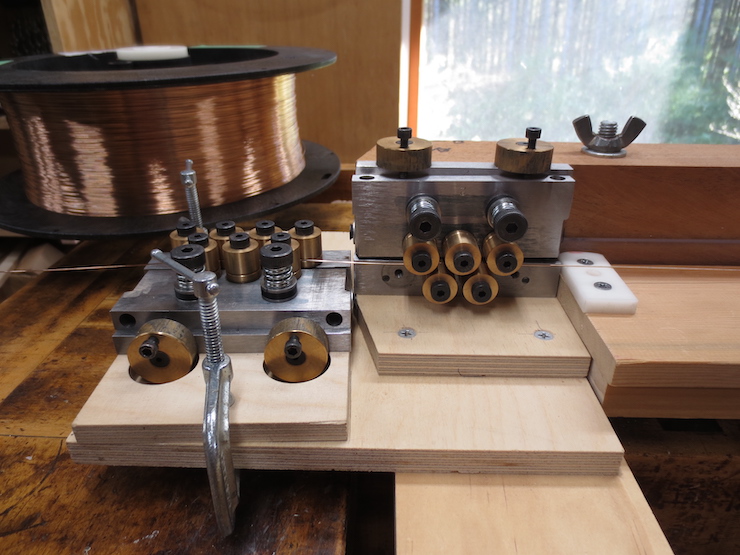
I made a second straightener out of steel with bronze rollers. The base plates of the first design were made of plastic. Steel, being much harder, can be more accurately calibrated. Now I can record the best settings for various sizes of wire so this unit can be used for all sizes of paper mould laid wire. Wire straighteners can be purchased but I chose to try to improve on what I had instead. (Besides, I like to make things and this looked like a fun challenge.)

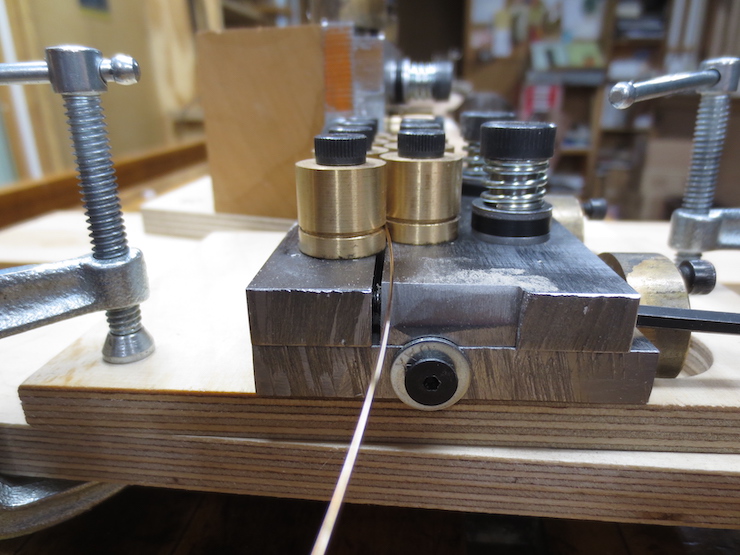
A closer view of the steel and bronze wire straightener. The first set of seven rollers is used to remove the cast. The second set is used to remove any remaining curve caused by the helix. I never use more than five rollers any more. And I now believe that one can get by very well using only the first (horizontal) unit to produce usable laid wires.

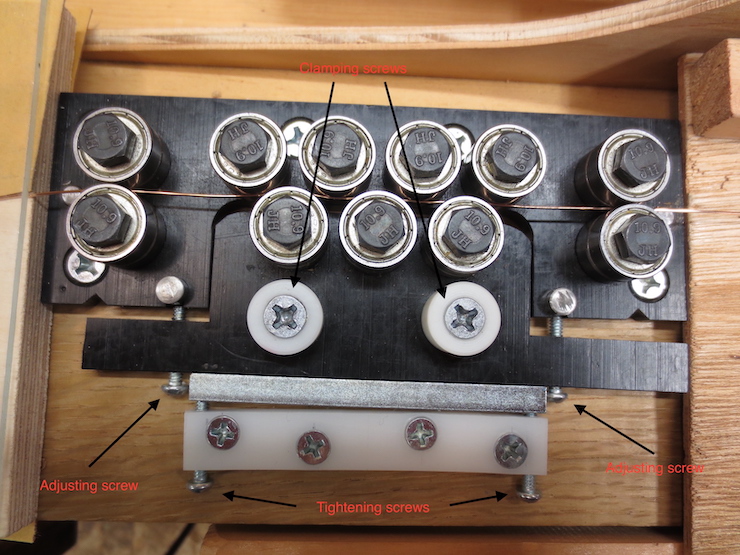
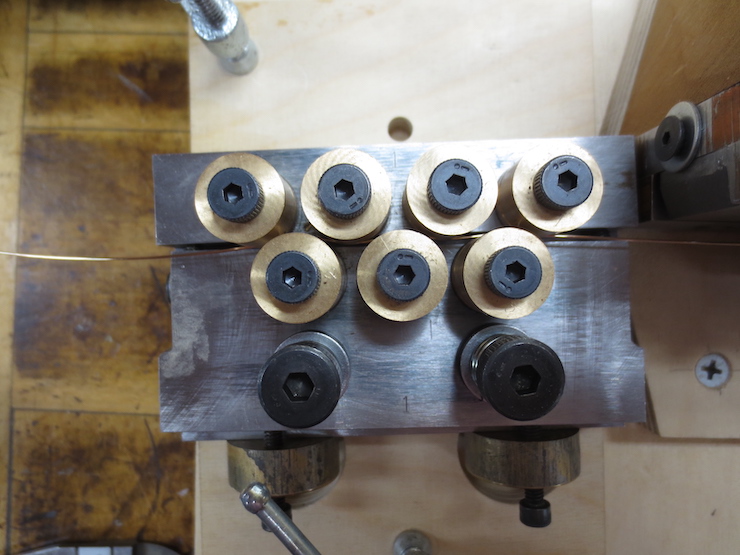
The horizontal bank viewed from above. You can see that the rollers are set to bend the wire back and forth and less aggressively as the wire moves from left to right. Adjusting screws are located at either end of the slot between the rollers and are accessed through deep holes in the front plate. The two tightening screws are visible at the bottom of the photo.

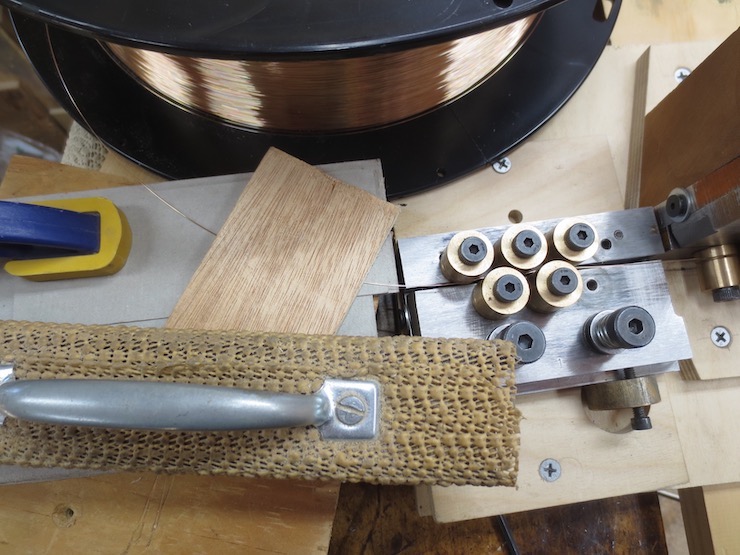
The photo above shows the use of a built up pad to orient the cast of the wire as it enters the first rollers. This photo has been added to show an improvement in the process. Please refer to post # 58 for more details. And see “An Addition” at the bottom of this post.

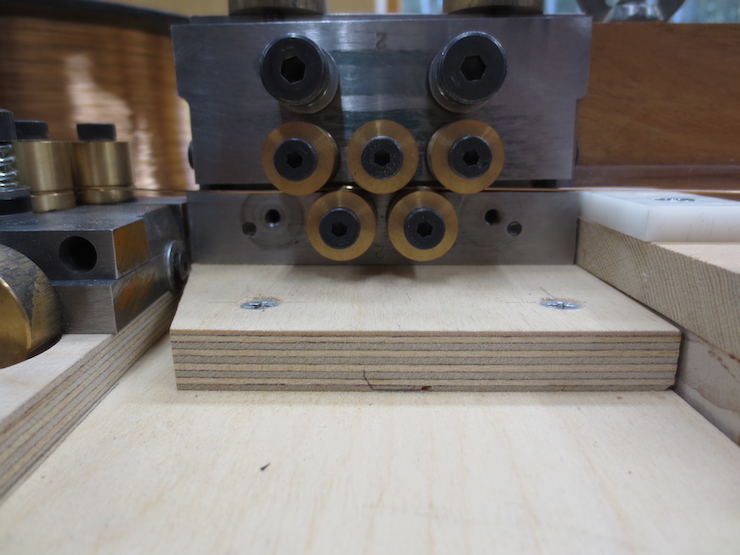
The vertical bank. I have the best luck using five rollers here. Wire this light requires only 7 or 5 rollers per bank; heavier or harder wire needs more rollers. The middle five rollers have been selected to remove a helix spiraling upward. If the helix curved downward the upper right roller would be removed and one added at the blank spot at the lower left.

The wire enters the horizontal bank of rollers. The cast is removed and slightly reversed by the first three rollers. Each trio of rollers creates a bending action as the wire is forced around the middle one. The remaining rollers form overlapping groups of three that apply a gradually diminishing amount of force. The wire is forced first one way, and then the other, to gradually change its shape from very curved to nearly straight.

After the first set of rollers are adjusted the wire will look fairly straight when viewed from directly above. But it may still have a noticeable curve when viewed form the side. This curve is mostly the result of the helix and the second set of rollers have the job of removing it. Since this is much slighter they don’t have to push as hard. The wire lengths seldom turn out completely straight. If the straightener is calibrated right the wires repeatedly cycle from nearly straight to less straight and then back again; but fortunately staying within a useful range. I don’t fully understand all that is happening but think the wire has acquired some slight variation in the spooling or coiling process. Also wire twists slightly as it is unspooled. Either may cause the wire to shift slightly in the rollers, affecting the final shape. (This is my current theory.) Using only the first set of rollers to remove the cast it seems that the wires, though always slightly curved, are more consistent.

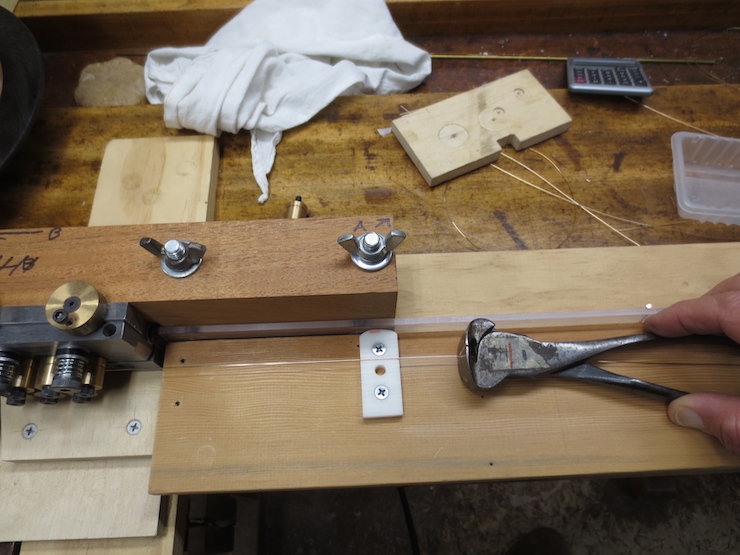
I pull the wire with this pair of wire cutters.

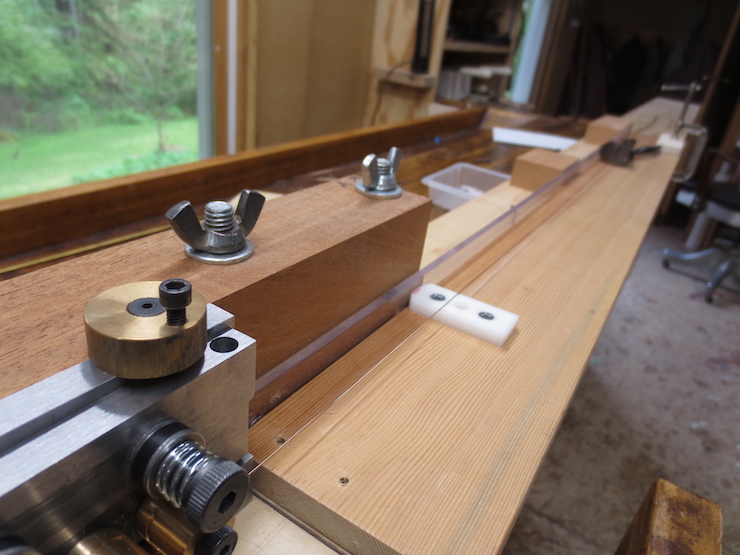
One jaw rides along the fence to keep the pulling angle constant.

When the outside handle hits the back stop the handles are squeezed to nip off a length of straightened wire. Then the cutter is moved back to the front stop to grab another length to begin again.

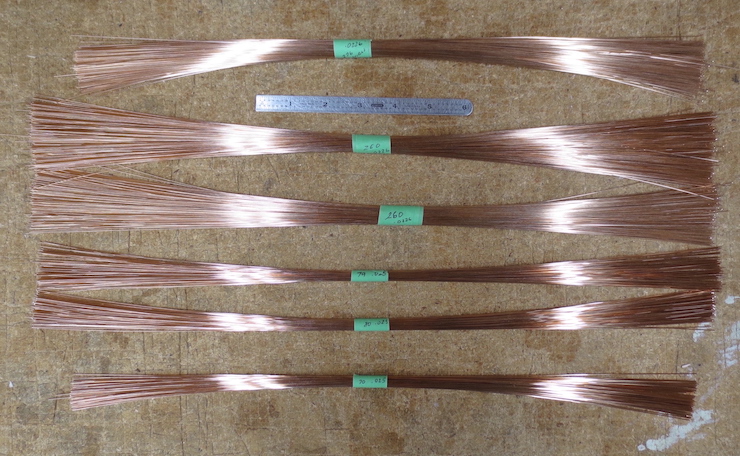
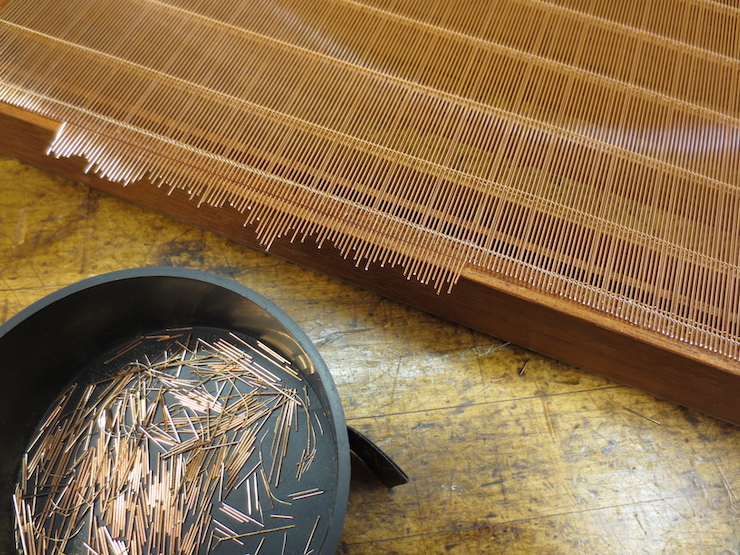
The top three bundles are .0226″ diameter 1/2 hard wire and will be made into laid facings for three moulds, two 12″ x 18″ moulds and one 10-1/2″ x 15-3/4″. The lower three bundles are .0254″ diameter wire and will be used to make the backing wires for these moulds. They are all to be “double-faced laid” (also known as “modern laid”) moulds.

Wire straightening is fairly new to me. I made moulds for about 25 years using wire that I purchased pre-straightened in lengths. After seeing a video of Ron Macdonald pulling wires from a coil I was inspired to try again. I like the idea of not needing a source of pre-straightened wire. I think that the hand pulled wires give a more interesting surface which carries over to the paper made on the mould (though this is pretty subtle).

I have tried to convey this information clearly. If something doesn’t make sense or if you would like further clarification let me know. I often have extra photos that can be posted and can also try to state things more clearly if I am aware of your questions.

An Addition:

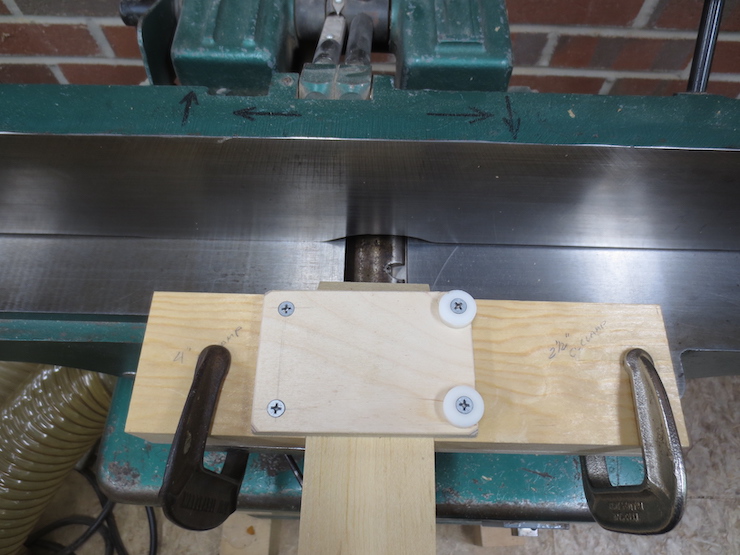
I made this device to add to the front of the wire straightener. It helps to orient the wire as it enters the rollers. Ideally the first bank of rollers removes the cast only but without some help the wire has a tendency to twist and wander a little as it passes between them. If the cast enters the rollers a little slanted the rollers won’t just be working at removing the cast but will also be altering the helix. I don’t think you can completely isolate the two with this simple technology but this does seem to help a little.

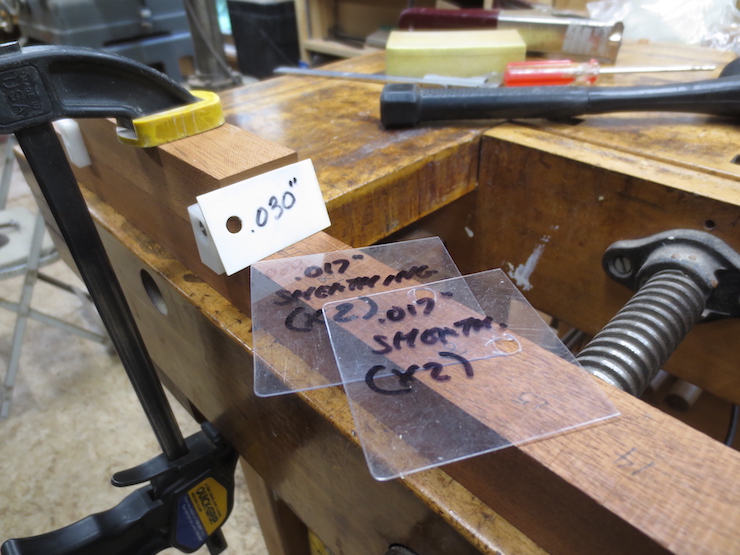
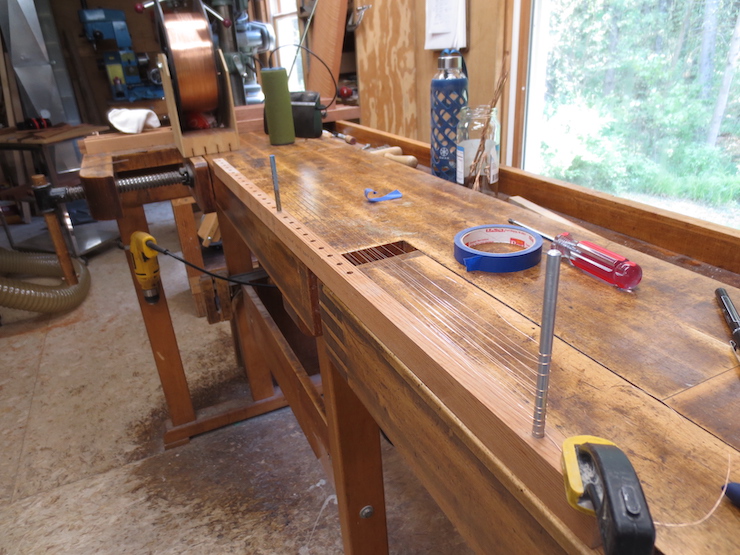
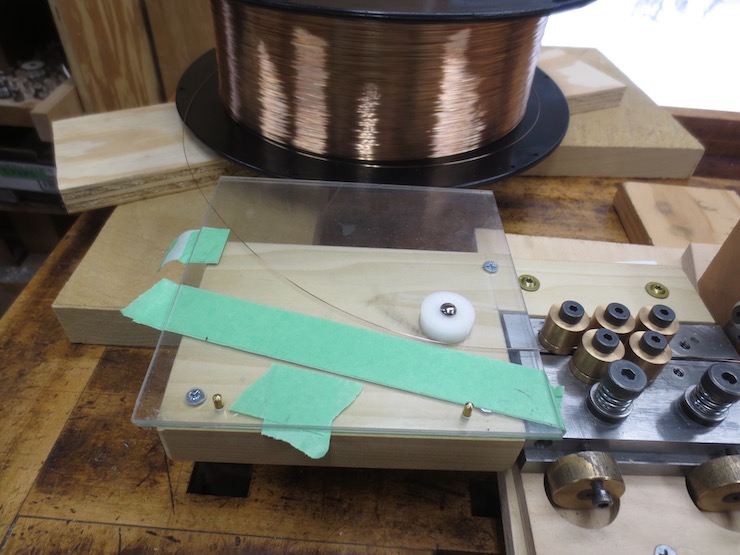
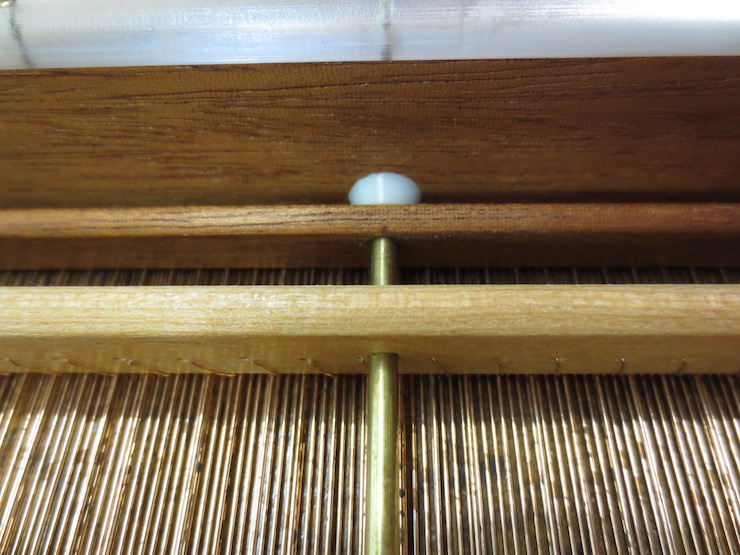
The wire is pulled between two sheets of polycarbonate. The bottom sheet is screwed down to the wooden base. The top sheet floats, held somewhat loosely in place by the two brass pins and by the white plastic (acetal) disk. A couple layers of tape hold the sheets apart so, when weighted, the wire is free to move. The wire is pulled past the disk while being held flat between the plastic sheets to hold the cast of the wire in line with the grooves in the first bank of rollers. This helps the rollers to work on the wire in a more uniform fashion. I find that thicker wire needs more layers. For instance .0254″ laid wire required 5 layers, .0226 required 4 layers. The very finest (.0144″ in my case) may only need 2 or 3 layers. After setting up for straightening and weighting the plastic sheet the wire should still be able to move freely without dragging. You can see this effect through the clear plastic. I put the tape shims on both sides of the wire with a weight spanning the two lines of tape.

Another view with the weight removed.

The weight has been added. The wire can move freely enough that the cast isn’t pulled straight. The wire isn’t pulled around the white disk hard enough to change the curve (cast) any. The disk just helps keep the wire oriented.

Order of Operations

Paper Mould and Deckle Construction

Following is a list of the topics I plan to cover as I document some European style moulds and deckles that I am making. As you can see this is a big topic. Some fairly simple steps are covered but others will be rather vast. I won’t follow a strictly traditional method of making moulds; instead I intend to extensively document the method I have arrived at after almost 40 years in the trade. If all goes well over the next few months pages will be added to cover all of these steps in detail.

Season Wood

Rough Wood to just over final dimensions

Sharpen Tools

Prepare Frame pieces

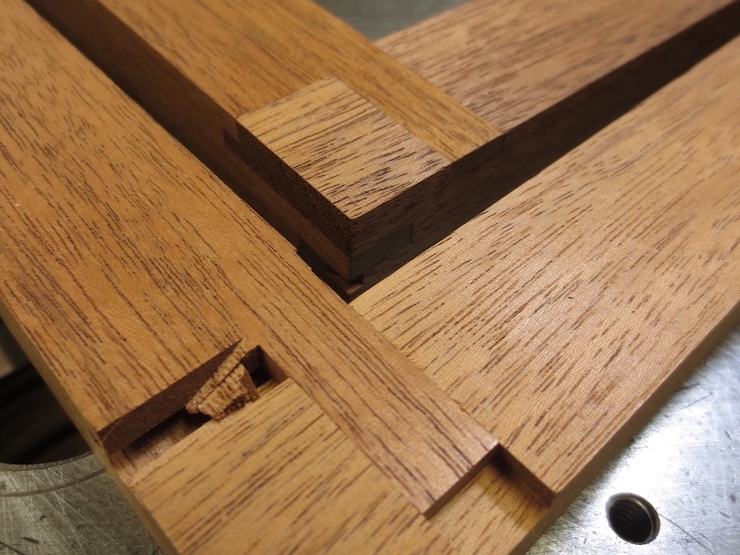
Cut Frame Joints

Waterbar Mortises

Prepare Ribs

Drill Sewing Holes

Fit Ribs to Frame

Fitting Stays

Assemble and Glue Mould

Clean up Mould Frame and fit Braces and Rub Strips

Pin Ribs and flatten Ribs

Straighten Laid Wires

Make Backing and Facing on Loom

Fit Wire Facing and Backing to Frame

Sew down Facing

Make Deckle Parts

Deckle Joints

Deckle Camber

Deckle Glue Up

Deckle Final Fit to Mould

Repairing a broken paper mould

A lot of gorgeous paper was made on this mould before it broke. I undertook to return it to a useable condition and learned a few things in the process.

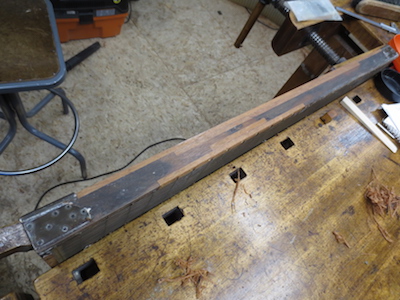
The bottom of the broken side with rub strips removed. The insertion of the brass brace rod may have helped cause the break.
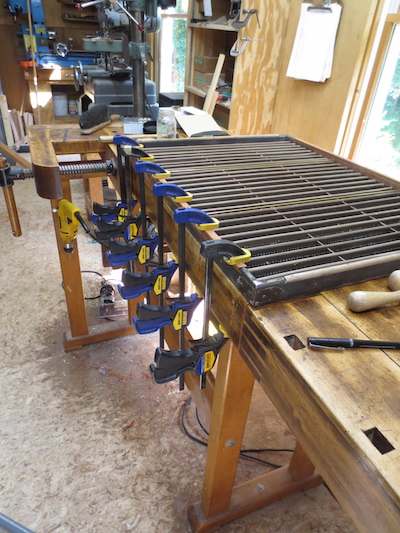
This frame was put together to hold the mould flat and to enable a router to cut a true surface on which to glue strips of new wood.
The first layer glued and screwed with epoxy and then machined (with the router) and ready to receive the next layer.
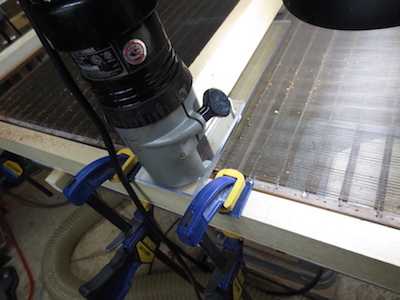
Beginning to repair the top of the mould. The (blue) blocks were clamped in place to guide the router to protect the chain wires where they overlap the frame. Notice that the wood that has been exposed is ‘just like new’. This mould has been in and out of water for years and has no remaining finish to keep water out. Yet beneath the darkened surface the wood is perfectly sound.
The frame has been cut away to just above the rib pins. You can see that the broken part of the mould has been almost entirely replaced, leaving only the narrow part in which the rib pins are inserted.
A longer area is routed away for the final top layer which will end up flush with the original top of the mould.

The mould had problems with sides that warped outwards. Braces had been added to restrain this but weakened the mould frame, resulting in a break which made the mould unusable. I decided to repair the mould by replacing parts of the mould frame with staggered strips of new wood which would be screwed down and glued with epoxy. The first step was to rough out a long area on each side to prepare a space to add the first layer.

The mould was then clamped into a specially made temporary frame. This provided a reference surface to enable a router to machine a true surface for glueing the new wood strips to.

New braces were installed along with the first layer. These are of a different design and should be much stronger than the ones they replaced.

After two layers of wood were added to the bottom, the second longer than the first, the mould was flipped over and clamped in the frame with the wire side up to repeat the same process of cutting away old wood and adding new strips but working from the top of the mould.

Great care was taken not to let the router bit contact the laid or chain wires. The remaining parts were carefully chiseled way to leave a good surface for gluing the next strip in.

A final layer was then added to bring the patch flush with the top of the mould. The copper edging was tacked back into place, finishing the top repair.

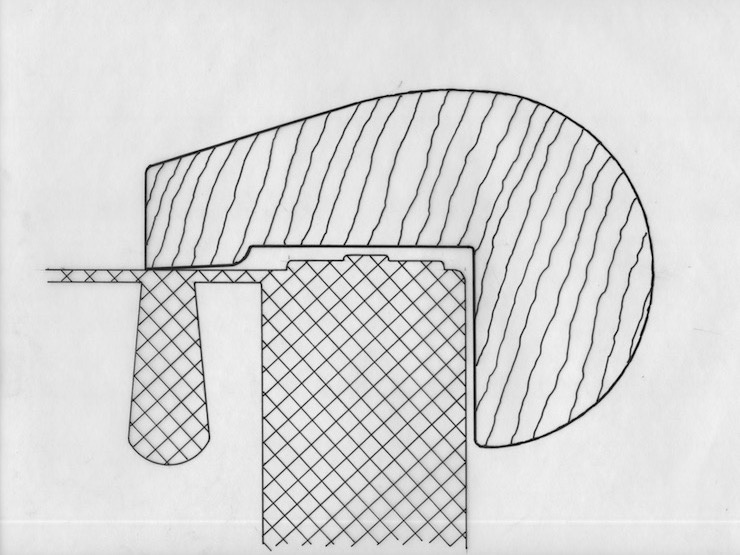
One more layer of wood was added to the bottom and given a rounded shape to match the remaining original parts of the mould frame.

The first cut has been roughed out freehand with a router fastened to a long base to span the sides of the mould. The little ‘pedestals’ were left to give the router a surface to ride on. They were chiseled off before machining a smooth surface with a router in the temporary frame.
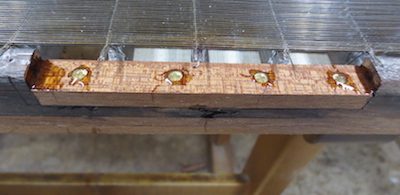
Two new braces were installed along with the first layer of wood. Threads were cut on both ends of 1/8″ brass rods. Each end was then threaded into a tapped delrin block. This gives a very strong connection.
A second layer has been added to the bottom of the mould.
The router is attached to a long base that spans the width of the mould.
The first top layer glued and screwed
The broken side of the mould showing the repair. One more layer will be added to the bottom to finish the repair.
Gluing on the last strip on one side of the mould.

What I learned.

The sight of the ‘like new’ wood that was exposed during the repairs reinforced my suspicions that any kind of finish which attempts to protect a paper mould from water is most likely pointless. I think if the wood is allowed to dry thoroughly between uses the mould will be fine. I think wet wood (wood is hydrophilic or ‘water loving’) allows water to flow better (along the surfaces of the mould while sheet forming) than wood that has been covered with a water resistant (‘hydrophobic’) coating.

Preparing and testing wood before using it is important to prevent the mould from distorting when wet. Unproven wood can lead to multiple problems due to warping; deckles that don’t fit well, difficulty couching, and uneven stresses on parts of the mould which can shorten its life.

Questions

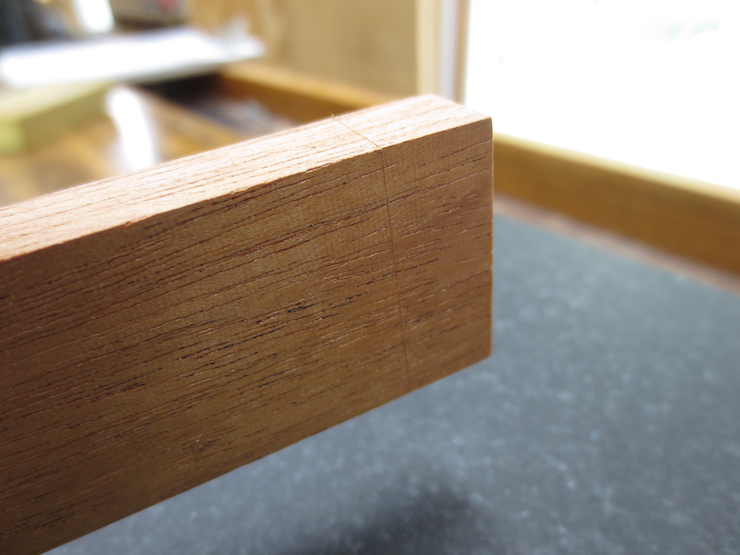
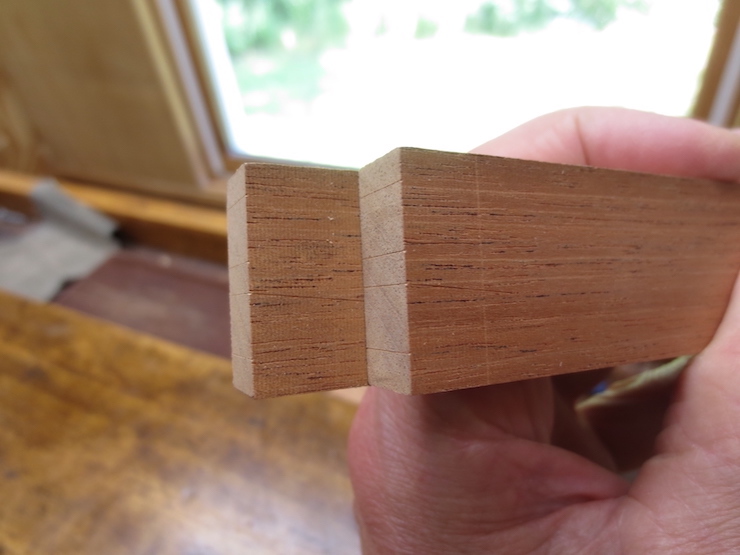
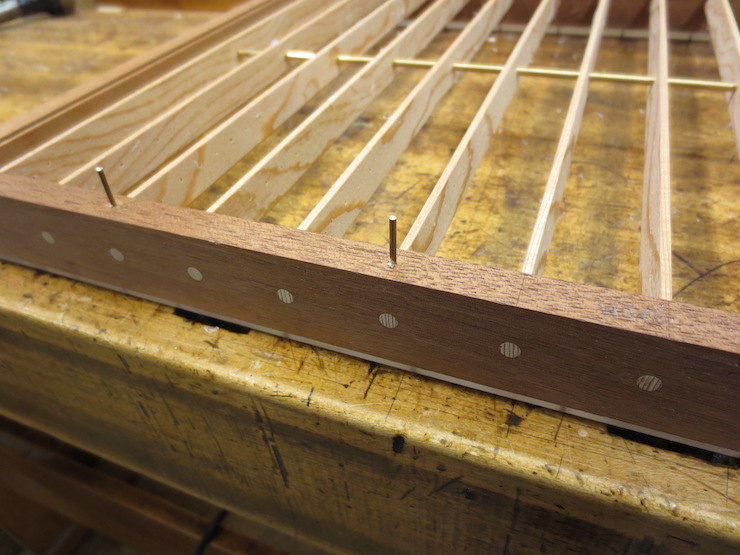
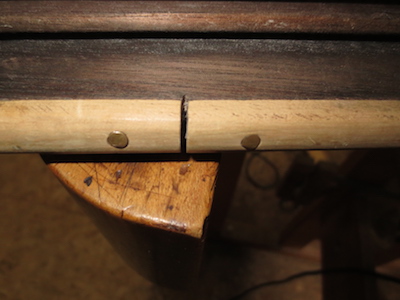
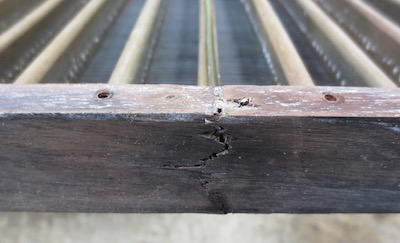
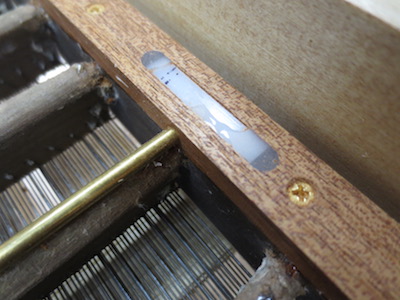
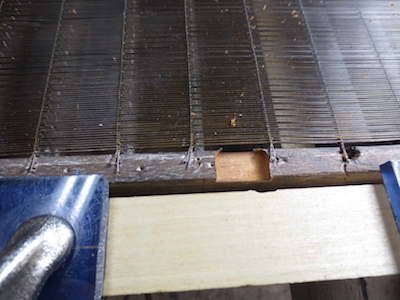
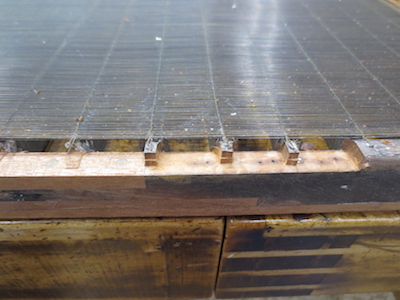
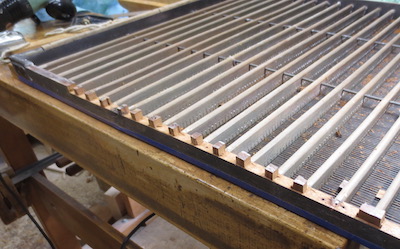
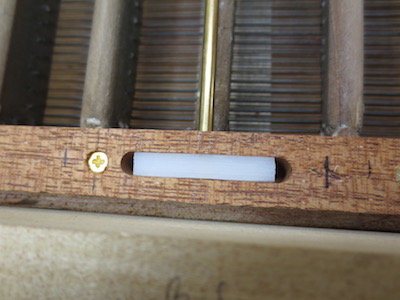
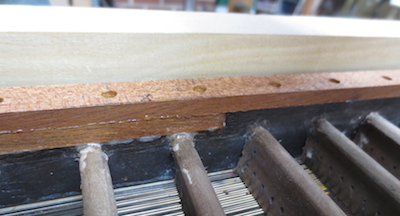
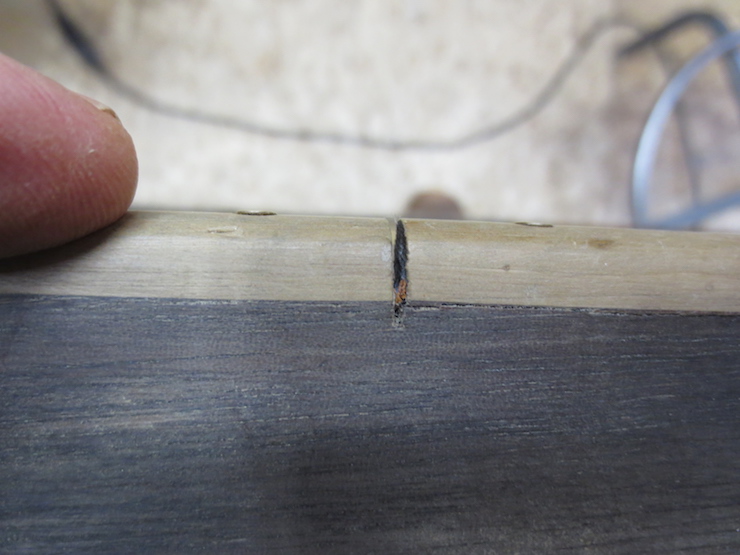
Rub strips made of boxwood or hornbeam (I can’t tell the difference) are nailed to the bottom edges to protect the mould from wear. On this mould (and others I’ve seen) these are attached in short sections that have gaps between them. The gaps seem intentional and it’s hard to see what purpose they serve. You can see here that a single piece of wood was nailed in place (the grain is continuous) and THEN sawn in two! The saw cut goes down into the mahogany frame. Was this to keep the strong, hard, possibly ‘ornery’ boxwood from distorting the frame? There may be another reason but I can’t think what it would be. The nails used to attach it are ring shank nails; possibly bronze boat nails.

Note

This my very first blog post. The choice may seem arbitrary and, in fact, it was! I hope to share a lot of stuff I’ve learned over the years but the order of topics will likely follow no discernible pattern. I hope some of these posts will be interesting to you.