I’ve mentioned a larger tap and die in previous posts but until now have not had the opportunity to show either being used.

Here the threaded half of an 18″ lying press is being tapped. The tap must cut a thread through nearly 5″ of hard maple. This is hard work; tapping one hole takes about 1-1/4 hours. Consider that the steel cutting bit in the tap travels about 6 feet each time it spirals through the hole! The bit brace that drives the tap is not shown here.

By using these off-the-shelf plastic bushings a tap originally made for threading a 1″ hole can be used for a 1-3/8″ hole. The former makes internal threads for a 1-1/4″ wooden screw; the latter makes threads to receive a 1-5/8″ diameter wooden screw. A longer cutter has been made and is fitted into a different hole in the shaft of the tap. The cutting face of this cutter is set at a different angle to match the shallower pitch of the larger screw. The cutter at the back is the new one; the front one has been replaced with a short piece of 3/8″ steel rod which holds the plastic bushing in place.

In this view from above you can see how bushings are stacked along the shaft between the cutter and the shaft connector. Four are needed between the black shaft connector and the tap cutter and one more is hidden inside the wooden press jaw.

The round plywood insert has been replaced with a new one with a larger, 1-3/8″ hole that the bushings can pass through.
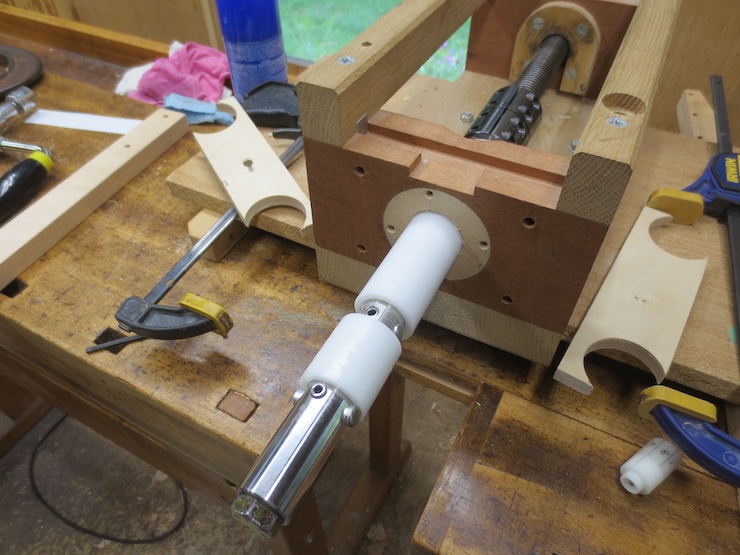
As the tap warms up with use the bushings become slightly loose and slide around They must sometimes be nudged back into place if they crowd the cutter. The gauge (seen here off to the side) is set by pressing it against the steel shaft, not the plastic bushings.

Three 18″ lying presses under construction.
 Timothy Moore Bookbinding Tools